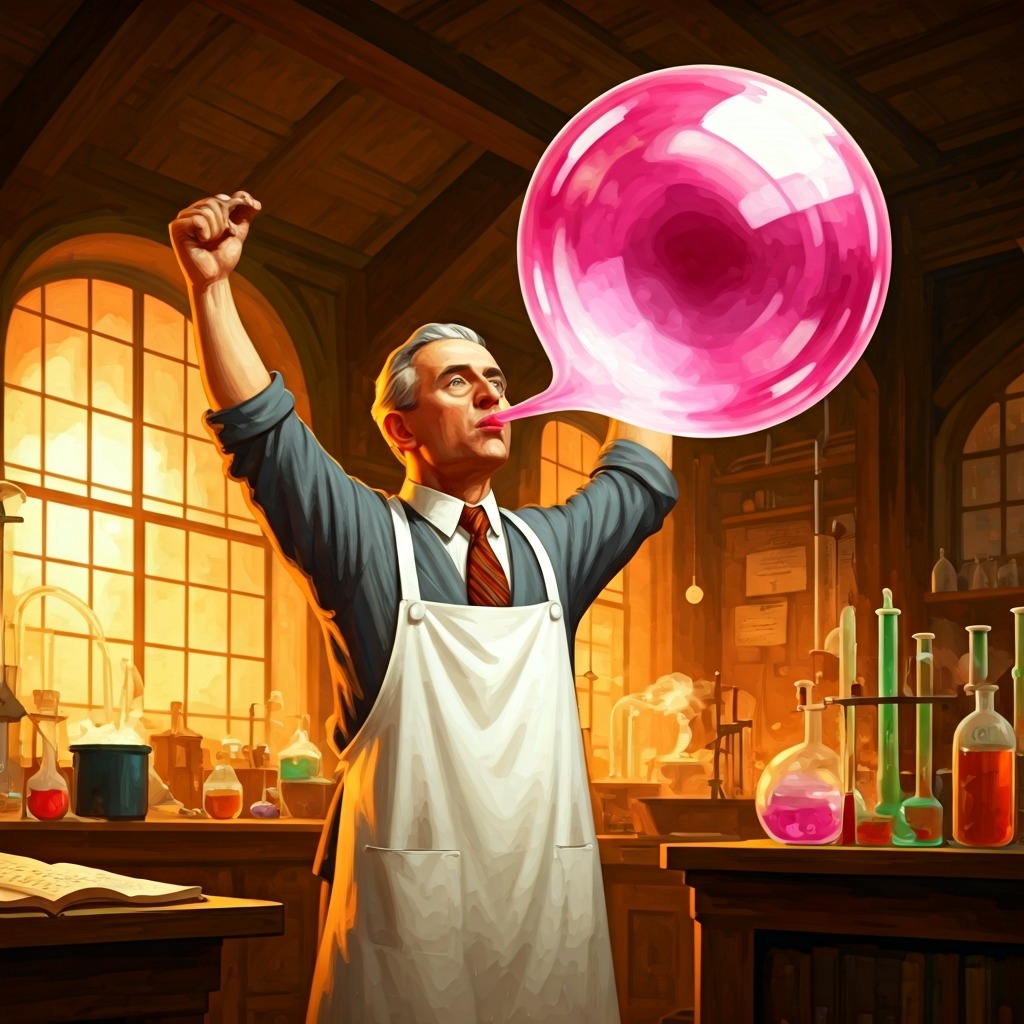
It sits at every checkout counter in the world, wrapped in bright foil and promising a quick burst of mint or fruit. But peel back the wrapper of the modern stick of chewing gum, and you will uncover a chaotic, globe-trotting saga forged in ancient rainforests, bound by strict social taboos, and birthed from a spectacular scientific failure.
You might think of chewing gum as a modern convenience, but its roots stretch deep into the ancient Americas—and its journey to the checkout aisle is nothing short of wild.
The Forbidden Chew of the Aztec Empire
Long before we had bubble-blowing contests, the urge to chew on non-nutritive substances was a global human quirk. The ancient Greeks chewed mastic resin, and Native Americans in New England gnawed on spruce tree sap. But the true ancestor of the modern stick of gum comes from the lush rainforests of Central America.
The ancient Maya figured out that by slashing the bark of the sapodilla tree, they could harvest its natural latex sap. They boiled this sticky substance into a chewable treat called chicle to quench their thirst, stave off hunger, and clean their teeth.
When the Aztecs adopted the practice, they called the substance tzictli. But here is where the plot thickens: the Aztecs were incredibly strict about who could actually chew it. According to ancient Mesoamerican social codes, public chewing was a privilege strictly reserved for unmarried women and young children. If an adult man or a married woman was caught smacking on tzictli in public, it was a massive scandal. For men, it was seen as a sign of effeminacy; for married women, it was considered a blatant mark of promiscuity. They were only allowed to chew it in the absolute privacy of their own homes.
An Exiled Dictator’s Secret Stash
So, how did this highly regulated Mesoamerican tree sap turn into a global phenomenon? The answer lies with an incredibly unlikely historical figure: General Antonio López de Santa Anna, the infamous former president of Mexico.
In the late 1860s, Santa Anna was living in exile on Staten Island, New York. But he hadn’t come empty-handed. He had smuggled a massive stash of chicle with him, harboring a secret, highly lucrative scheme. At the time, rubber was wildly expensive, and Santa Anna wanted to find a cheaper substitute to manufacture carriage tires. He partnered with an American inventor named Thomas Adams, hoping they could vulcanize the chicle and make a fortune.
For over a year, Adams acted like a mad scientist, boiling, baking, and chemically treating the tree sap. But the chicle stubbornly refused to turn into durable rubber. The experiment was a complete, expensive bust.
The East River Epiphany
Defeated and frustrated, Adams packed up the useless chicle, fully intending to hurl the entire batch into the murky depths of the East River. But right before he threw it away, a memory flashed in his mind: he remembered seeing General Santa Anna casually chewing the raw chicle.
Adams knew that Americans were already buying sweetened paraffin wax and spruce gum. What if this failed rubber tire could be a superior candy?
Instead of tossing it, Adams boiled the chicle down and rolled it into small pieces. In 1871, he patented a manufacturing machine and launched Adams New York Chewing Gum. It was an overnight sensation. Chicle was infinitely better than spruce resin or wax—it held flavor longer and had a smooth, elastic texture. Adams quickly rolled out flavored varieties, including the licorice-flavored ‘Black Jack’ in 1884, and ‘Tutti-Frutti,’ which made history in 1888 when it became the first chewing gum sold in vending machines, conveniently located right on New York City subway platforms.
The Pink Accident That Conquered the World
Once the secret of chicle was out, the industry exploded. But it took a ruthless, board-game-level strategy to conquer the globe. Enter William Wrigley Jr.
Wrigley wasn’t even in the candy business; he was a soap and baking powder salesman. He started offering free sticks of gum as a premium to his customers, only to realize the freebie was vastly more popular than the products he was actually trying to sell. Pivoting instantly, he launched Juicy Fruit and Spearmint in 1893. In a stroke of marketing genius, Wrigley eventually mailed free sticks of gum to every single address listed in the U.S. telephone directory.
Yet, the final piece of the modern gum puzzle wouldn’t snap into place until 1928, thanks to an accountant named Walter Diemer. Working for the Fleer Chewing Gum Company, Diemer liked to tinker with gum recipes in his spare time. One day, he accidentally stumbled upon a formula that was less sticky and highly stretchable. He had just invented ‘Dubble Bubble,’ the world’s first commercially successful bubblegum. And the only reason it was colored pink? It was literally the only food coloring Diemer had sitting on his shelf at the factory that day.
The Ultimate Synthetic Irony
The world’s appetite for gum grew insatiable, especially after it was included in the daily rations of American soldiers during World War II. But there was a problem: tapping sapodilla trees in the Central American rainforests was incredibly labor-intensive, and the natural supply of chicle simply couldn’t keep up with billions of chewing jaws.
By the mid-20th century, manufacturers quietly phased out the ancient tree sap. They replaced it with synthetic petroleum-based polymers—essentially the very same butadiene-based rubbers that Thomas Adams had originally been trying to invent for carriage tires.
Today, while a few boutique brands have returned to harvesting natural chicle for ecological reasons, the vast majority of the gum you find at the grocery store is made of synthetic plastics and resins. It is a fascinating, full-circle irony: we set out to turn tree sap into rubber tires, failed, turned it into candy instead, and eventually swapped the candy out for synthetic rubber anyway.
So, the next time you blow a pink bubble, just remember—you’re participating in a legacy that involves Aztec secrets, exiled dictators, and a Staten Island science experiment gone wonderfully wrong.