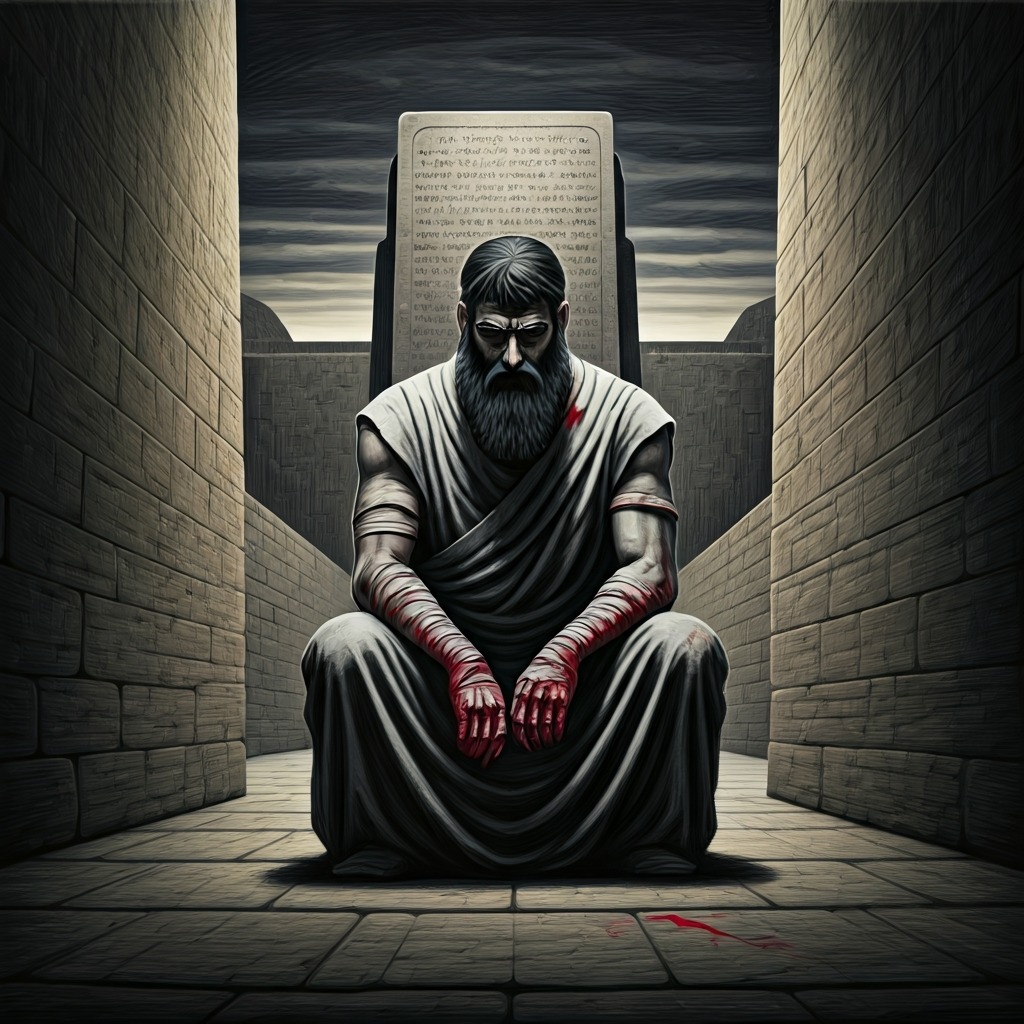
You know the phrase: an eye for an eye. Today, it’s a casual idiom for poetic justice. But nearly four millennia ago, it was a terrifyingly literal promise.
Welcome to ancient Mesopotamia, where the legal code was less about fair play and more about maintaining absolute order through pure, unadulterated terror. If you think modern laws are strict, prepare yourself. You are about to enter the absolute wild west of early justice.
The Architect of Retribution
Around 1754 BCE, the sixth king of the First Babylonian Dynasty, Hammurabi, faced a monumental task: unifying a rapidly expanding empire. His solution was not a peace treaty, but a massive, finger-shaped black stone stele erected for all to see. Carved into this imposing monument were exactly 282 edicts.
This was the dawn of lex talionis—the law of retribution. But justice in Babylon was anything but blind. The severity of your punishment depended entirely on your social class. In a society rigidly divided into free men, commoners, and slaves, the “eye for an eye” concept didn’t protect those at the bottom. It simply meant the state could dismember you with absolute legal backing.
The River Will Decide Your Fate
Imagine a neighbor accuses you of dark magic. Today, that might earn you a strange look. In ancient Babylon, it earned you a one-way trip into raging waters.
The Babylonian justice system relied heavily on divine intervention through trial by ordeal. According to Law 2, anyone accused of sorcery was forced to plunge into the sacred Euphrates River. The logic was brilliantly, brutally simple: the river gods would sort it out.
If the current overwhelmed the accused and they drowned, their guilt was proven, and the accuser inherited their entire estate. But if they survived the treacherous waters? The river had declared them innocent. The accuser was promptly executed for bearing false witness, and the soaking-wet, newly vindicated survivor walked away with the dead accuser’s property. It was the ultimate, high-stakes gamble.
A Deadly Pint of Ale
Beer was a vital, sacred part of Babylonian culture, but pouring it was arguably the most dangerous job in the empire.
Tavern-keepers were predominantly women, and they faced horrifying occupational hazards. Under Law 108, if a female tavern-keeper shortchanged a customer—pouring a smaller measure of beer than the value of the grain paid—she wasn’t slapped with a fine. She was thrown into the river and drowned.
Furthermore, these women were expected to act as an ancient neighborhood watch. If a tavern-keeper allowed criminals to gather in her establishment and failed to arrest them, she faced immediate execution. One bad night behind the bar could easily be her last.
The Ultimate Price for Malpractice
If you think modern malpractice insurance is expensive, you wouldn’t have survived the Bronze Age. Professional accountability in Babylon was terrifyingly literal.
Consider the builders. Under Law 229, if a builder constructed a house that collapsed and killed the homeowner, the builder was put to death. But the Code took the “eye for an eye” principle to a chilling, heartbreaking extreme: if the collapse killed the homeowner’s son, the builder’s own son was executed.
Physicians faced equally terrifying stakes. Law 218 stated that if a surgeon performed a careless operation resulting in the death of a nobleman or the loss of his eye, the surgeon’s hands would be chopped off. It was a brutal, permanent guarantee that he could never practice medicine again.
Blood, Bone, and Absolute Obedience
The strict social hierarchy of Babylon was fiercely protected, especially behind closed doors. Slaves endured horrific physical punishments for even the slightest acts of defiance. Under Law 282, if a slave simply declared to his owner, “You are not my master,” the owner was legally entitled to cut off the slave’s ear. This wasn’t just physical pain; it was a permanent, visible marker of disobedience.
Marital and familial disputes were met with the same draconian force. A wife caught conspiring to murder her husband for another man didn’t just face a tribunal—she was impaled on spikes. And in a society that revered patriarchal authority, a son who dared to strike his father had his hands amputated.
These laws seem bizarre and nightmarish to our modern sensibilities. Yet, the Code of Hammurabi provides an extraordinary window into the deep anxieties of ancient Babylon. It reveals a society desperate to maintain order, terrified of chaos, and willing to use absolute, disproportionate fear to keep the world spinning.