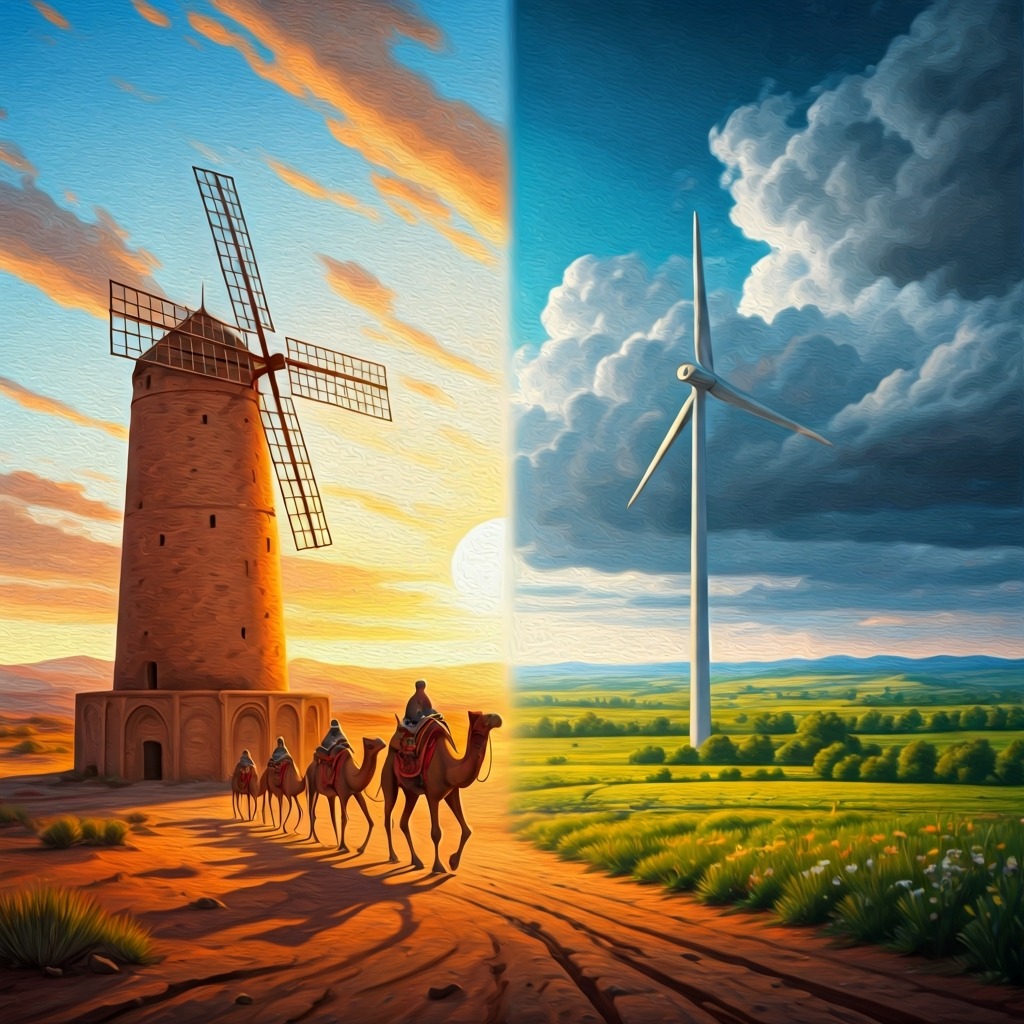
The Great European Illusion
Picture a windmill. What do you see? Your mind instantly conjures a lush, green landscape in the Netherlands, complete with a dusting of tulips and wooden clogs. It is one of the most enduring, romanticized images in Western history. It is also a complete illusion.
The true origin of the windmill isn’t European at all. To find its birthplace, we must leave behind the damp fields of Holland and travel centuries back in time to the harsh, sun-baked expanses of ancient Persia. Here, the incredible story of how humanity first harnessed the sky has been entirely misplaced by popular culture.
The Howling Curse of Sistan
Our story begins in a place where mere survival was a daily puzzle: the Sistan region, sitting on the modern-day border of eastern Iran and southwestern Afghanistan.
This area was terrorized by an invisible, relentless monster known as the bad-e sad-o-bist ruz, or the Wind of 120 Days. From late spring to late summer, a fierce, howling gale batters the landscape without pause. Imagine a violent storm that simply refuses to die for four straight months. For most, this wind was a curse that stripped the earth dry.
But between the 7th and 9th centuries CE, local innovators looked at this invisible terror and saw something else: unlimited, untapped energy. They just had to figure out how to catch it.
Trapping the Invisible Beast
The Persian engineers didn’t build the romanticized, horizontal-axis pinwheels we see in Europe. They built something entirely different, born out of strict environmental necessity: the panemone windmill.
Instead of a horizontal shaft, the panemone featured a vertical-axis design. Picture a modern revolving door. The engineers constructed sails out of locally available materials—usually bundles of stiff reeds or woven palm leaves—and lashed them to an upright timber frame.
But here is where the suspense of ancient engineering comes in. If you put a revolving door in the middle of a windstorm, the wind hits both sides of the sails at the exact same time. The opposing forces cancel each other out, and the machine sits dead in its tracks.
How did they solve this? With brilliant, elegant simplicity. They built a mud-brick enclosure around the windmill. This wall featured strategically placed, narrow slits that acted like a funnel, directing the violent incoming wind onto only one side of the sails, while shielding the returning sails from the wind’s resistance. The wind caught the exposed reeds, violently spinning the vertical shaft, which was connected directly to a heavy grinding stone below.
Suddenly, the desert was tamed. These machines were used to grind grain into flour and pump water for irrigation, transforming a hostile, wind-battered wasteland into a thriving agricultural hub.
A Captive’s Whisper
So, when exactly did this world-changing technology first spin into existence? The timeline is shrouded in historical mystery.
There is a legendary, though heavily debated, anecdote from 644 CE. A brilliant Persian captive named Abu Lu’lu’a supposedly stood before the second Caliph, Umar, and boldly boasted that he could build a mill driven entirely by the wind. It’s a tantalizing glimpse into the early mechanical genius of the region.
However, the hard, undeniable proof comes a bit later. The 9th-century Persian geographer Estakhri traveled through the region and provided the first definitive written accounts of these towering machines. He documented their widespread use in Sistan, proving that the Persians had successfully weaponized the wind long before the rest of the world caught on.
The Seeds of a Global Machine
The legacy of the Persian panemone is staggering. This ingenious design didn’t stay a local secret. It traveled the ancient trade routes, spreading eastward to China, where the vertical-axis design was adapted to evaporate seawater for salt production.
Westward, it moved across the Islamic world. It wasn’t until the late 12th century that horizontal-axis windmills finally began appearing in Northwestern Europe. To this day, historians are locked in a debate: did European engineers independently figure out the horizontal windmill, or did Crusaders and Silk Road merchants see the Persian panemone and bring the foundational concept back home in their saddlebags?
History leans heavily toward the latter. Ideas, like the wind, refuse to be contained.
So, the next time you see a picture of a quaint Dutch windmill, take a moment to look past the tulips. Remember the brilliant engineers of the ancient Middle East, staring down a four-month hurricane, and deciding to make it work for them.