In the bitter winter of 208 AD, the earth along the banks of the Yangtze River trembled beneath the boots of an unstoppable juggernaut. Cao Cao, the brilliant and ruthless Chancellor of the Eastern Han dynasty, had spent years steamrolling his northern rivals. Now, his gaze shifted south. His objective was absolute: cross the treacherous Yangtze, crush the defiant southern warlords, and forge a reunified China under his iron grip.
He claimed to command a mind-numbing 800,000 men. Even conservative historical estimates place his force at nearly a quarter of a million. The sheer logistical terror of this advancing horde was enough to paralyze his enemies. But as history so often proves, the most colossal empires are often brought to their knees by a single, catastrophic blind spot.
The Ultimate Underdog Alliance
Facing this northern leviathan was a fragile, hastily assembled coalition led by southern warlords Sun Quan and Liu Bei. On paper, it was a slaughter waiting to happen. The southern alliance could barely scrape together 50,000 troops, leaving them outnumbered nearly five to one.
Yet, what they lacked in sheer manpower, they compensated for with unparalleled naval mastery and the tactical genius of their commander, Zhou Yu. Cao Cao’s northern troops were hardened cavalrymen and infantry, masters of the open plains. But here, on the rolling, turbulent waters of the Yangtze, they were entirely out of their element.
By the time the massive northern army reached the riverbanks, exhaustion and waterborne diseases had taken their toll. Worse, the northern soldiers were violently seasick, unable to even stand on the swaying decks of their warships, let alone fight.
To solve this nauseating crisis, Cao Cao made a decision that seemed brilliantly pragmatic in the moment—but would ultimately echo through the ages as one of military history’s most devastating blunders.
The Floating Fortress
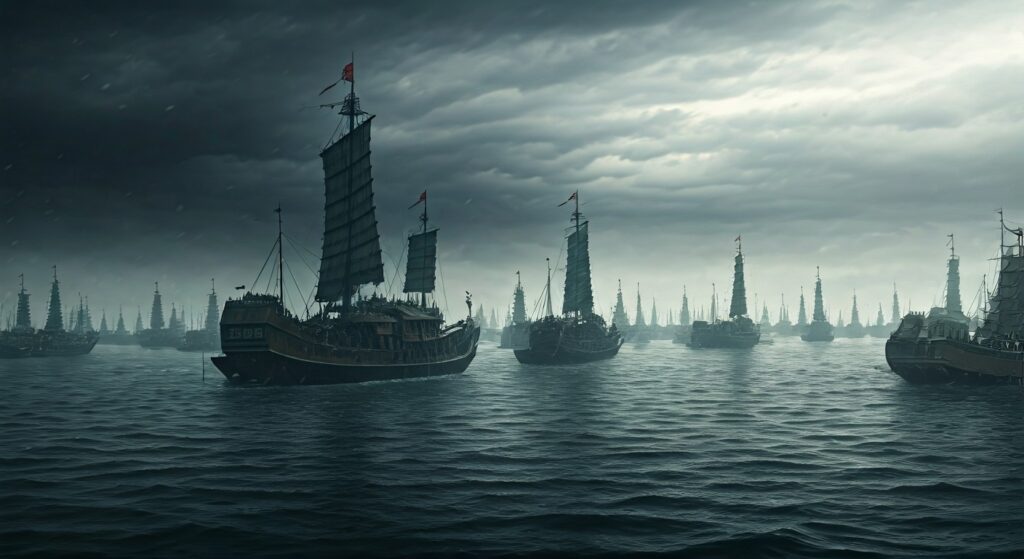
To stop his men from vomiting over the hulls, Cao Cao ordered his massive fleet to be chained together, end-to-end. Broad wooden planks were laid across the ships, effectively transforming his armada into a colossal, stable, floating fortress.
The seasickness vanished instantly. Morale soared. His cavalry could literally ride their horses across the decks of the interconnected ships.
But across the misty expanse of the river, Zhou Yu and his veteran general, Huang Gai, watched the transformation with predatory patience. They saw a chained, immobile wooden city floating on the water. And they knew exactly how to reduce it to ash.
The Ruse of Suffering
You do not defeat an army five times your size with brute force; you dismantle it with deception.
To get close enough to Cao Cao’s floating fortress, the southern alliance needed a Trojan Horse. General Huang Gai stepped forward to play the sacrificial lamb. In a brilliantly orchestrated piece of theater, Huang Gai publicly challenged Zhou Yu’s authority during a war council. In a staged fit of rage, Zhou Yu ordered the veteran general to be severely flogged in front of the entire camp.
This was no pantomime. It was a brutal, bloody physical punishment known in Chinese stratagem as the “ruse of suffering.” Bruised, bleeding, and publicly humiliated, Huang Gai secretly dispatched a letter to Cao Cao, offering to defect and surrender his squadron of ships to the northern fleet.
Cao Cao’s spies embedded in the southern camp confirmed the vicious flogging. Believing the defection was genuine, the northern warlord eagerly awaited his new prize.
The Wind Shifts
On the night of the attack, Huang Gai’s squadron sailed across the black waters of the Yangtze toward Cao Cao’s chained fleet. But these ships carried no defectors. Beneath their decks, the hulls were packed to the brim with dry reeds, kindling, and highly flammable oil.
There was only one variable left to chance: the wind. In the dead of winter, the winds on the Yangtze typically blew from the northwest. If Huang Gai ignited his ships, the gale would blow the inferno directly back into the southern alliance’s face.
But then, the atmosphere shifted. A sudden, rare winter gale began to howl from the southeast, blowing directly toward Cao Cao’s camp. While folklore attributes this miraculous weather event to the mystical rituals of the legendary strategist Zhuge Liang, it was, in reality, a localized meteorological phenomenon that the southern commanders had observed and masterfully timed.
As Huang Gai’s ships closed the distance, he gave the fatal order. Torches were dropped into the oil-soaked reeds.
The Inferno of Red Cliffs
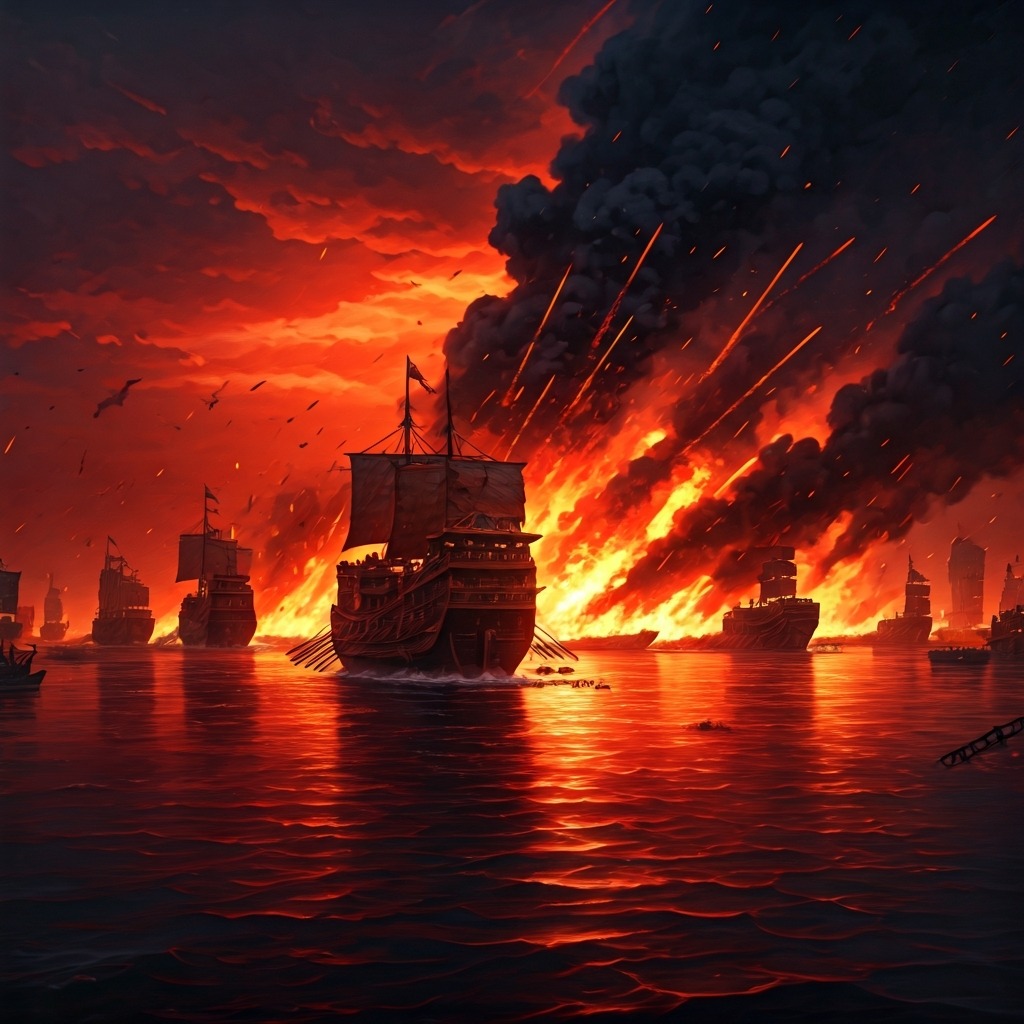
The fire ships became floating missiles. Accelerated by the howling southeastern wind, they rammed violently into Cao Cao’s chained armada.
Because the northern warlord had locked his ships together to cure his men’s seasickness, the vessels could not scatter. The flames leaped from mast to mast, hull to hull, spreading with terrifying, unstoppable speed. Within minutes, the greatest fleet in China was transformed into an inescapable inferno. The fire roared across the water, painting the night sky blood-red as it violently consumed Cao Cao’s onshore encampments.
The chaos was absolute. Tens of thousands of northern soldiers burned alive or drowned in the freezing, merciless waters of the Yangtze as they desperately tried to flee the blazing wreckage.
Cao Cao survived the initial blast, but his nightmare had only just begun. With his invincible army shattered, he was forced into a grueling retreat along the muddy, treacherous Huarong Trail. Heavy rains turned the path into a quagmire, while disease and starvation decimated whatever remained of his forces.
The fiery upset at the Battle of Red Cliffs permanently altered the trajectory of Chinese history. It shattered Cao Cao’s dream of a unified empire, ensured the survival of the southern warlords, and drew the geopolitical lines that would soon divide China into the legendary rival states of Wei, Shu, and Wu. It remains a stark, smoldering reminder that in the theater of war, the greatest armor can become the deadliest trap.