Ask anyone to name the first author in human history, and you’ll likely hear the same guesses: Homer, perhaps, or an anonymous Egyptian scribe. But the first person to ever look at a piece of writing and declare, “I made this. This is mine,” wasn’t a Greek philosopher. And she wasn’t a man.
She was a Mesopotamian princess, a high priestess, and a political mastermind who lived over four thousand years ago. Her name was Enheduanna. And her weapon of choice wasn’t a sword—it was a sharpened reed stylus.
The Emperor’s Inside Woman
To understand Enheduanna’s unprecedented rise, we must travel back to the 23rd century BCE. Her father was the formidable Sargon of Akkad, the ruthless conqueror who established the world’s first true empire.
But Sargon had a massive problem. He had conquered the independent Sumerian city-states, but holding them together was a logistical nightmare. The Akkadians in the north and the Sumerians in the south were divided by culture, language, and gods. Sargon needed a unifier. He needed a loyalist on the inside.
Enter his daughter.
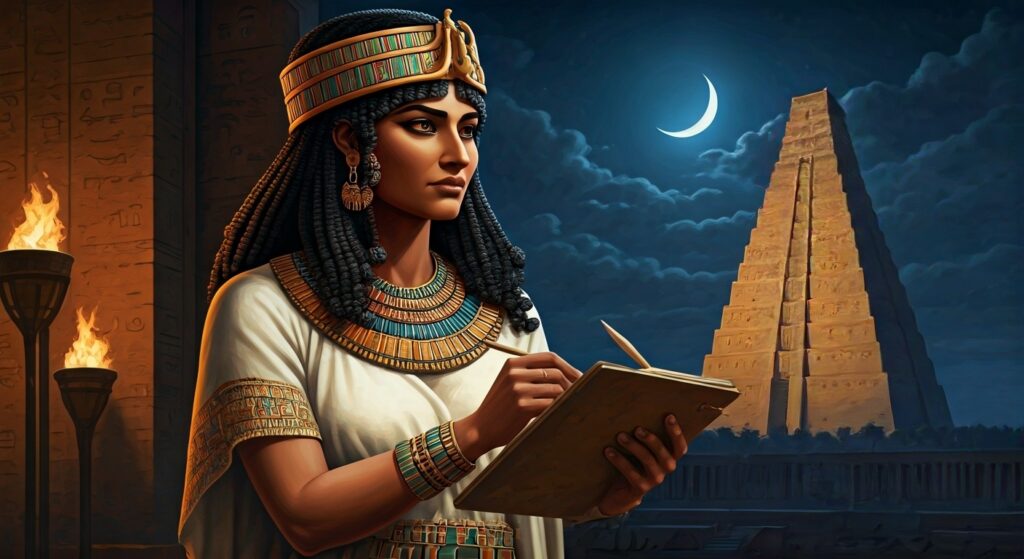
In a brilliant, calculated political move, Sargon appointed Enheduanna as the High Priestess of the moon god Nanna in the powerful Sumerian city of Ur. Her very name was a political statement, translating roughly to ‘High Priestess, Ornament of Heaven.’ Suddenly, this Akkadian princess wielded immense religious and political power over a restless Sumerian populace. Her mission was clear: blend their religious traditions and keep the empire from fracturing.
For years, she succeeded. Until the day the shadows of rebellion crept into the temple.
Mutiny and the Desert Sands
Following Sargon’s death, the empire became dangerously unstable. Sensing weakness, a ruthless Sumerian rebel leader named Lugal-Ane staged a violent uprising.
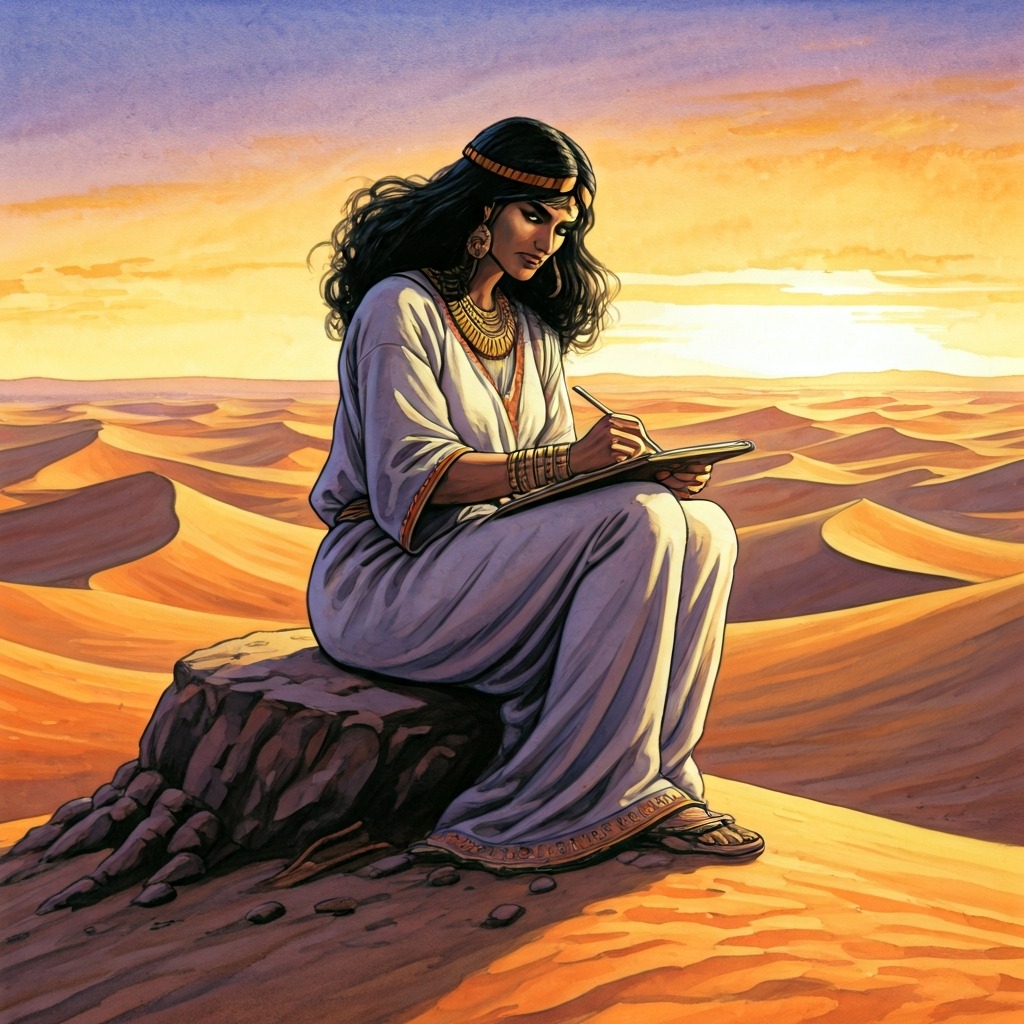
Lugal-Ane didn’t just want the throne; he wanted Enheduanna gone. Recognizing her as the ultimate symbol of Akkadian control, he stripped her of her holy title, cast her out of her temple, and drove her into the unforgiving desert.
In the ancient world, political exile was almost always a death sentence. She was a woman who had once been the highest religious authority in the land, now wandering the wastes, her life hanging by a thread. Lugal-Ane expected her to quietly disappear into the sands of history.
He was wrong. Enheduanna fought back.
The Birth of the “I”
In her desperation and fury, Enheduanna did something entirely unprecedented. She pressed her stylus into wet clay and wrote a passionate, deeply personal hymn.
Known today as The Exaltation of Inanna, the text is a fierce plea to the goddess of love and war, begging for divine intervention and restoration. In this poem, Enheduanna elevates Inanna to the very top of the pantheon, masterfully synthesizing Sumerian and Akkadian religious beliefs to unify the warring factions.
But the true shock of this text lies in its perspective. For the very first time in recorded human history, a writer used the pronoun “I.”
Enheduanna wrote about her own suffering, her political exile, and her visceral fears. She stepped out from behind the veil of anonymous, bureaucratic scribes and claimed her personal narrative.
She didn’t stop there. She also compiled the Sumerian Temple Hymns, a massive collection of 42 hymns dedicated to temples across the empire. At the end of this monumental work, she added a colophon—a statement of authorship—that still echoes through the millennia:
“The compiler of the tablets is Enheduanna. My king, something has been created that no one has created before.”
She knew exactly what she was doing. She even described the grueling, exhausting act of composing poetry as a physical process akin to childbirth. She was entirely self-aware of her own creative genius.
Unearthed from the Ashes
Enheduanna’s words were so powerful that she was eventually restored to her rightful position in Ur. Her poetry became the gold standard of Mesopotamian literature. For half a millennium after her death, students in Sumerian scribal schools painstakingly copied her texts to learn the art of writing.
But as the Bronze Age collapsed and empires turned to dust, her name was swallowed by time.
It wasn’t until 1927 that the mystery of the first author was finally solved. Archaeologist Sir Leonard Woolley was excavating the ancient city of Ur when he brushed the dirt off a translucent alabaster relief. Now known as the Enheduanna Disk, the artifact depicts a woman participating in a sacred religious ritual. The cuneiform inscription on the back clearly identifies her: Enheduanna.
From the very first written words in Mesopotamia to the screen you are reading this on right now, the lineage of literature traces back to a brilliant, defiant woman in the ancient Middle East who refused to be silenced by a usurper.