Imagine a military commander whose battlefield statistics read like a glitch in the matrix. An underdog with zero formal naval training who stepped up to face one of the most ruthless war machines in history—and walked away with an unprecedented record of 23 consecutive victories. Zero defeats. To pull off the greatest winning streak in naval history, Korea’s Admiral Yi Sun-sin needed more than just brilliant tactics. He needed a monster.
The Floating Samurai Problem
In 1592, battle-hardened Japanese warlord Toyotomi Hideyoshi launched a massive invasion of Korea. His ultimate goal? March straight through to conquer Ming China. The Japanese forces were fresh off decades of brutal civil war. They were seasoned, ruthless, and armed to the teeth with superior firearms. At sea, their naval doctrine was terrifyingly simple. Japanese ships were essentially floating platforms designed to deliver lethal samurai infantry into close-quarters combat. They didn’t want to sink an enemy ship; they wanted to pull up alongside it, swarm the deck with heavily armed warriors, and slaughter the crew in hand-to-hand combat. Admiral Yi realized that engaging the Japanese in a traditional naval brawl was a death sentence. He needed a vessel that made boarding not just difficult, but completely suicidal.
Drafting the Ultimate Tank
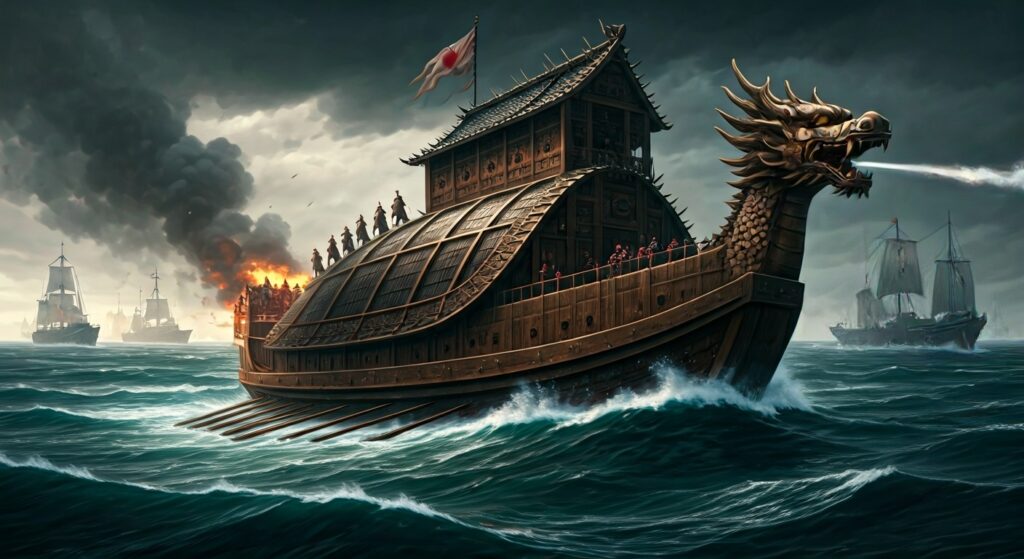
Yi’s answer was the revival and perfection of the Geobukseon, or ‘Turtle Ship.’ Forget everything you know about traditional wooden sailboats. The Turtle Ship was an armored shock-assault vessel that looked like it sailed straight out of a nightmare. Its most defining feature was a fully enclosed roof. Covered in heavy plating and razor-sharp iron spikes, the roof was a death trap. To maximize the carnage, Yi’s crews camouflaged these spikes with innocent-looking straw mats. When Japanese samurai confidently leapt from their vessels onto the Turtle Ship, expecting to breach the deck, they were instantly and brutally impaled.
The Fire-Breathing Vanguard
The internal engineering of the Turtle Ship was just as devastating. At the bow sat a massive, menacing carved dragon head. This wasn’t mere intimidation—it was a fully functional weapon designed to fire cannonballs and belch thick, toxic sulfur smoke. This artificial smokescreen blinded the enemy fleet and struck psychological terror into the Japanese, many of whom genuinely believed they were fighting demonic sea monsters. Below the spiked roof, the ship featured a flat, U-shaped hull. While a V-shaped hull is faster in open ocean travel, Yi cared only about combat geometry. The flat bottom gave the Turtle Ship the mind-bending ability to turn on a dime, rotating entirely within its own radius. With oarsmen safely protected below deck, the ship could maneuver independently of the wind, spinning in circles to unleash a continuous, devastating barrage of cannons from every angle. In battle, these mechanical beasts served as Yi’s vanguard. They charged directly into the center of the Japanese fleet, absorbing enemy fire and shattering formations so the rest of the Korean fleet could pick off the panicking invaders.
Benched by the Crown
You would expect a commander who single-handedly choked off Japanese supply lines to be carried on the shoulders of his king. Instead, Yi became the victim of one of the most frustrating betrayals in military history. Consumed by court jealousy, King Seonjo had his greatest hero stripped of his rank, imprisoned, and brutally tortured. In Yi’s absence, the Korean navy was handed over to a rival commander. The result was catastrophic: the fleet was almost entirely annihilated by the Japanese.
The Final Drumbeat
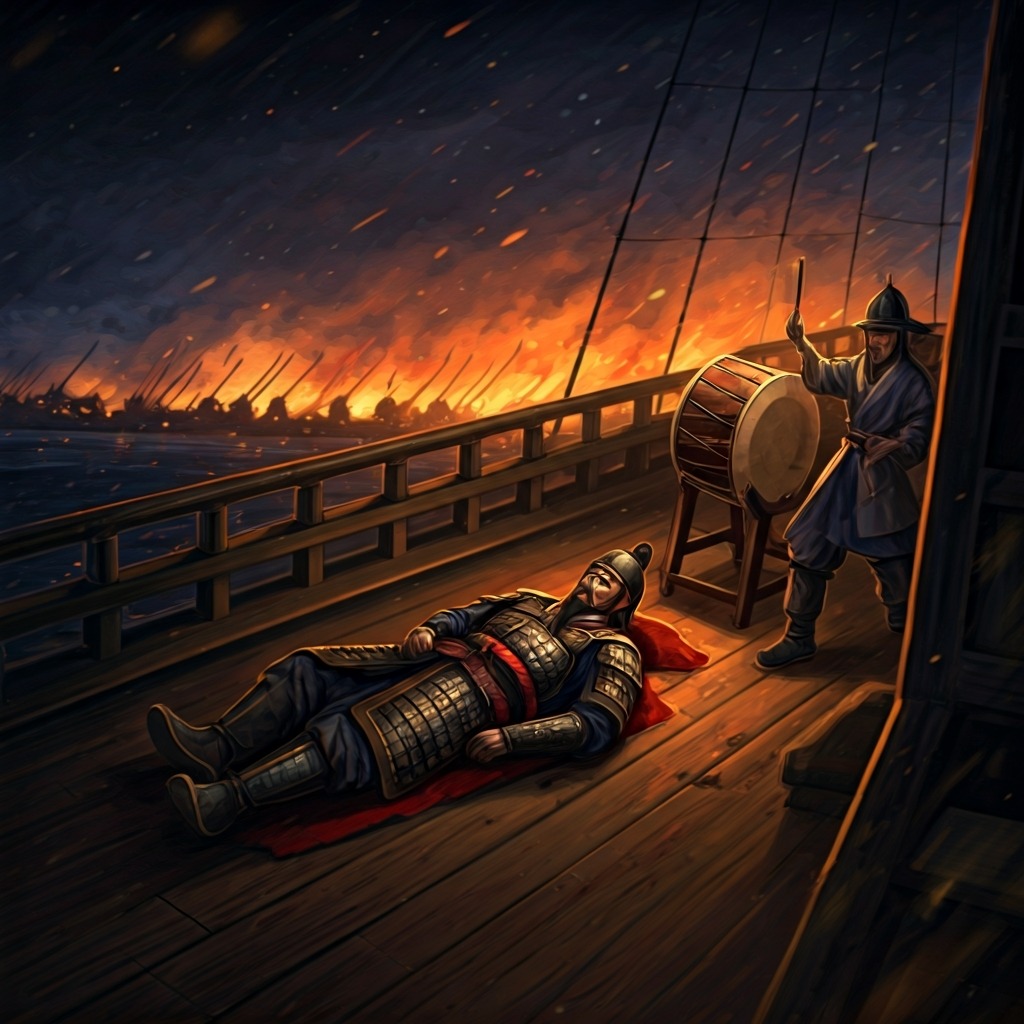
Reinstated out of sheer desperation, a battered Admiral Yi took command of the devastated Korean navy. He had exactly 13 ships left. With his back against the wall—and without his beloved Turtle Ships for this specific engagement—Yi relied purely on his mastery of logistics, tides, and strategy. At the miraculous Battle of Myeongnyang, he used the treacherous currents of a narrow strait to defeat a Japanese fleet of over 130 warships. Admiral Yi’s story ends like a cinematic masterpiece. During the final clash of the war at the Battle of Noryang, Yi was fatally struck by a stray bullet. Knowing his death would shatter the morale of his men and potentially cost them the war, his final order to his nephew was absolute: keep beating the war drum, and hide his death until the battle was won. The Japanese fleet was destroyed, and Korea was saved. Today, Admiral Yi remains the ultimate undefeated underdog—a tactical genius who built a fire-breathing sea monster and saved a nation.