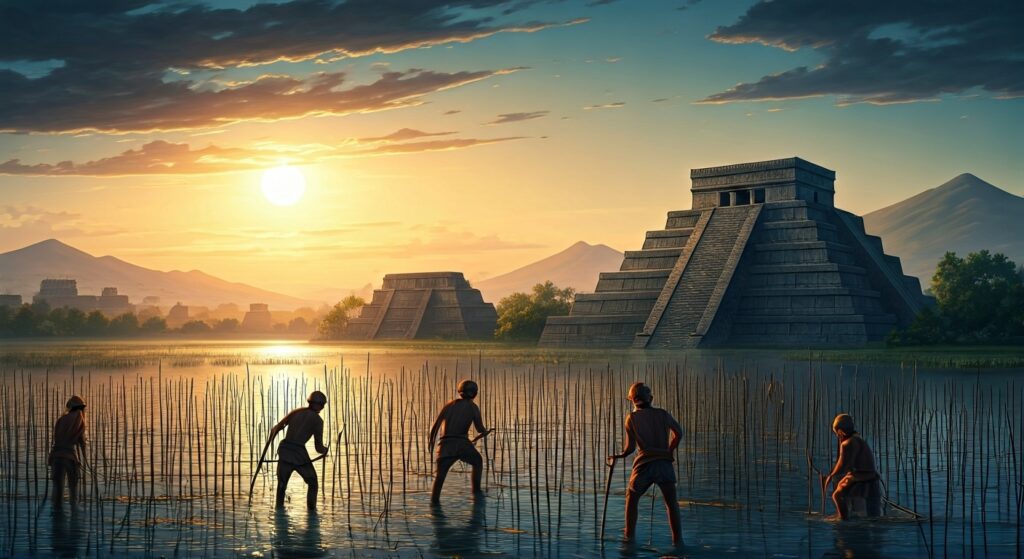
Imagine the ultimate logistical nightmare. You are the ruler of a sprawling, glittering metropolis of over 200,000 people. Your city is a marvel of architecture, a bustling hub of trade and military power. There is just one fatal flaw: it is built on an island in the middle of a shallow, brackish lake. You have virtually no arable land.
How do you keep your empire from starving?
If you were the Aztecs in the Valley of Mexico, you didn’t conquer more land. You engineered it out of thin air—and water.
The Floating Illusion
When Spanish conquistadors first laid eyes on the magnificent city of Tenochtitlan, they were spellbound. Among the many wonders they recorded were what they described as “floating gardens” drifting across the lake. To the European mind, it looked like pure magic.
But it wasn’t magic, and they weren’t floating.
They were chinampas, and they represent one of the most brilliant feats of engineering in human history. The Aztecs and earlier Mesoamerican civilizations didn’t just passively farm the land; they manipulated the very fabric of the wetland ecosystem to create a hyper-fertile grid of artificial islands. It was a flawless system of resource management that kept a massive empire fed against all odds.
Engineering Earth from Water
To pull off this impossible agricultural feat, Aztec engineers had to build from the lakebed up. They began by staking out massive rectangular enclosures in the shallow waters. But they didn’t use dead wooden posts. They used poles from the Ahuejote tree, a native willow.
This is where the genius kicks in: these were living stakes.
Once driven into the lakebed, the Ahuejote branches would take root, creating a living, breathing, erosion-resistant retaining wall. Inside this living perimeter, workers piled alternating layers of aquatic vegetation, woven reeds, and nutrient-dense mud dredged straight from the lake bottom.
They built these layers up until the planting surface sat just inches above the water level. Because the soil was so close to the lake, it continuously wicked moisture upward through capillary action. The result? The crops rarely needed manual watering. The island watered itself.
The Secret in the Soil
This system didn’t just sustain the population; it created an agricultural powerhouse. Because the dredged lake mud was so rich in nutrients, and the water supply was constant, the soil was incredibly fertile. While European farmers were thrilled to get one or two good harvests a year, the chinampas could produce a staggering seven harvests annually.
But the mystery of how they sustained this fertility without exhausting the soil reveals an even more brilliant twist.
The chinampa system was a masterpiece of the circular economy centuries before the term was invented. The grid-like network of canals between the islands served as a highly efficient aquatic highway, allowing canoes to transport fresh produce directly into the heart of Tenochtitlan. But those canoes didn’t return empty.
To solve the sanitation nightmare of a densely packed urban center, human waste was collected from the city and transported back to the chinampas to be used as fertilizer. They literally turned a public health hazard into the lifeblood of their food supply, enriching the soil and keeping the glittering city sparkling clean.
A Living Legacy
Today, we talk about sustainable agriculture, permaculture, and hydroponics as if they are cutting-edge solutions to our modern climate and food crises. Yet, looking back at the chinampas, it’s clear that the blueprint for working symbiotically with wetland ecosystems has existed for centuries. The Aztecs didn’t destroy their environment to survive; they integrated with it.
While the sprawling lake of Tenochtitlan was mostly drained by the Spanish—a catastrophic environmental decision we are still learning from—the legacy of the chinampas isn’t entirely lost. If you travel to the southern edge of modern-day Mexico City, you can still navigate the last remaining canals of Xochimilco.
Now a recognized UNESCO World Heritage site, these surviving chinampas serve as a living, breathing testament to an empire that looked at an un-farmable lake and saw an endless harvest.