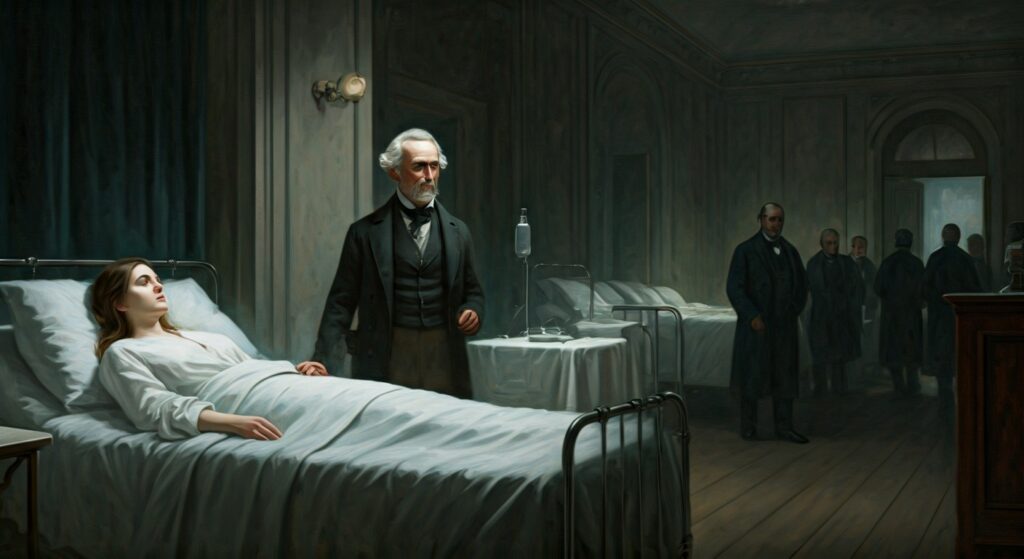
In the 1840s, the most dangerous place a pregnant woman could be was not a freezing slum or a plague-ridden street. It was a pristine hospital bed, surrounded by the most educated men in Europe.
At the time, the Vienna General Hospital was the absolute epicenter of cutting-edge medical research. Yet, a terrifying, invisible plague known as puerperal fever—or “childbed fever”—was ravaging its maternity wards. The horror, however, had a bizarre and specific geography.
The House of Weeping Women
The hospital was divided into two clinics. The First Obstetrical Clinic was staffed by elite doctors and brilliant medical students. The Second Clinic was staffed entirely by midwives.
The mortality rate in the First Clinic hovered at a staggering 10 percent, often spiking much higher. In the Second Clinic? A mere 2 percent.
This discrepancy was the worst-kept secret in Vienna. It was so widely known that pregnant women would beg on their knees not to be admitted to the First Clinic. They would actively fight the nurses, choosing to give birth in the filthy, freezing streets rather than face the doctors.
Enter Ignaz Semmelweis, a Hungarian physician appointed as an assistant to the First Clinic. Fueled by a desperate need to stop the dying, Semmelweis became obsessed. He meticulously ruled out every variable. Was it overcrowding? No, the Second Clinic was more crowded. Was it the climate? Identical. He even considered the psychological terror of the hospital priest, who would ring a bell as he walked through the ward to administer last rites. Semmelweis had the priest change his route and silence his bell.
Still, the women kept dying.
The Slip of the Scalpel
The breakthrough didn’t come from a microscope. It came from a tragedy.
In 1847, Semmelweis’s close friend and colleague, Jakob Kolletschka, died after accidentally pricking his finger with a student’s scalpel. They had been performing an autopsy on a woman who had succumbed to childbed fever.
When Semmelweis reviewed his friend’s autopsy report, a chill went down his spine. The pathology inside Kolletschka’s body was identical to the pathology of the mothers dying in the First Clinic.
Suddenly, the pieces clicked into place with horrifying clarity. What did the doctors and medical students do every morning before their rounds? They dissected rotting corpses in the morgue. What did the midwives in the Second Clinic do? They performed no autopsies.
Because germ theory didn’t exist yet, Semmelweis didn’t know about bacteria. But he deduced that the doctors were carrying invisible, deadly “cadaverous particles” on their hands, transferring death directly from the morgue to the birthing beds.
The doctors were the monsters.
The Scent of Death
Semmelweis needed a way to destroy the invisible particles. He noticed that regular soap and water didn’t remove the putrid, lingering stench of the morgue from his hands. But a harsh solution of chlorinated lime did.
He instituted a draconian new rule: anyone examining a patient in the First Clinic had to plunge their hands into the chemical solution first.
The results were nothing short of miraculous. In April 1847, the mortality rate in the First Clinic was 18.3 percent. By mid-summer, thanks to the handwashing protocol, it plummeted to just over 1 percent. In some subsequent months, the death rate hit absolute zero.
He had solved the mystery. He had saved the mothers. You would think the medical establishment would have thrown him a parade.
The Ego Strikes Back
If history has taught us anything, it is that human ego is a far deadlier force than ignorance.
The medical establishment vehemently and viciously rejected Semmelweis. At the time, diseases were blamed on “miasma” (bad air) or imbalances of the bodily humors. But the real issue was class prejudice. Doctors were high-society gentlemen, and it was an unquestioned societal truth that a gentleman’s hands were inherently clean.
To suggest that the esteemed doctors of Vienna were walking around with filthy, murderous hands was an unforgivable insult. Semmelweis’s superior, Professor Johann Klein, was particularly enraged by the implication and eventually refused to renew Semmelweis’s appointment.
Ostracized, mocked, and essentially exiled by the Victorian medical elite, Semmelweis fled to Budapest in 1850. He implemented his protocols at St. Rochus Hospital, virtually eradicating childbed fever there. Yet, the broader European medical community continued to ignore him.
A Descent into Darkness
By the time Semmelweis finally published his magnum opus in 1861, the isolation had taken its toll. The book received scathing reviews.
Semmelweis snapped. He grew erratic, bitter, and deeply depressed. He began writing furious open letters to the most prominent obstetricians in Europe, publicly denouncing them as “ignorami” and “irresponsible murderers.”
By 1865, his behavior had become so bizarre and his cognitive decline so severe that his colleagues—and his own wife—conspired against him. Under the guise of taking him to tour a new medical institute, they lured him to an insane asylum in Vienna.
When Semmelweis realized it was a trap, he fought back. He tried to run. The asylum guards descended on him, beating him mercilessly before binding him in a straitjacket and throwing him into a dark cell.
Fourteen days later, the “savior of mothers” was dead at the age of 47.
The cause of death? He succumbed to sepsis from a gangrenous wound on his right hand—an injury likely sustained while fighting the guards. In a twist of fate so cruel it feels like fiction, Ignaz Semmelweis died of the exact same type of blood infection he had spent his entire life trying to eradicate.
The Semmelweis Reflex
It would take years, and the groundbreaking work of Louis Pasteur and Joseph Lister, for the world to realize that Semmelweis had been entirely right. Germ theory eventually vindicated him, but far too late to save the man himself.
Today, psychologists use a term called the “Semmelweis reflex.” It describes the knee-jerk human tendency to reject new evidence because it contradicts established norms, beliefs, or paradigms.
Ignaz Semmelweis stared into the darkness, found a way to save millions of lives, and paid the ultimate price—simply for asking the world’s greatest minds to wash their hands.