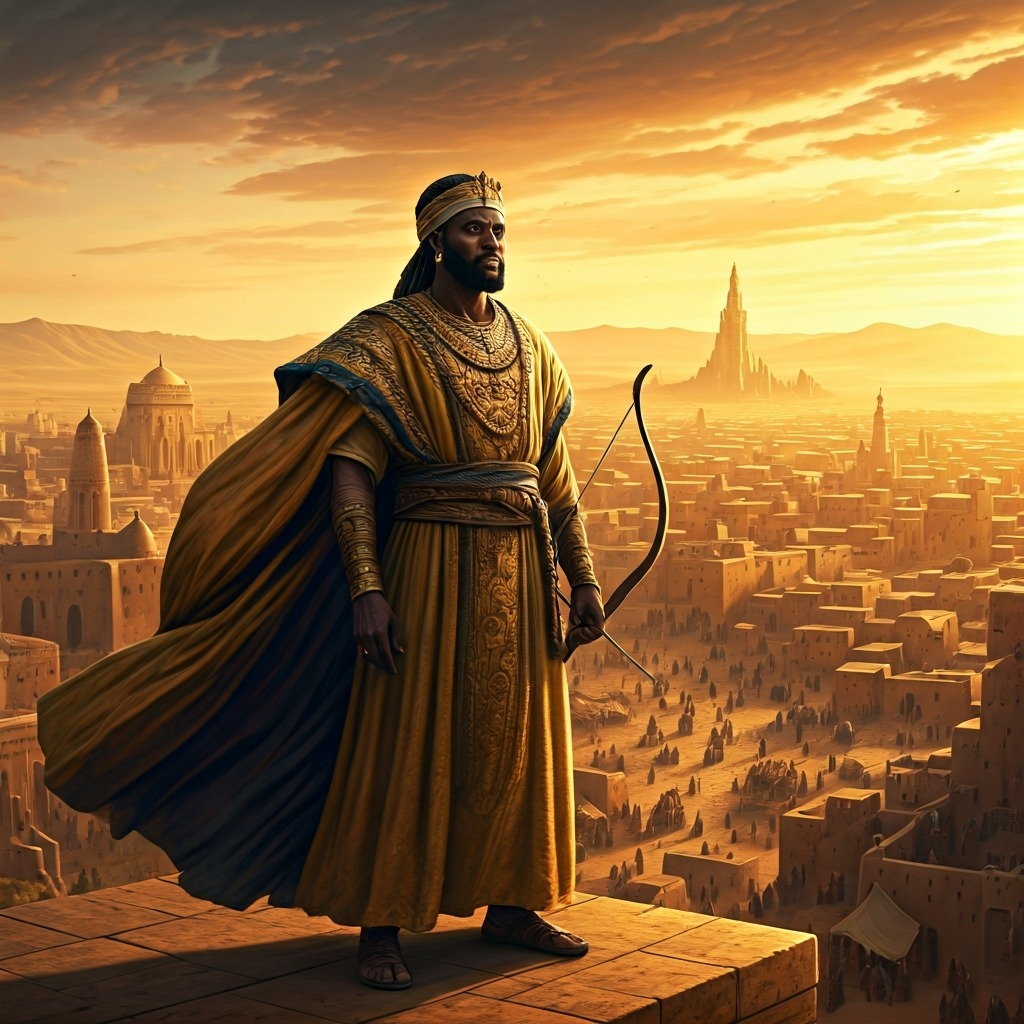
History is often sanitized into dry dates and dusty textbooks. But hidden in the 13th-century sands of West Africa lies a saga of dark magic, vicious royal court drama, and a bullied, paralyzed outcast who rose to forge one of the wealthiest empires the world has ever seen. This is the epic of Sundiata Keita, the legendary founder of the Mali Empire.
A Prophecy Delivered in the Shadows
Our story begins in the small Mandinka kingdom of Kangaba with King Maghan Kon Fatta. One evening, a traveling hunter arrived at the royal court and delivered a bombshell prophecy: if the king married a remarkably ugly woman, she would give birth to a son destined to become the greatest king the world had ever seen.
Not long after, two hunters rolled into town presenting a hunchbacked woman named Sogolon Condé, widely known as the “buffalo woman.” Honoring the prophecy, King Maghan married her. She soon gave birth to a boy named Mari Diata, known to history as Sundiata.
But being the child of prophecy did not guarantee a life of luxury. For Sundiata, it guaranteed a waking nightmare.
The Boy Who Crawled in the Dust
Sundiata was born with a severe physical disability. For the first seven years of his life, he couldn’t walk, spending his days crawling in the dirt on all fours.
This perceived weakness delighted Sassouma Bérété, the king’s first wife. Sassouma was terrified that this child of prophecy might threaten the royal inheritance of her own son, Dankaran Touman. She and her loyalists in the court ruthlessly mocked Sundiata’s paralysis and ridiculed his mother, Sogolon. The royal court became a den of vipers, with Sassouma ensuring that Sogolon and her disabled son were treated as absolute social pariahs.
Iron, Will, and the Uprooted Tree
The breaking point arrived over a seemingly trivial matter. Sogolon needed baobab leaves to cook her dinner, and Sassouma publicly humiliated her for having to beg for them, loudly boasting that her own able-bodied son could fetch leaves whenever she desired.
Seeing his mother weeping in the dirt was the spark that ignited Sundiata’s destiny.
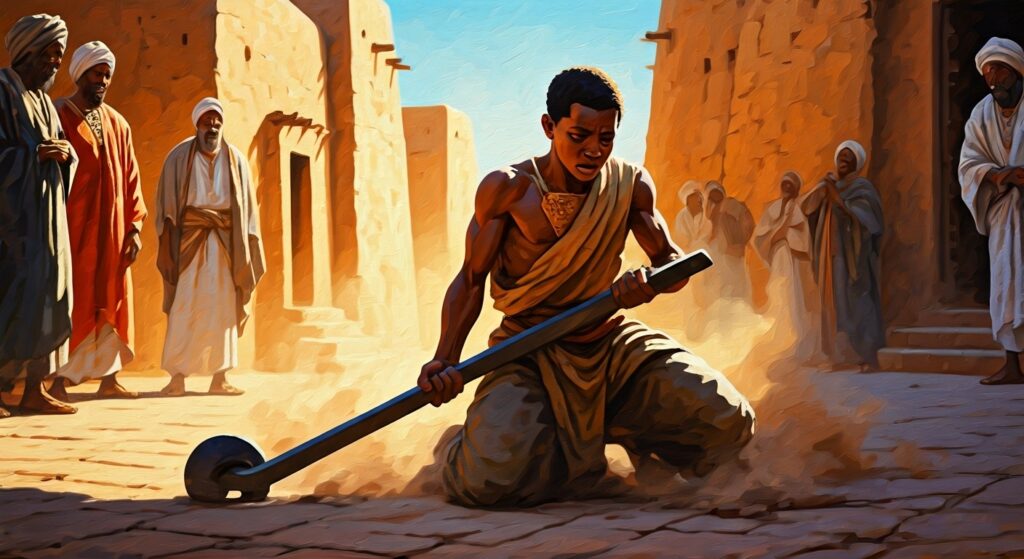
The boy who had never taken a single step demanded that the local blacksmith forge him a massive, impossibly heavy iron rod. Using a strength that defied human limitation, Sundiata gripped the iron and pulled himself up. As he forced himself to stand for the very first time, the sheer force of his will bent the massive iron rod into the shape of a bow.
But he wasn’t done. He marched straight to a massive baobab tree, violently uprooted the entire thing from the earth, and planted it directly in front of his mother’s door. He declared that from that day on, she would never have to beg for leaves again.
The Sorcerer-King’s Macabre Wardrobe
When King Maghan died, Sassouma seized power for her son and immediately put a target on Sundiata’s back. To survive, Sogolon took her children into a grueling, years-long exile.
But exile wasn’t a punishment for Sundiata; it was a masterclass. As he wandered through neighboring kingdoms, eventually finding refuge in Mema, he studied their politics, absorbed their customs, and trained to become a lethal, brilliant military tactician.
Back home, a terrifying new threat had emerged. Soumaoro Kanté, the cruel sorcerer-king of the Sosso people, had invaded and conquered the Mandinka lands. Soumaoro wasn’t just a tyrant; he was a walking horror story. He possessed dark magic, kept a secret chamber full of occult artifacts, and casually wore robes made of human skin. Sassouma’s son, the “rightful” king, cowardly fled into the night.
Desperate and oppressed, the Mandinka people sent covert messengers into the wilderness. They needed the boy who uprooted the baobab tree. They needed Sundiata.
The White Rooster’s Fatal Flaw
Sundiata answered the call, assembling a massive coalition army from the kingdoms that had sheltered him. But there was a massive problem: Soumaoro was protected by powerful sorcery. Conventional swords and spears literally bounced off his skin.
But every tyrant has a fatal flaw.
During Soumaoro’s reign of terror, he had held Sundiata’s half-sister, Nana Triban, and his fiercely loyal griot (traditional bard), Balla Fasséké, captive. While imprisoned, the two managed to uncover Soumaoro’s tana—a magical taboo or secret weakness. They escaped and brought this highly classified intel straight to Sundiata.
Armed with this knowledge, Sundiata didn’t forge a bigger sword. He crafted a single, special arrow, tipping it with the spur of a white rooster.
The Clash at Kirina and a New Dawn
The two massive armies collided at the Battle of Kirina around 1235. Amidst the chaos of clashing steel and roaring warriors, Sundiata locked eyes with the sorcerer-king. He drew his bow and let the rooster-spurred arrow fly.
It didn’t impale Soumaoro; it merely grazed him. But that was enough. The magical taboo instantly shattered the sorcerer’s dark protections, stripping him of his powers. Terrified and suddenly mortal, Soumaoro fled the battlefield, disappearing into a dark cave, never to be seen again.
Sundiata Keita returned home a liberator and was crowned Mansa (King of Kings). He didn’t just conquer; he built. Choosing Niani as his capital, he united the region and established the Mali Empire, which would become one of the wealthiest and most powerful realms in global history.
Even more incredibly, he established the Kurukan Fuga, or Mande Charter. Passed down orally, this was essentially a constitution that codified human rights, protected property, organized trade, and ensured social harmony centuries before similar documents appeared in Europe.
Sundiata’s epic is a reminder that history is driven by human will. It is the story of a mother’s tears, a bent iron rod, and a marginalized kid who stood up from the dust to build an empire.