It didn’t begin with a royal decree or a master tailor’s grand vision. The most dangerous, structurally demanding, and downright absurd fashion craze of the 17th century started with a simple wardrobe malfunction in the woods. And before it was over, it would terrorize the courts of Europe for more than thirty years, turning aristocrats into walking fire hazards.
A Royal Wardrobe Malfunction
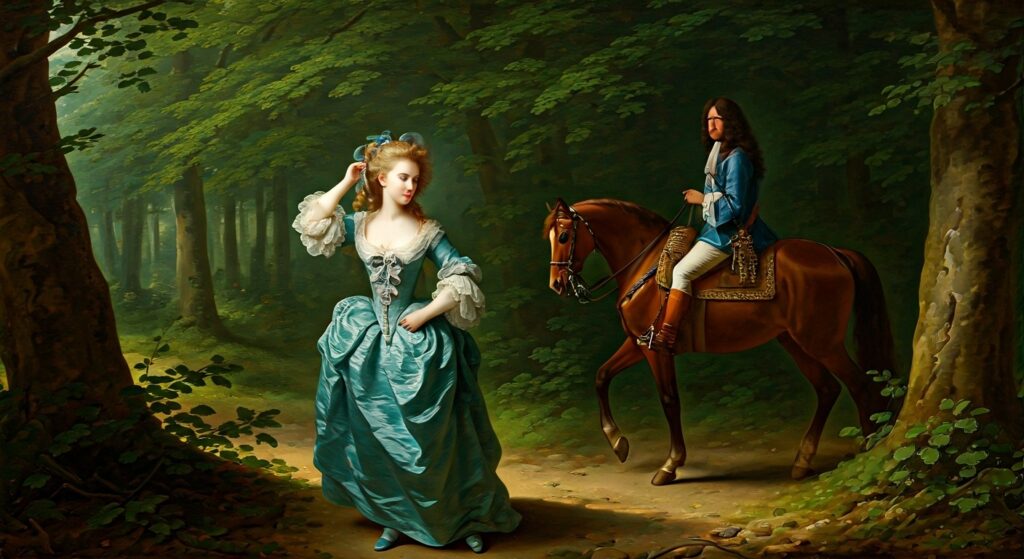
The year was 1680. Deep within a lush, sun-dappled forest in France, King Louis XIV was leading a royal hunting party. Riding alongside him was his latest obsession: a teenage mistress named Marie Angelique de Scorailles, the Duchesse de Fontanges.
As the hunting party dashed through the dense trees, disaster struck. The young Duchesse’s hair became hopelessly entangled in a low-hanging branch, violently ripping her hat from her head. Left with a disheveled, chaotic mess of curls, she had to think fast. In a moment of pure sartorial improvisation, she gathered her hair atop her head and tied it up with a piece of ribbon. Some historical whispers suggest it wasn’t just any ribbon, but her own lace garter.
King Louis XIV was instantly enchanted. To the monarch, this improvised, slightly undone look was the height of soft, romantic perfection. He demanded she wear her hair exactly like that to the royal court that evening.
In the high-stakes, hyper-competitive drama of Versailles, the ladies of the court were absolutely desperate to capture the King’s wandering eye. Overnight, they began mimicking the Duchesse. The “fontange” was born. But this innocent little ribbon was about to mutate into a monster.
The Architecture of Absurdity
What began as a charming cluster of curls quickly fell victim to the era’s insatiable appetite for extreme excess. If a little lace was good, a mountain of it had to be better.
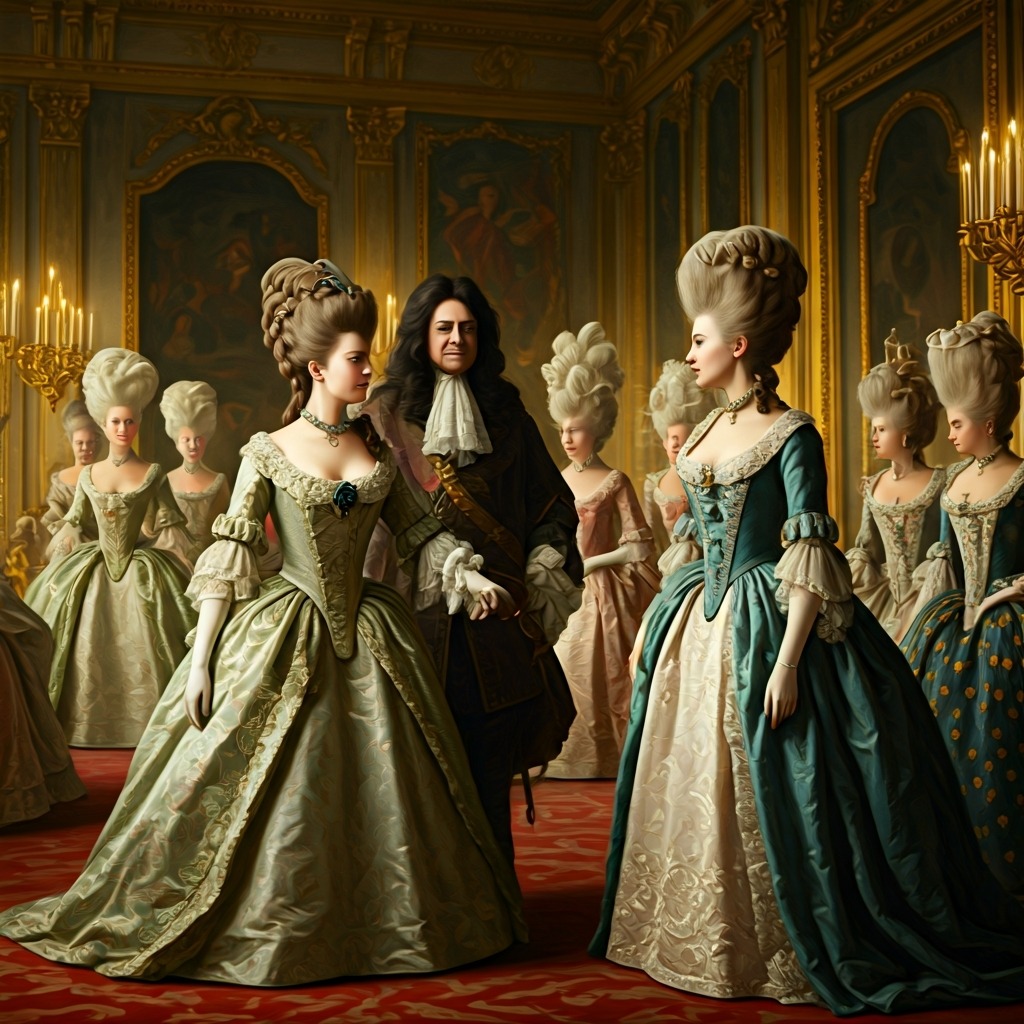
Over the next two decades, the women of the court stopped styling their hair and started engineering it. The fontange evolved from a soft updo into a towering, architectural monstrosity. By the 1690s, women were balancing elaborate, heavily starched constructions of lace, linen, and ribbons on their heads. To keep these gravity-defying towers from collapsing, they required a rigid iron or brass wire framework known as a commode.
These headdresses reached comical heights, sometimes towering up to two feet above the wearer’s skull. The sheer scale of the fontange forced women to entirely alter their anatomy and posture. They had to walk with incredibly stiff necks just to balance the precarious structures, and passing through a standard doorway required an awkward, deeply undignified ducking maneuver. The bizarre trend operated like a virus, quickly spreading beyond France and infecting the courts of England and other European nations, where onlookers simply referred to the style as a “tower.”
Flammable Ostriches and Moving Buildings
Naturally, you can’t walk around balancing two feet of wire and starched lace on your head without inviting mockery. Satirists and playwrights had a field day, ruthlessly comparing aristocratic women to steeples, ostriches, and ships in full sail.
But the fontange wasn’t just an assault on good taste; it was a genuine physical hazard. Imagine navigating a crowded, dimly lit 17th-century ballroom with a two-foot dry-tinder tower on your head. The highly flammable starched fabrics frequently caught fire on low-hanging chandeliers and wall sconces, turning a night of dancing into a potential inferno.
The ultimate irony? King Louis XIV—the very man whose initial admiration sparked the entire craze—grew to absolutely loathe the towering fontanges. He complained about them incessantly, lamenting that the women of his court looked like “moving buildings.” Yet, in a rare moment of royal impotence, his protests were entirely ignored. The court was too obsessed. The monster had outgrown its master.
The Flat-Haired Savior
The fontange’s reign of terror over European fashion seemed like it would never end, but salvation eventually arrived in the most unlikely of forms: an Englishwoman.
Around 1714, a woman often identified in historical lore as Lady Sandwich arrived at the French court. In a sea of towering lace steeples, she appeared sporting a shockingly modern, much lower, and flatter hairstyle.
The aging King Louis XIV took one look at her modest hair and loudly, openly praised it. After thirty years of ignoring the King’s complaints, the women of Versailles finally took the hint. Almost instantly, the towering wire commodes were dismantled. The starched lace was packed away. The bizarre, comical era of the fontange came to an abrupt, unceremonious close.
History is often stranger, and much more dramatic, than fiction. The next time you watch a period drama set in the late 1600s, scan the background extras. You likely won’t see a historically accurate, two-foot-tall wire commode—because modern audiences would simply think it was too ridiculous to be true.