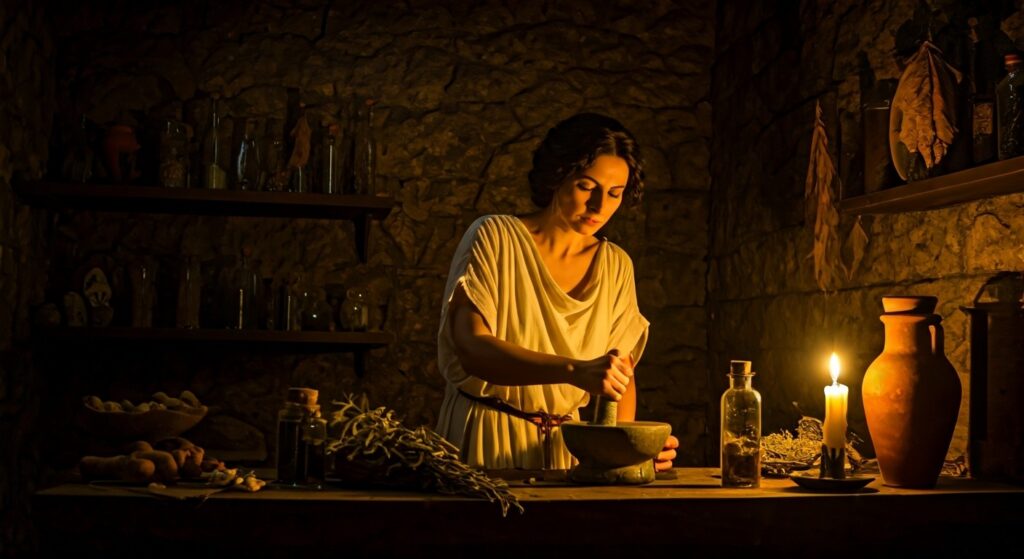
Long before modern fixers and hitmen, the Roman elite had a much quieter way of making their political rivals disappear. You didn’t need a dagger in the dark; you just needed the right tincture. And for that, you called Locusta.
Originally from Gaul, Locusta wasn’t a chaotic murderer striking at random. She was a brilliant, calculating apothecary who turned botany and toxicology into the most lucrative underground business in the ancient world. She was Rome’s premier poisoner—and arguably history’s first documented serial killer.
The Apothecary in the Shadows
In AD 54, Locusta’s deadly reputation had finally caught up with her. She was rotting in a Roman prison on poisoning charges. But in the imperial city, a lethal skill set was merely a resume waiting for the right employer.
Empress Agrippina the Younger had a monumental problem: her husband, Emperor Claudius. For her son, Nero, to ascend to the throne, Claudius had to die. Agrippina quietly pulled the strings to have Locusta released from her cell. The assignment was as simple as it was treasonous: assassinate the most powerful man in the world.
Locusta delivered. Slipping a lethal toxin—likely derived from death cap mushrooms or aconite—into a dish of the Emperor’s favorite mushrooms, she executed the hit flawlessly. Claudius perished, Nero took the throne, and Locusta proved she was worth her weight in gold.
A Lethal Promotion
If Agrippina was a demanding client, Emperor Nero was a waking nightmare.
By AD 55, Nero’s paranoia was spiraling. His younger stepbrother, Britannicus—the biological son of Claudius—held a legitimate claim to the throne. To Nero, the boy was a walking death sentence. Naturally, he summoned the woman who had secured his crown.
But Locusta’s first attempt on Britannicus failed. The dose was too weak, leaving the boy with nothing more than a severe bout of illness. Nero’s reaction was terrifying. According to ancient historians, the furious Emperor beat Locusta himself, threatening her with immediate execution if she didn’t produce a faster-acting, foolproof toxin.
The Perfect Murder
With her own life hanging in the balance, Locusta went to work under Nero’s psychotic scrutiny. She began a chilling phase of animal testing. First, a goat, which took an agonizing five hours to die. Not fast enough. She tweaked the recipe and tested it on a pig. The animal dropped dead instantly.
The poison was ready, but the delivery required absolute genius. As royalty, Britannicus never ate or drank anything that hadn’t been cleared by a food taster. How do you poison a man when someone else takes the first sip?
During a lavish banquet, Britannicus was served a steaming hot, completely harmless drink. The food taster took a sip, survived, and handed the cup to the boy. But the drink was intentionally served scalding hot. When Britannicus inevitably complained and asked for it to be cooled, a servant poured in cold water.
The cold water was laced with Locusta’s rapid-acting poison.
Britannicus collapsed and died almost instantly in the dining hall. Nero, barely looking up from his dinner, casually dismissed the boy’s death as an epileptic seizure.
Rome’s Academy of Death
Nero was so mesmerized by Locusta’s lethal efficiency that he rewarded her extravagantly. He granted her a full pardon, gifted her a sprawling country estate, and provided a massive allowance.
Then, he did the unthinkable: he sent her students.
Rome essentially established a state-sponsored academy of poisoning. Locusta transitioned from an underground criminal to a highly-paid government contractor, teaching the dark arts of toxicology to aspiring imperial assassins. The historian Tacitus famously dubbed her an “instrument of state.”
The Poison Dries Up
In ancient Rome, survival was only as secure as the Emperor who backed you. And Nero was a sinking ship.
When the Senate declared Nero a public enemy in AD 68, he fled the city. Legend dictates he took a vial of Locusta’s poison with him, though he ultimately chose to die by the sword. With Nero gone, Locusta’s imperial shield vanished.
The new Emperor, Galba, wasted no time purging Nero’s cronies. Locusta was arrested, paraded through the streets of Rome in chains, and executed in AD 69. (And despite a bizarre, persistent internet myth involving a specially trained giraffe, her execution was standard Roman fare—likely strangulation or the arena. The giraffe story is pure modern fiction.)
While our primary sources for Locusta’s life despised the Julio-Claudian dynasty and may have embellished her deeds to highlight Nero’s tyranny, her existence and execution are historical facts. Locusta remains one of history’s most terrifying figures: a woman who navigated the deadliest political landscape in the ancient world, armed with nothing but a mortar, a pestle, and a brilliantly lethal mind.