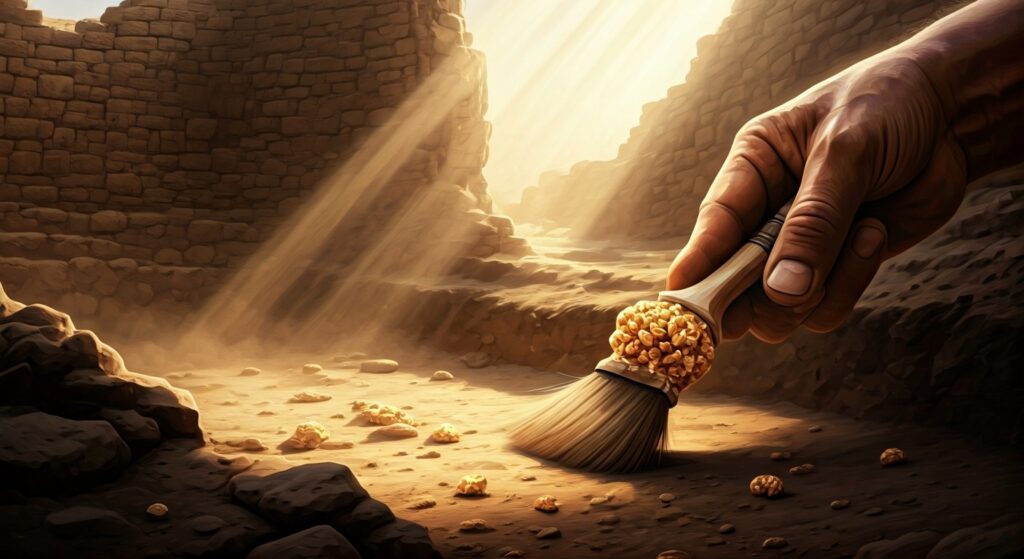
Deep in the arid, sun-scorched ruins of an ancient coastal settlement in Peru, archaeologists sifting through the dust of millennia expected to find the usual remnants of early civilization: shattered pottery, crude tools, perhaps the bones of the forgotten. Instead, they unearthed an anomaly that seemed to defy time itself.
Buried in the dirt was a perfectly preserved, 6,700-year-old piece of popcorn.
Today, we dismiss popcorn as the ultimate modern convenience—a cheap, buttery vessel for movie theater salt or a quick microwaveable midnight snack. But this seemingly mundane treat harbors one of the most explosive, deeply sacred, and ancient histories in the Americas. Long before the concept of a “snack” even existed, popcorn was a cornerstone of civilization, a marvel of botanical engineering, and a sacred offering to fearsome gods.
The Wild Grass That Hid a Secret
The story begins thousands of years ago with a feat of ancient indigenous genius: the domestication of wild teosinte grass into Zea mays (corn). Among the incredibly diverse yields of this agricultural revolution was Zea mays everta—popcorn.
It wasn’t a mere byproduct of the harvest; it was one of the very oldest cultivated forms of corn. During excavations at Huaca Prieta and Paredones on the northern coast of Peru, researchers made a staggering discovery. They unearthed fossilized corn husks, stalks, and completely popped kernels dating back to 4700 BC. This revelation proved that long before corn became the dominant dietary staple of the Americas, it was already being engineered for its explosive properties.
The phenomenon wasn’t isolated to South America, either. Deep in the Bat Cave of west-central New Mexico, researchers found perfectly preserved popcorn ears dating to approximately 3600 BC. But to these ancient populations, popcorn wasn’t just something to munch on to pass the time. It was magic.
Explosions for the Rain God
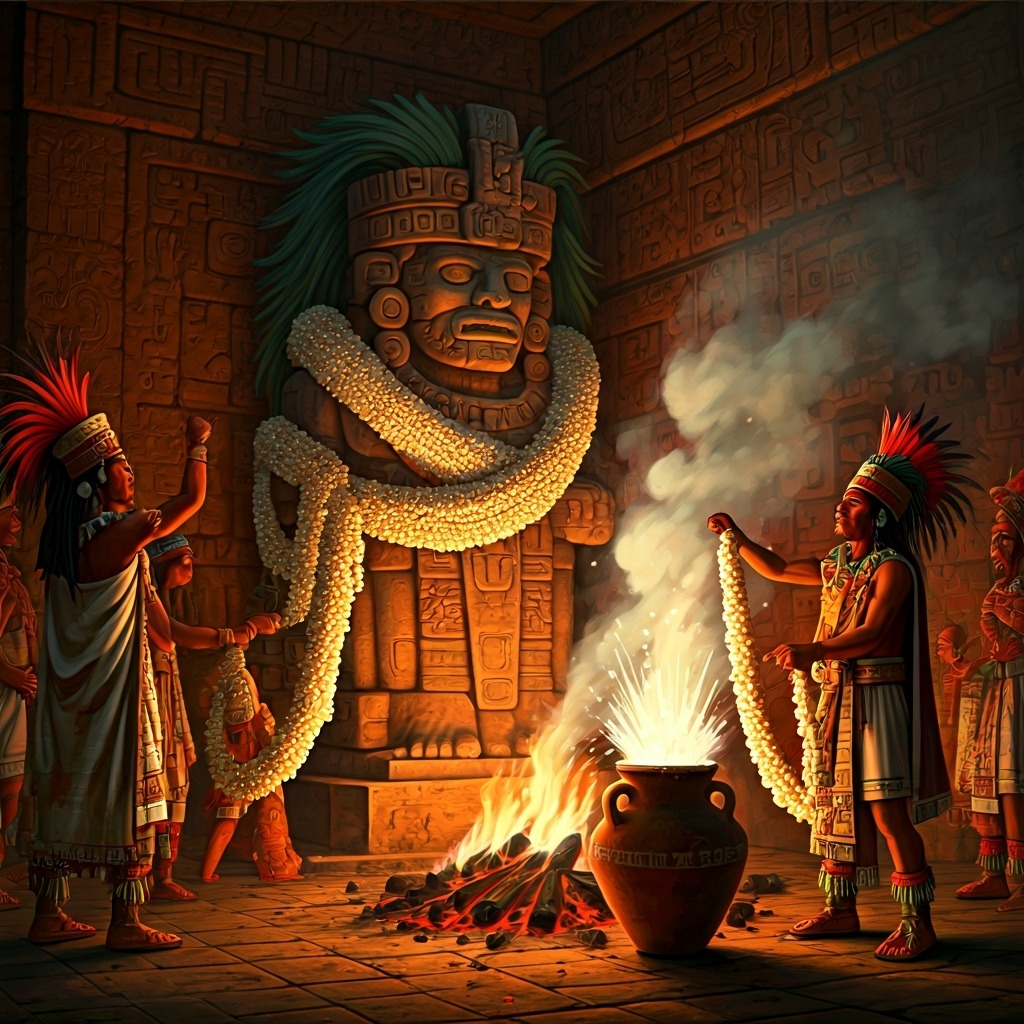
As centuries bled into millennia, popcorn became deeply woven into the spiritual and ceremonial fabric of Mesoamerica. For the Aztecs, popcorn—which they called momochitl—was imbued with divine significance.
When Spanish conquistadors arrived in the 16th century, they were entirely baffled by the sight of it. They documented the Aztecs using momochitl not just as sustenance, but as sacred adornment. The brilliant white bursts were used to decorate ceremonial headdresses, intricate necklaces, and imposing statues of their deities. Popcorn was heavily associated with Tlaloc, the fearsome god of rain and fertility, perhaps because the violent popping mirrored the crack of thunder and the life-giving burst of rain.
To achieve this pop without modern appliances, the Aztecs utilized brilliant culinary engineering. They tossed whole ears of corn directly onto white-hot coals, or cooked loose kernels in shallow clay vessels filled with scorching sand, waiting for the inevitable, violent eruption.
The Anatomy of a Micro-Explosion
What exactly makes Zea mays everta erupt with such sudden violence? The secret lies in a microscopic, high-stakes pressure cooker.
The science behind the pop relies on the unique anatomy of the kernel. Each one features a tough, water-impermeable hull (the pericarp) that encloses a dense, starchy vault (the endosperm). At the very center of this vault sits a tiny, crucial droplet of water.
When heated to roughly 356 degrees Fahrenheit, that microscopic water droplet vaporizes into steam. Because the hull is completely impermeable, the steam has nowhere to go. It creates immense, agonizing pressure inside the kernel. Finally, the hull can no longer contain the force and violently ruptures. In a fraction of a second, the highly pressurized, gelatinized starch expands outward and cools instantly, forming the familiar white, puffy foam.
From Ancient Altars to the Silver Screen
Popcorn’s transition from a sacred indigenous offering to a global phenomenon took a massive leap in 1885, when Charles Cretors invented the steam-powered popcorn popper. This machine allowed the snack to be efficiently mass-produced on street corners, capturing the imagination of the modern public and cementing its association with amusement parks and theaters.
However, it was the Great Depression that truly solidified popcorn’s modern legacy. While most treats became entirely unaffordable, popcorn remained incredibly cheap. It became one of the few affordable luxuries for struggling families, a small, buttery comfort during an era of immense hardship.
So, the next time you grab a handful of popcorn at the movies or pull a steaming bag from the microwave, take a moment to look at it. You aren’t just holding a snack. You’re holding a micro-explosion, a 6,700-year-old agricultural marvel, and a sacred offering to the gods of rain.