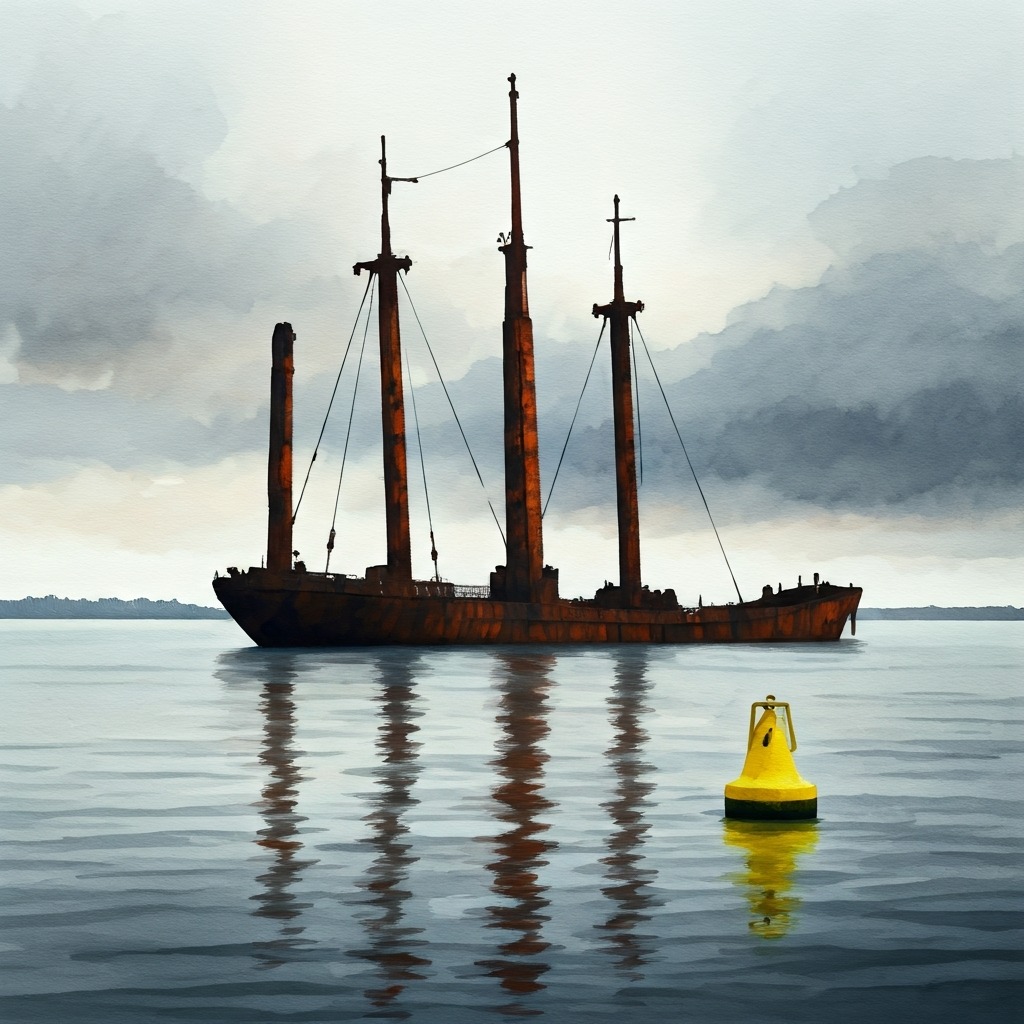
Just off the coast of the United Kingdom, where the murky waters of the Thames Estuary meet the North Sea, three rusted iron pillars pierce the surface. They look like skeletal fingers reaching from the deep, a stark and eerie monument to a disaster that hasn’t fully happened yet.
This is no ordinary maritime grave. It is an active, ticking time bomb. Beneath those gray waters lies a sunken behemoth packed with enough high explosives to trigger a localized tidal wave, shatter coastal towns, and cripple one of the world’s busiest shipping lanes.
The War Machine’s Behemoth
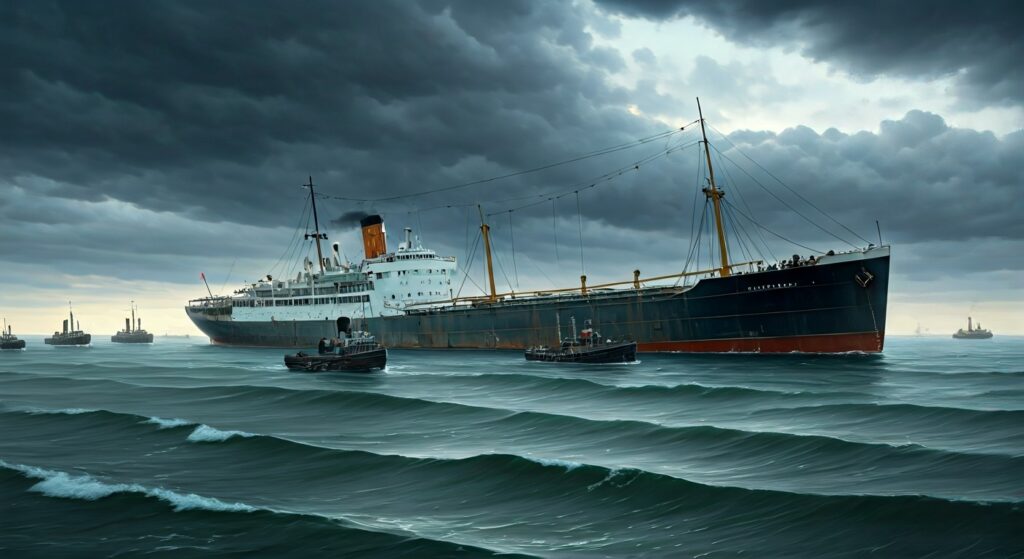
In August 1944, the Allied advance in France was a ravenous beast demanding a continuous diet of firepower. To keep the post-D-Day momentum alive, the military required a massive, uninterrupted supply of munitions. Enter the SS Richard Montgomery, an American Liberty ship built to fuel the war effort.
Loaded to the brim with approximately 7,000 tons of munitions, the vessel was sent across the Atlantic. Upon arriving in the Thames Estuary, the ship was directed to anchor near Sheerness, Kent. But the waters there are notoriously treacherous, plagued by shifting sandbanks and unpredictable, violent currents.
While waiting for further orders, the ship began dragging its anchor in the shallow waters. Before the crew could correct the drift, the heavy vessel ran hard aground on a submerged sandbank.
The Agony of Bending Steel
Running aground is a crisis for any captain, but for a ship carrying 7,000 tons of high explosives, it is an apocalyptic nightmare. As the tide receded, the water drained away, leaving the colossal vessel entirely unsupported. The sheer, crushing gravity of its lethal cargo began to bend the steel hull.
Salvage crews rushed to the scene, working frantically against the clock and the rising tides to offload the explosives. It was terrifying, painstaking work, with every creak of the ship threatening instant annihilation. They managed to extract about half of the payload before the inevitable happened.
With a sickening groan of tearing metal, the ship completely broke its back. The hull fractured, and the SS Richard Montgomery sank into the estuary, taking the rest of its deadly cargo with it.
1,400 Tons of Sleeping Thunder
Today, approximately 1,400 tons of high explosives remain entombed in the submerged forward holds of the wreck. These aren’t just bullets and artillery shells. The flooded cargo bays are packed with massive blockbuster bombs and thousands of cluster fragmentation devices.
The wreck presents a unique and terrifying disaster scenario. If those munitions were to detonate simultaneously, experts predict a massive explosion that could generate a localized tsunami. This wall of water and concussive force would cause catastrophic damage to the nearby coastal towns of Sheerness and Southend-on-Sea, shattering windows miles away. Adding to the nightmare is the ship’s proximity to a nearby liquefied natural gas (LNG) terminal—a variable that makes the potential for a chain reaction almost unthinkable.
The Deadliest 500 Meters on Earth
For decades, authorities have been locked in a paralyzing debate over how to handle the wreck. The UK government has largely maintained a strict policy of non-intervention. Their argument is chillingly simple: the explosives are relatively stable underwater, and attempting to move them carries a far greater risk of triggering a detonation than just leaving them alone.
The site is officially designated as a prohibited area under the Protection of Wrecks Act 1973. It is surrounded by a 500-meter exclusion zone, fiercely monitored 24/7 by radar and coastal authorities. If a rogue vessel even drifts toward the perimeter, it is immediately intercepted.
Nature’s Firing Pin
But leaving the ship alone doesn’t mean the danger is paused. Marine archaeologists and structural engineers have a much more pessimistic view: the wreck is rapidly decaying.
The saltwater environment is eating away at the ship’s hull. If the structural integrity fails and the ship collapses in on itself, the resulting shockwave of twisting steel could easily detonate the highly sensitive, decades-old fuses.
This terrifying realization prompted a major shift in strategy in the 2020s. Surveys indicated that the protruding masts—those skeletal fingers above the water—were severely degrading. If a heavy storm caused the iron masts to snap and crash down into the cargo holds below, it could act as the exact trigger everyone fears. To mitigate this, the UK Department for Transport initiated incredibly delicate plans to dismantle and remove the ship’s masts.
Today, the SS Richard Montgomery remains a haunting standoff between the perils of proactive salvage and the unstoppable decay of a submerged wartime relic. It sits rusting in the dark, a sleeping giant waiting to see which force of nature will blink first.