In the sweltering August of 1951, the postcard-perfect French village of Pont-Saint-Esprit became the epicenter of a waking nightmare. It didn’t start with a bomb, a chemical spill, or an invading army. It began with the most innocent and essential staple of human survival.
Within hours, this quiet hamlet was plunged into a psychological horror film, birthing a medical mystery that still haunts toxicologists and historians today.
A Quiet Town Descends into Madness
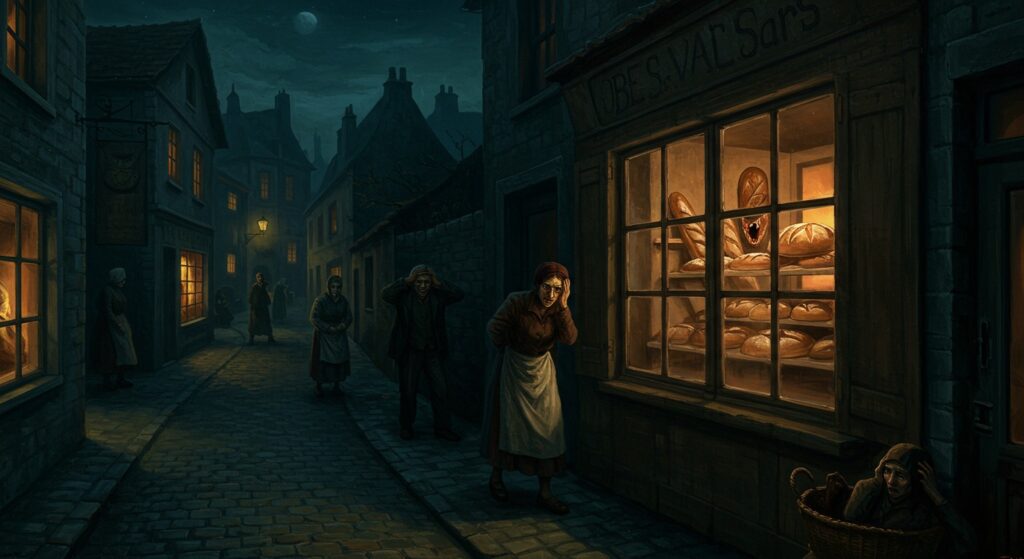
At first, the complaints were isolated. A few villagers reported severe abdominal pain, violent vomiting, and a horrifying burning sensation in their limbs. Local doctors might have easily written it off as a severe bout of food poisoning—until the physical agony gave way to intense, waking nightmares.
Seemingly overnight, the townspeople were swallowed by delirium. They reported terrifying beasts stalking the cobblestone streets. They screamed that their bodies were engulfed in invisible fire, or that monstrous creatures were tearing at their flesh. In one of the most tragic instances of the outbreak, a man threw himself from a second-story window, genuinely believing he was an airplane. Others had to be physically restrained to prevent them from mutilating themselves or their own families.
Le Pain Maudit
By the time the immediate nightmare subsided, the toll was devastating. Seven people were dead, roughly fifty residents had been committed to psychiatric asylums, and hundreds more were left suffering from the physical and mental fallout.
When a disaster of this magnitude strikes, investigators must trace the spark. For the medical detectives in Pont-Saint-Esprit, the culprit wasn’t a mysterious virus or a contaminated water supply. It was the town’s bread.
Specifically, the crisis was traced back to a local bakery owned by a man named Roch Briand. The terrified locals quickly gave the phenomenon a name that would echo through history: Le Pain Maudit—The Cursed Bread.
The Demon in the Grain
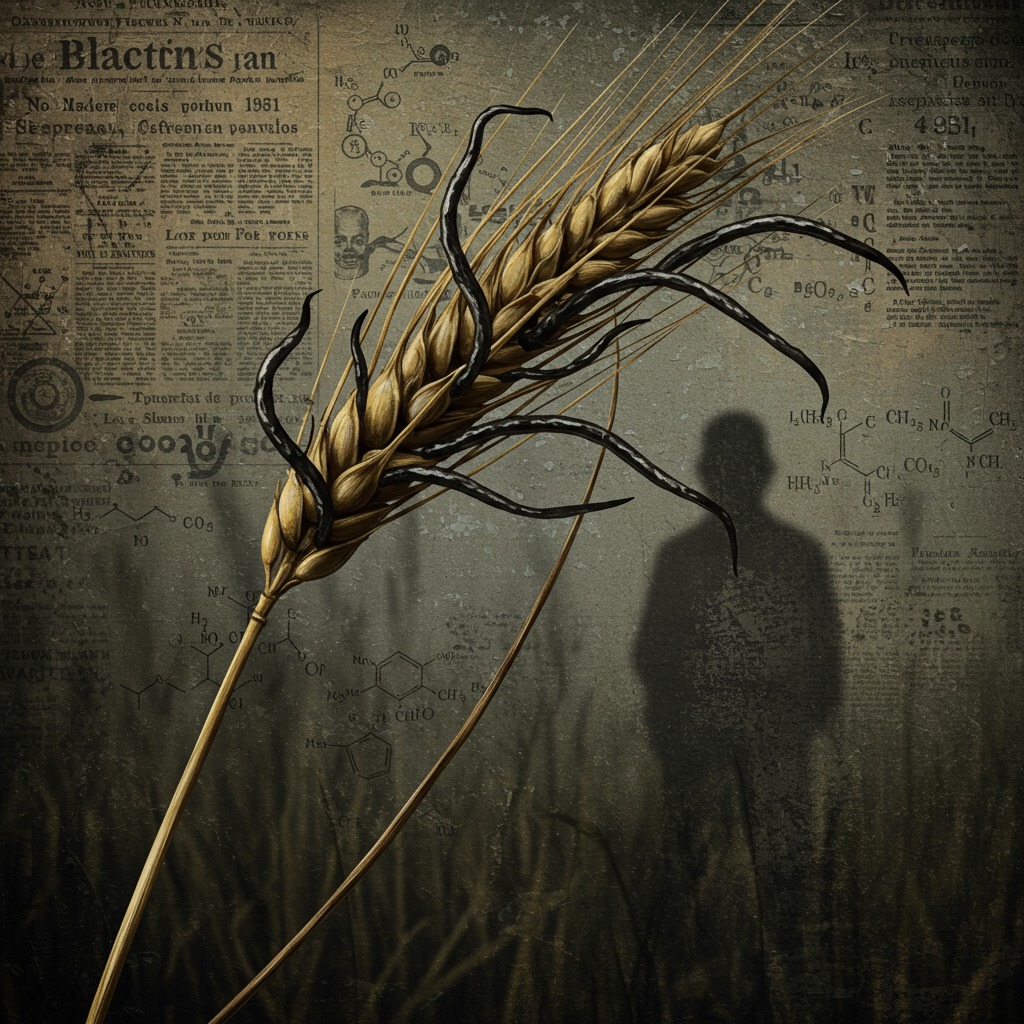
For decades, the accepted scientific consensus pointed to a medieval-sounding affliction known as ergotism, historically referred to as “St. Anthony’s Fire.”
Ergot is a naturally occurring fungus that thrives on rye during unusually damp agricultural seasons. It produces a cocktail of toxic alkaloids, including a compound called ergotamine—a chemical precursor to LSD.
Ergotism perfectly explained the dual nature of the Pont-Saint-Esprit outbreak. It accounted for the severe psychoactive effects—the beasts, the invisible fire, the flying men—while also explaining the physical devastation. Ergot poisoning causes severe vascular constriction, leading to the agonizing burning sensations in the limbs and, eventually, gangrene.
While ergotism was the leading theory, some toxicologists proposed alternative culprits, suggesting the flour might have been contaminated by nitrogen trichloride (a bleaching agent) or mercury-based fungicides. Yet, for over half a century, the consensus remained: this was a tragic, natural agricultural disaster exacerbated by post-war supply chain issues.
The MKULTRA Plot Twist
Just when history thought it had closed the book on Le Pain Maudit, a massive plot twist emerged in 2009.
Investigative journalist H.P. Albarelli Jr. published a bombshell book claiming the outbreak wasn’t a natural disaster at all. Instead, he alleged it was a covert field experiment conducted by the CIA and the U.S. Army’s Special Operations Division.
According to Albarelli, the CIA was deep into the early, unregulated days of its infamous MKULTRA mind-control research. He claimed the agency deliberately dosed the town to observe the effects of mass hysteria, either by secretly spiking the local food supply with LSD or by spraying the hallucinogen over the village from the air. Albarelli even cited declassified documents that supposedly referenced the Pont-Saint-Esprit incident alongside discussions of LSD experimentation.
Suddenly, a fungal infection had transformed into a Cold War espionage thriller.
The Terrifying Truth
It is a seductive theory. We want to believe that a tragedy of this magnitude requires a shadowy villain in a suit, pulling strings from a smoke-filled room. But the cold, hard data tells a different story.
Mainstream historians, scientists, and French authorities have largely rejected the MKULTRA hypothesis. The reason is rooted in basic biology: pure LSD simply does not cause the severe physical symptoms observed in Pont-Saint-Esprit. Acid might make a man believe he can fly, but it doesn’t cause severe digestive hemorrhaging, agonizing vascular constriction, or the physical fatalities that struck the village.
The prevailing scientific consensus remains firmly rooted in the biology of the ergot fungus or toxic agricultural chemicals.
In a way, that reality is far more chilling. The natural world is perfectly capable of producing its own nightmares. Sometimes, a damp harvest and a bad batch of flour are all it takes to plunge an entire town into madness.