When the citizens of Prague wanted to send a political message, they didn’t write a manifesto. They didn’t stage a peaceful protest. They opened a window.
History is full of assassinations, coups, and rebellions, but only one city was so committed to a highly specific, gravity-assisted method of regime change that an entirely new word had to be invented to describe it: defenestration. Derived from the Latin de (out of) and fenestra (window), it is the formal act of chucking someone out of a building.
But in the Bohemian capital, this wasn’t just a random act of mob violence. It was a formalized, recurring political statement. And the most terrifying part? These airborne evictions directly ignited two of the bloodiest, most devastating conflicts in European history.
The Deadly Pavement of 1419
The precedent for this bizarre brand of political turnover was set on July 30, 1419. Tensions in Prague were a powder keg. Radical Hussite reformers were furious with the Catholic city council, who had stubbornly refused to release their imprisoned brethren. A mob marched on the New Town Hall, demanding justice.
According to legend, the spark that ignited the keg was a single stone, hurled from a town hall window, striking the Hussite leader below.
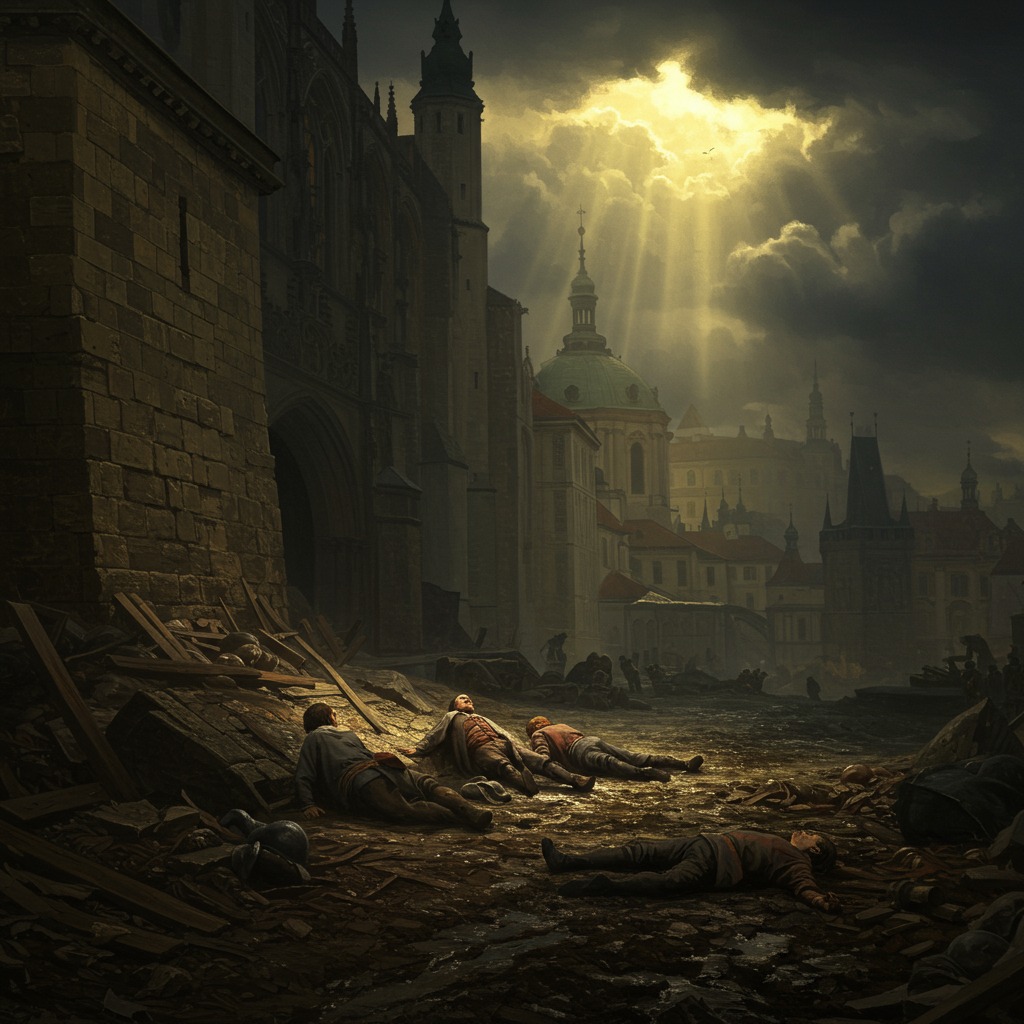
The retaliation was swift and merciless. The enraged mob stormed the building, but they didn’t just arrest the judge, the burgomaster, and the council members. They dragged them to the window and shoved them out. Waiting below wasn’t a soft landing, but a furious crowd armed with bristling pikes. This violent, literal overthrow sparked the Hussite Wars, a brutal conflict that would drown Central Europe in blood for nearly two decades.
Prague had established a terrifying new tradition. But it was a sequel, over a century later, that would cement defenestration into global infamy.
The 70-Foot Plunge That Broke Europe
Fast forward to 1618. Protestant Bohemian nobles were livid. The Catholic Habsburg Emperor Ferdinand II had just revoked their hard-won religious freedoms. Feeling utterly betrayed, a group of armed Protestant nobles stormed Prague Castle to confront two Catholic regents, Vilem Slavata and Jaroslav Borzita, along with their secretary.
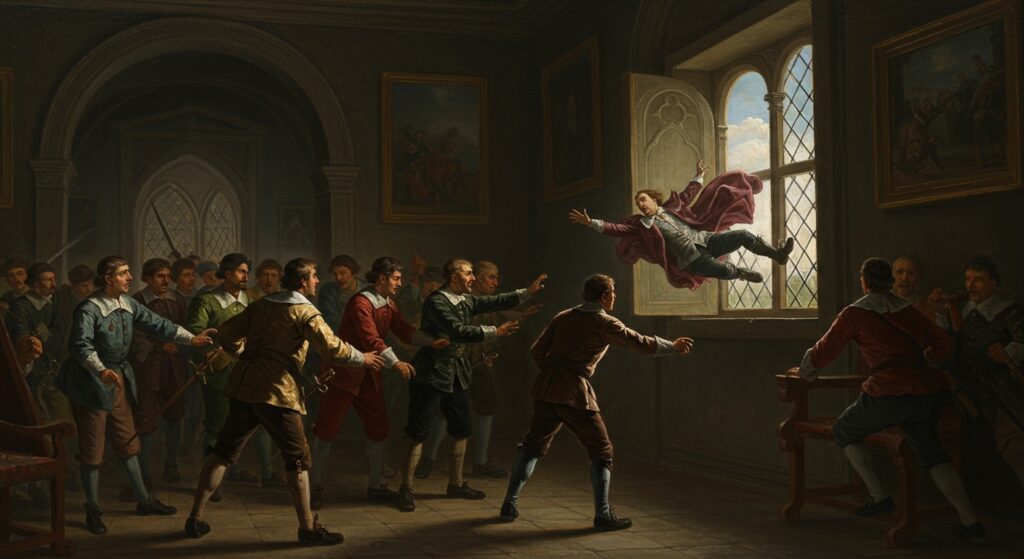
Inside the Bohemian Chancellery, the nobles subjected the three men to a tense, terrifying mock trial. The verdict was guilty. The sentence was tradition.
The screaming men were dragged to the third-floor window. This wasn’t a first-story tumble into a garden hedge. This was a sheer, dizzying drop of roughly 70 feet. One by one, the men were shoved out into the open air, plummeting toward the unforgiving earth below.
Angels, Manure, and a Masterclass in Propaganda
Here is where a grim political execution pivots into one of history’s most absurd mysteries.
They survived.
All three men plunged 70 feet from the Chancellery window, hit the ground, and lived to tell the tale. The immediate aftermath birthed one of the most vicious—and hilarious—propaganda wars in European history.
Catholic presses immediately claimed a divine miracle, insisting that the Virgin Mary and a host of angels had swooped down from the heavens to gently catch the men and lower them to safety. The Protestants, refusing to let their enemies claim divine intervention, fired back with their own narrative: the men only survived because they had the embarrassing misfortune of landing in a massive, cushioning pile of horse manure.
Modern historians attribute their survival to a combination of steeply sloped castle walls that broke their fall and the thick, voluminous cloaks they wore. But whether saved by angels, aerodynamics, or animal waste, the survival of these three men couldn’t stop the impending doom. This bizarre, failed execution was the direct catalyst for the Thirty Years’ War—a catastrophic, continent-spanning bloodbath that redrew the map of Europe and left millions dead.
A Dark Modern Echo
You’d think after starting two massive wars, the Czechs would learn to lock their windows. But this deeply ingrained cultural quirk carries a dark, modern postscript.
In 1948, following a communist coup, the democratic foreign minister Jan Masaryk was found dead in the courtyard beneath his bathroom window. Today, his tragic, highly suspicious death is grimly referred to as the Fourth Defenestration of Prague.
It is a chilling reminder of how history echoes itself. What started as a chaotic, violent riot in 1419 evolved into an internationally recognized—and uniquely Bohemian—declaration of war. It proves that our ancestors were just as dramatic as we are, only with much higher stakes and a terrifyingly literal approach to throwing their problems out the window.