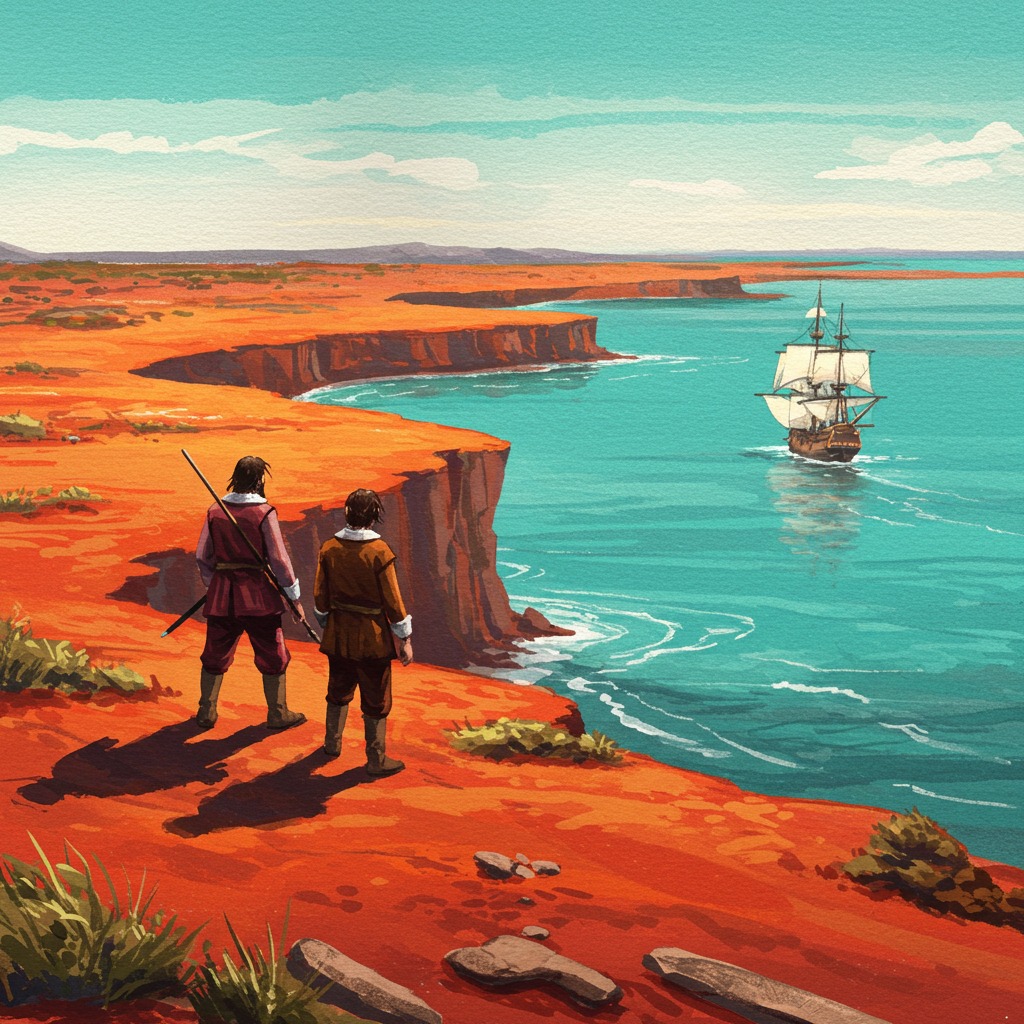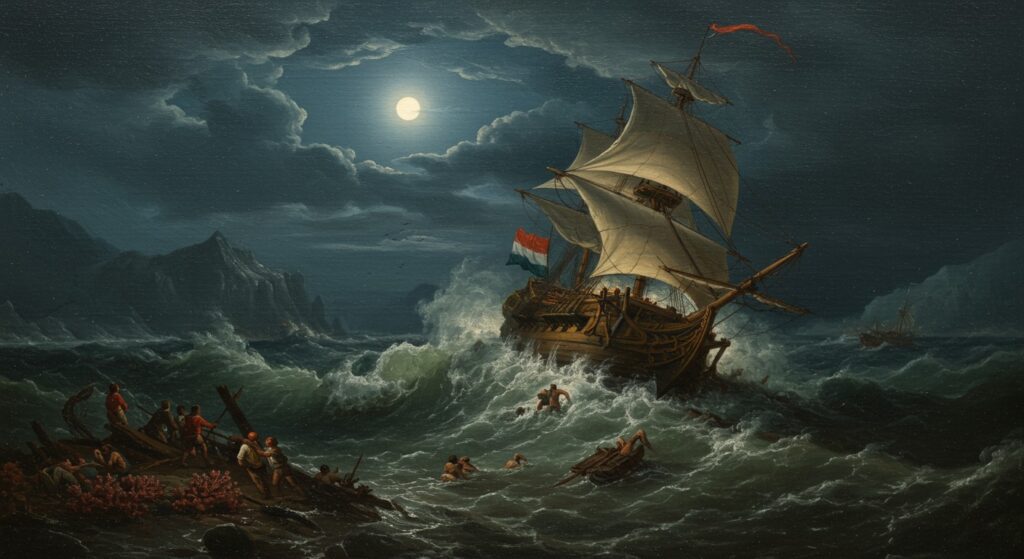
The turquoise waters off the western coast of Australia hide a multitude of secrets, but none as blood-soaked or psychologically terrifying as what unfolded on a desolate chain of coral islands in the winter of 1629.
The sinking of the Batavia is often remembered as a tragic tale of a ship lost to the whims of the sea. But the destruction of the vessel was merely the prologue to a nightmare. What followed was a masterclass in manipulation, mutiny, and mass murder that proves the most dangerous monsters aren’t found in the ocean’s depths—they are the people standing right beside you.
A Fortune and a Fatal Grudge
In October 1628, the Batavia set sail on her maiden voyage from the Netherlands, bound for the Dutch East Indies. As the flagship of the Dutch East India Company, she was a floating fortress, carrying roughly 340 sailors, soldiers, and civilian passengers, along with a staggering fortune in silver coins.
Commanding the expedition was Upper Merchant Francisco Pelsaert, a man whose authority was constantly undermined by the ship’s navigator, Skipper Ariaen Jacobsz. The two men despised one another. As the voyage dragged on, Jacobsz’s resentment festered into a full-blown conspiracy. He found a willing accomplice in the ship’s Under Merchant, a bankrupt apothecary named Jeronimus Cornelisz.
Cornelisz was charismatic, cunning, and fiercely dangerous. He was a follower of a heretical sect, believing that because he was predestined for salvation, he was entirely free from moral law. In his twisted mind, he was literally incapable of committing a sin. Together, Jacobsz and Cornelisz whispered in the dark corners of the ship, plotting to incite a mutiny, murder the command, and steal the silver to start a new life of piracy.
But before they could spring their trap, the ocean intervened.
The Midnight Crack of Timber
On June 4, 1629, the Batavia violently crashed into Morning Reef in the Houtman Abrolhos. The impact was catastrophic. Around 40 people drowned in the chaotic black waters, while nearly 300 desperate survivors managed to drag themselves onto a smattering of tiny, barren coral islands.
There was no fresh water. There was no food. Death by dehydration seemed imminent.
Realizing the direness of their situation, Pelsaert, Jacobsz, and a few dozen others made a controversial and desperate decision. They boarded a longboat to search the nearby mainland for water. Finding none, they aimed the small open boat toward the city of Batavia—a miraculous, grueling 33-day journey across the open ocean to seek rescue.
They left behind nearly 250 terrified survivors. And they left them under the de facto leadership of Jeronimus Cornelisz.
The Apothecary’s Reign of Terror
With Pelsaert gone, Cornelisz saw his opportunity. He knew a rescue ship would eventually return, and he planned to hijack it, eliminate anyone who wouldn’t swear absolute loyalty, and finally establish his pirate kingdom.
To make his plan work, he needed to drastically reduce the island’s population and eliminate any capable threats. He began by confiscating all weapons and makeshift rafts. Then, under the guise of searching for water, he sent a group of loyal, well-trained soldiers led by an officer named Wiebbe Hayes to a distant island. Cornelisz expected them to die of thirst under the baking Australian sun.
With the soldiers out of the way, the apothecary unleashed hell.
Over the next two months, Cornelisz and his inner circle of mutineers murdered an estimated 115 to 125 men, women, and children. The brutality was systematic and cold. Victims were taken out on boats and shoved overboard to drown, strangled in their sleep, or hacked to death on the coral beaches.
Cornelisz rarely bloodied his own hands. Instead, he used masterful psychological manipulation, forcing his followers to commit the atrocities. By making them kill, he bound them to him through shared, inescapable guilt. A few women were deliberately kept alive to serve as captives for the mutineers, including Lucretia Jans, a prominent and wealthy passenger whom Cornelisz claimed exclusively for himself.
A Fortress of Coral and Bone
Cornelisz’s perfect nightmare had only one flaw: Wiebbe Hayes.
Against all impossible odds, Hayes and his exiled soldiers did not die. They discovered a source of fresh water and survived by hunting tammar wallabies. Their isolated peace was shattered when a few desperate survivors, clinging to driftwood, washed ashore and gasped out the horrors unfolding on the other islands.
Hayes immediately sprang into action. Knowing Cornelisz would eventually come for them, the soldiers fashioned crude weapons from ship debris and timber with iron spikes. They built a small, rudimentary fort out of limestone and coral—a structure that still stands today and is widely considered the first European structure ever built on Australian soil.
When Cornelisz realized Hayes was alive, well-fed, and heavily fortified, he panicked. He launched a series of violent amphibious assaults against the soldiers. Despite being heavily outnumbered and lacking muskets, Hayes and his men formed a disciplined defensive line and repelled the mutineers time and time again.
During one desperate attempt to negotiate a false truce, Hayes outsmarted the psychopath. He and his men ambushed the parley and captured Jeronimus Cornelisz alive.
The Race for Salvation
The climax of this horrific saga arrived on September 17, 1629. The remaining mutineers, desperate to free their leader, launched one final, massive assault on Hayes’s fort.
As the battle raged on the shoreline, a set of white sails pierced the horizon. It was the Sardam—the rescue ship commanded by Francisco Pelsaert.
What followed was a frantic, high-stakes race across the water. Both Hayes’s men and the mutineers leaped into rowboats, rowing furiously toward the Sardam. If the mutineers reached the ship first, they would board her, kill Pelsaert, and sail away with the silver.
Hayes’s boat cut through the surf and reached the Sardam just moments before the mutineers. He screamed a warning to Pelsaert, detailing the massacres and the impending hijacking. When the mutineers’ boat finally pulled alongside, they found themselves staring directly down the barrels of the Sardam’s primed cannons. They surrendered immediately.
Justice at the Edge of the World
Pelsaert wasted no time. He convened a makeshift tribunal right there on the blood-stained islands. The confessions he extracted, detailed meticulously in his journals, painted a picture of human depravity so severe it shocked the Dutch East India Company back in the Netherlands.
Justice was swift and brutal. Cornelisz and his worst accomplices had their hands severed before being hanged on makeshift gallows.
Curiously, two minor mutineers—Wouter Loos and Jan Pelgrom de Bye—were spared the noose. Instead, Pelsaert marooned them on the Australian mainland. They became the first recorded European residents of the continent, swallowed by the vast, unknown landscape. Their ultimate fate remains one of history’s great unsolved mysteries.
For centuries, the exact location of the massacre was lost to time. It wasn’t until the wreck was rediscovered in 1963 that archaeologists began unearthing the chilling physical evidence of Pelsaert’s journals. The timbers of the Batavia, the remnants of Hayes’s coral fort, and the shallow mass graves of the victims were all brought to the surface—silent, enduring witnesses to a voyage that sailed straight into the heart of darkness.