Standing on the serene shores of China’s largest freshwater lake today, skipping stones across the glassy water, it is almost impossible to imagine the sheer apocalyptic scale of what happened here. Today, Lake Poyang is a quiet expanse. But centuries ago, this very water boiled with the blood of nearly a million men, the deafening roar of primitive cannons, and a towering inferno that changed the course of human history forever.
This is the story of a clash so massive it defies belief.
The Dragon Throne Awaits
The year was 1363. The Mongol-led Yuan Dynasty was crumbling, its iron grip on China dissolving into chaos, famine, and warlordism. Out of this brutal power vacuum rose the Red Turban Rebellion, a fractured movement of desperate insurgents vying for ultimate control.
From the pack of ruthless warlords, two apex predators emerged. They were on a collision course.
On one side stood Chen Youliang, the ambitious and ruthless commander of the Han faction. On the other was Zhu Yuanzhang, a brilliant, cunning tactician leading the Ming faction. Their rivalry had reached a boiling point, and the ultimate showdown would not take place on a sprawling grassy plain, but on the shimmering waters of Lake Poyang. Between August 30 and October 4, 1363, these two commanders would orchestrate one of the largest naval battles in human history.
Leviathans of Iron
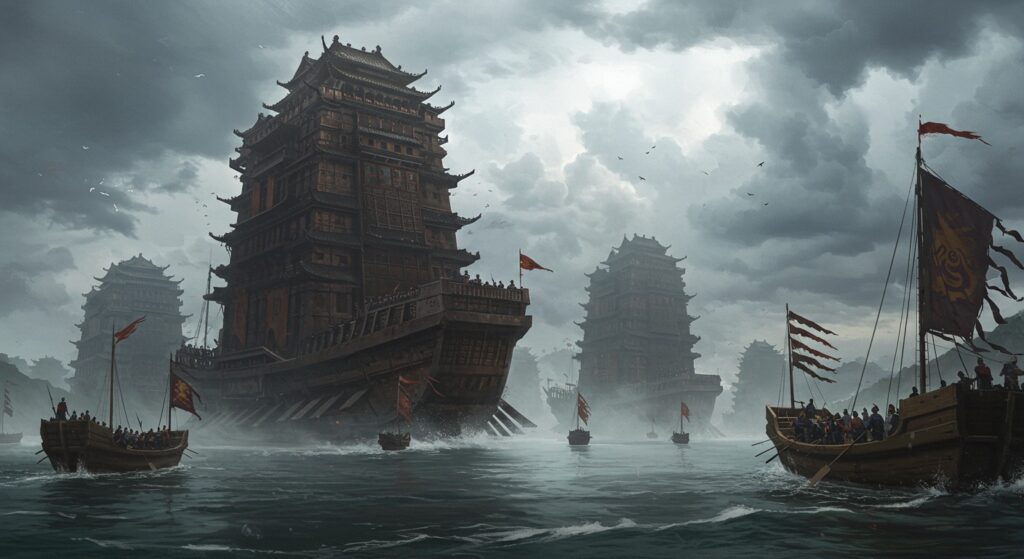
To understand the sheer terror of this engagement, you have to picture Chen Youliang’s armada. Chen did not just bring ships to Lake Poyang; he brought floating castles.
Known as louchuan, these colossal, multi-story tower ships were lined with thick iron plates. They loomed several stories over the water, casting long, dark shadows across the lake. From these elevated platforms, Chen’s soldiers could rain down a relentless storm of arrows, rocks, and early gunpowder weapons on anyone foolish enough to approach. And he had the numbers to back up his terrifying fleet: a staggering 600,000 men. It was an armada so vast it seemed to swallow the horizon.
Zhu Yuanzhang, rushing to relieve a besieged city, brought a drastically smaller force of roughly 200,000 men. Outnumbered three-to-one, Zhu was staring into the jaws of a behemoth. But what he lacked in sheer size, he made up for in agility. His fleet consisted of smaller, highly maneuverable vessels.
When Zhu’s nimble ships intercepted Chen’s iron-clad leviathans, the trap was sprung.
The Fatal Chain
The initial engagements were an absolute bloodbath. The lake echoed with the deafening cracks of primitive firearms, the air growing thick with the acrid smoke of fire lances, cannons, and explosive bombs.
At first, Chen’s towering fortresses dominated. Zhu’s smaller ships were dwarfed and pulverized by the heavy artillery raining down from the iron-plated heights above. But as the skirmishes dragged on, a fatal flaw in Chen’s grand design began to reveal itself.
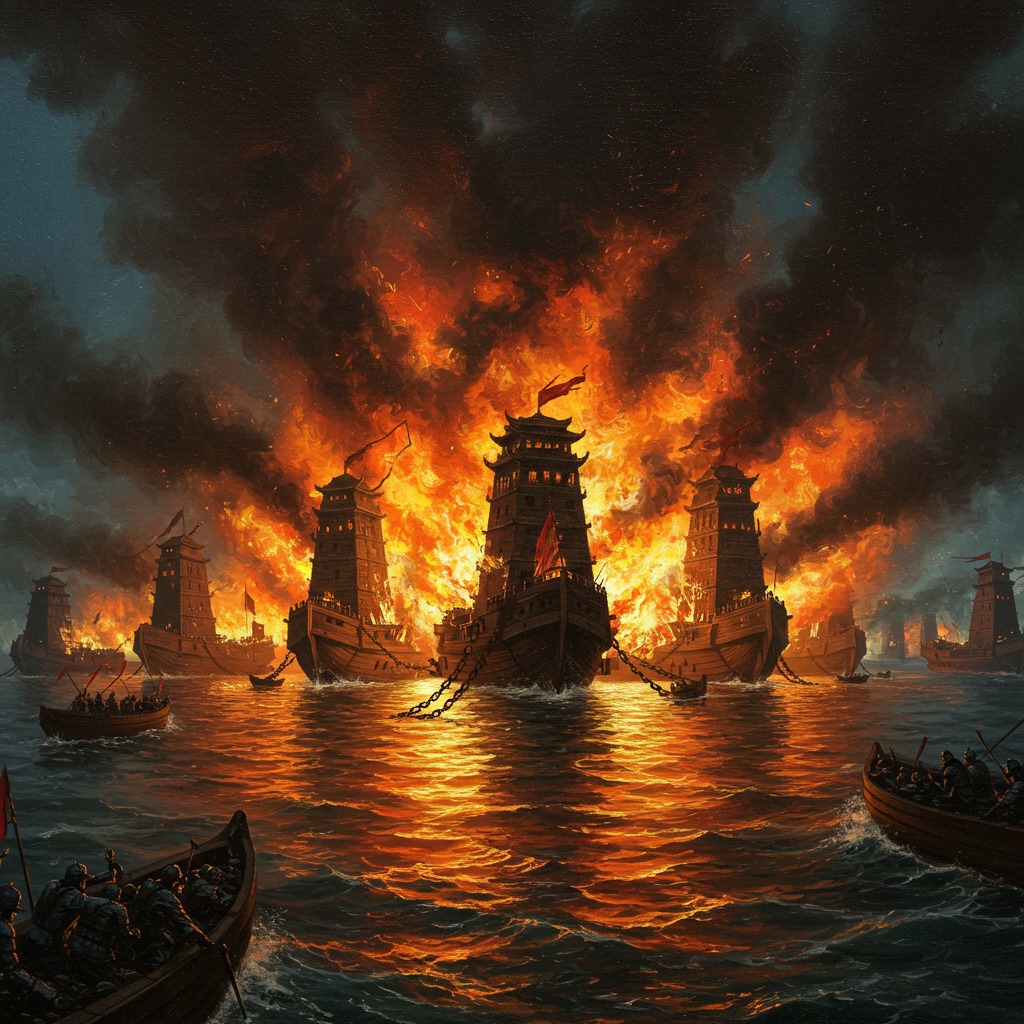
The louchuan were magnificent, but they were incredibly sluggish. In the shallow, treacherous waters of Lake Poyang, they maneuvered with the grace of wounded elephants. To stabilize these massive, top-heavy structures and prevent them from tipping in the chaos of battle, Chen made a fateful decision: he ordered his ships to be chained together.
It was a brilliant defensive move. Until the wind changed.
A Whisper of Wind, A Roar of Flame
For weeks, Zhu Yuanzhang waited. He absorbed heavy losses, watched the skies, and studied the waters. Then, the moment he had been praying for arrived. A favorable wind began to howl across the lake, blowing directly toward the densely packed, chained-together Han fleet.
Zhu unleashed his masterstroke. He deployed a vanguard of small, unassuming boats. But these were no ordinary vessels—they were floating bombs, packed to the brim with dry reeds, straw, and gunpowder.
Zhu’s men set the boats ablaze and directed them into the heart of Chen’s armada.
Driven by the fierce wind, the fire ships slammed into the iron-clad behemoths. Because Chen had chained his ships together, there was no escape. The flames leaped from hull to hull, climbing the wooden superstructures of the louchuan. The lake turned into a blinding, roaring inferno. Trapped in their floating fortresses, Chen’s men suffered catastrophic casualties as the fire consumed the pride of the Han fleet.
The Arrow That Changed the World
The horrific fire broke the back of Chen’s armada, but the warlord refused to yield. For weeks, the remnants of his fleet endured a grueling, suffocating blockade by Zhu’s highly mobile forces. Starving, desperate, and out of options, Chen Youliang orchestrated a final, frantic breakout attempt on October 4.
Standing on the deck of his flagship, trying to spot a weakness in Zhu’s tightening net, Chen peered out over the chaotic waters.
In a flash of cruel, sudden finality, a stray arrow pierced the smoke and struck Chen directly in the head. He was killed instantly.
With their seemingly invincible leader dead, the remaining Han forces lost their will to fight. The fleet collapsed, and the survivors surrendered to Zhu Yuanzhang.
The waters of Lake Poyang eventually cooled, but the ripples of Zhu’s victory washed over the entire world. By eliminating his most formidable rival, Zhu gained uncontested control over the vital Yangtze River valley. Armed with this immense power, he marched north, expelled the remaining Mongols from China, and ascended the throne as the Hongwu Emperor—officially establishing the legendary Ming Dynasty.
The Battle of Lake Poyang was more than just a clash of warlords. It was a terrifying preview of modern warfare, showcasing the devastating potential of early gunpowder. And it all came down to a single shift in the wind, a spark of fire, and an arrow in the dark.