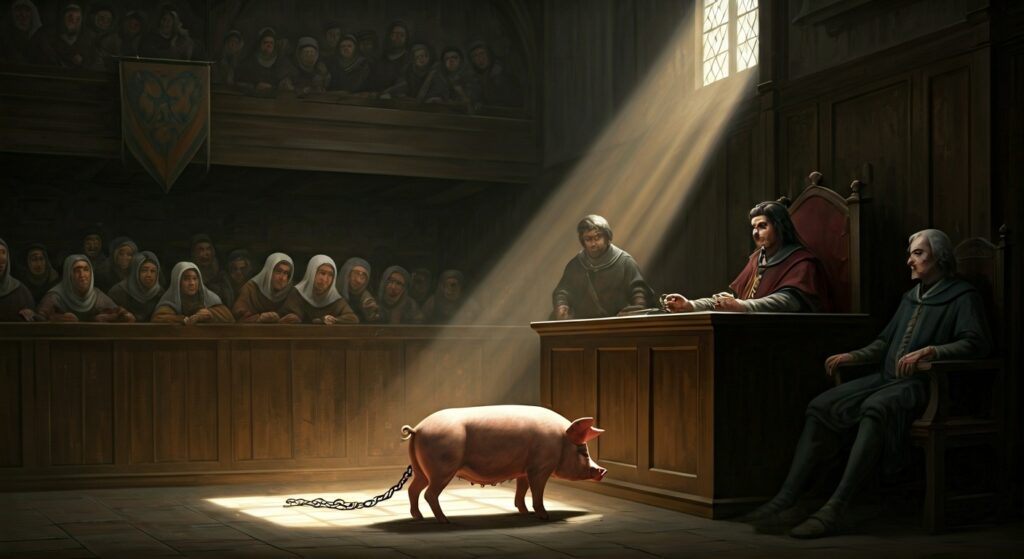
The year is 1386. Inside a dimly lit French courtroom, the air is thick with tension. The judge sits high on his bench, his face stern and unyielding. The defense attorney nervously shuffles his parchment, sweating under the weight of the impending verdict. The gallery is hushed, the townsfolk waiting with bated breath to catch a glimpse of the accused murderer.
The heavy oak doors groan open. The bailiff steps forward, dragging the prisoner by a heavy iron chain. The crowd gasps.
The defendant is a pig.
The Defendant Wore Human Clothes
Between the 13th and 18th centuries, Europe was consumed by a legal phenomenon that defies modern logic: the animal trial. This was no pitchfork-wielding mob justice. These were highly formalized, meticulously documented legal proceedings. Animals were granted defense attorneys, witnesses were sworn in, and verdicts were delivered with chilling sincerity.
Secular courts handled domestic animals accused of violent crimes against humans. Pigs, acting as medieval Europe’s roaming garbage disposals, were the most frequent offenders. When a wandering pig committed the unthinkable—such as attacking an unattended infant—the law demanded blood.
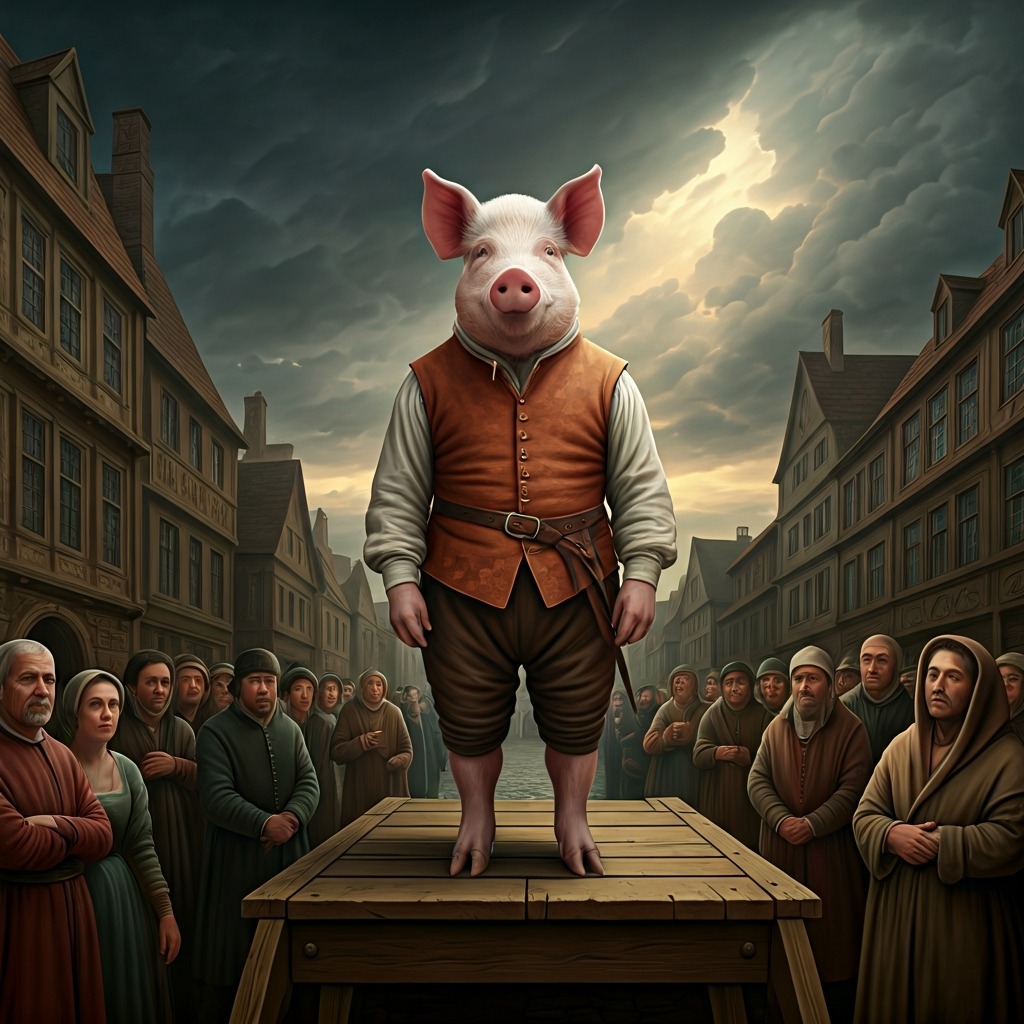
The most infamous case unfolded in Falaise, France. After a pig was convicted of murdering a child, the court sought to subject the beast to the full, crushing weight of human justice. The animal was thrown into a human jail cell, dressed in a custom-made waistcoat and breeches, and publicly executed in the town square.
Excommunicating the Unseen Enemy
While secular courts dealt with individual murderers, the ecclesiastical (Church) courts faced a far more elusive threat: the swarm.
How does a village prosecute a plague of locusts, a horde of rats, or a swarm of weevils decimating the winter food supply? You cannot slap iron shackles on a weevil.
Because these creatures could not be physically captured, the Church intervened. Ecclesiastical judges would formally summon the pests to appear in court. When the insects inevitably failed to show, the trial proceeded in absentia. If found guilty, the pests faced the ultimate spiritual devastation: excommunication. With solemn chants and burning incense, the Church would literally banish the bugs from the grace of God.
The Lawyer Who Outsmarted Cats
If an animal was to stand trial, it required legal counsel. Enter Bartholomew Chassenée, a 16th-century French jurist who built his formidable reputation by defending the rats of Autun.
When his furry clients failed to appear for their first hearing, Chassenée did not flinch. He stood before the judge and argued that the summons had not been distributed widely enough. How could the rats appear if they were unaware they were being sued?
The judge agreed, ordering the summons to be read from the pulpits of every parish in the region.
When the rats missed their second court date, Chassenée delivered a masterclass in legal maneuvering. He argued his clients were eager to comply, but the journey to the courthouse was fraught with peril. The village cats, he claimed, were lying in wait as assassins. The court could not guarantee the defendants’ safety, so the trial had to be delayed. Chassenée won the day, cementing his legacy as a brilliant legal mind.
The Method to the Madness
It is tempting to look back at these trials and laugh, dismissing them as pure medieval superstition. For decades, historians did exactly that. But beneath the bizarre court transcripts lies a much darker, more profound truth. These trials were not born of ignorance; they were born of trauma.
Medieval life was brutally unpredictable. Disease, famine, and sudden violence were constant, lurking shadows. When a family lost a child to a wandering farm animal, or a village lost its winter harvest to a swarm of locusts, the sheer senselessness of the tragedy was too much to bear.
By arresting the pig, hiring a lawyer, and holding a trial, medieval society was desperately attempting to impose order on a chaotic, cruel natural world. It was a coping mechanism. Framing a senseless tragedy within the rigid, familiar structure of human justice made a terrifying world feel manageable. It reinforced a deeply held theological worldview—echoing the biblical mandate of Exodus 21:28, which dictated that a goring ox must be stoned.
These trials were not a glitch in the medieval legal system; they were a feature. They were humanity’s way of screaming into the void that all of creation—even the rats, the weevils, and the pigs—was subject to a divine and moral order.