The roaring waters of the Nile River sounded like a death sentence. Standing on the sun-baked banks at Aswan, the 11th-century Arab polymath Ibn al-Haytham stared at the rushing currents and realized he had made a colossal, career-ending mistake. Worse, it was a mistake that was about to cost him his head.
To survive the wrath of one of history’s most unpredictable and bloodthirsty rulers, this brilliant engineer would have to pull off the ultimate performance. He had to fake a total mental breakdown.
It is a story of towering hubris, mortal peril, and a mysterious disappearance. But above all, it is the story of a desperate survival tactic that inadvertently changed the way humanity sees the world.
A Boast That Invited Death
Our story begins with a man who was, frankly, a little too smart for his own good. Born in Basra around 965 CE, Ibn al-Haytham (known in the West as Alhazen) was a brilliant polymath, mathematician, and engineer.
Confident in his own unrivaled genius, Ibn al-Haytham made a loud, public boast: he claimed he could engineer a mechanical system to regulate the unpredictable, annual flooding of the mighty Nile River.
Word of this bold claim traveled fast, eventually reaching the ears of Al-Hakim bi-Amr Allah, the Fatimid Caliph of Egypt. Al-Hakim was a powerful ruler, but he was also notoriously ruthless and erratic—so much so that later historians dubbed him the “Mad Caliph.” Intrigued by the engineer’s promise, Al-Hakim summoned Ibn al-Haytham to Cairo and bankrolled a massive expedition to Aswan to get the damming project underway.
The Terrifying Epiphany at Aswan
One can only imagine the cold dread that washed over Ibn al-Haytham when he finally stood before the Nile.
Looking at the sheer, roaring scale of the river, and then looking up at the monumental ruins left behind by the ancient Egyptians, the awful truth hit him. If the brilliant architects of antiquity hadn’t attempted to dam this river, his own plan was technologically impossible with the tools of the 11th century.
He was thousands of miles from home, spending the money of a volatile dictator who had a nasty habit of executing people who disappointed him. Ibn al-Haytham was trapped. He couldn’t build the dam, and he certainly couldn’t return to Cairo and simply apologize to Al-Hakim.
A Desperate Descent into the Shadows
To save his own neck, Ibn al-Haytham made a desperate, highly calculated decision. He began to act erratically. He raved. He stopped making sense. He feigned absolute, incurable madness.
It was a brilliant legal loophole. Under Islamic jurisprudence at the time, the mentally ill were protected from execution. Believing his star engineer had completely lost his mind, Al-Hakim spared his life. Instead of sending him to the executioner’s block, the Caliph confiscated the scholar’s vast wealth and placed him under strict house arrest in Cairo. The year was roughly 1011 CE.
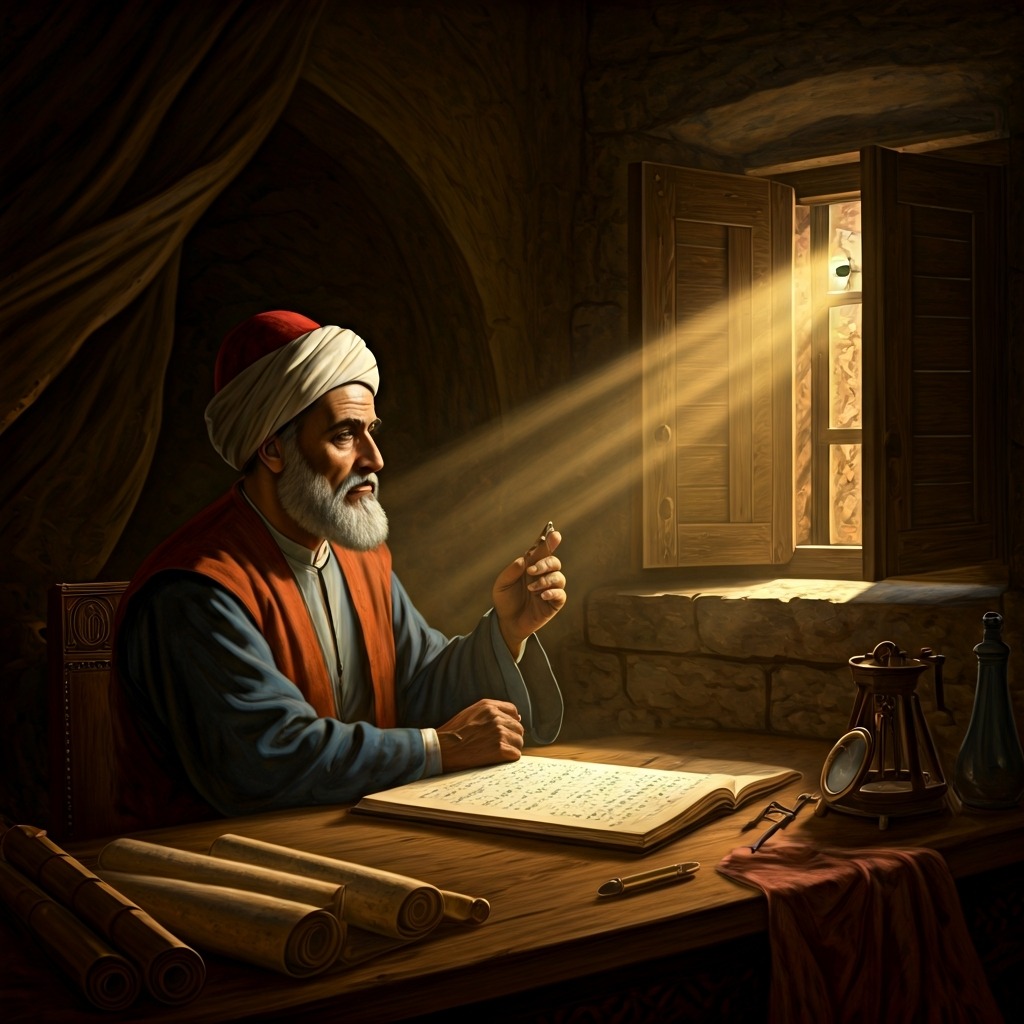
For the next decade, Ibn al-Haytham was a prisoner in his own home. Stripped of his administrative duties, his wealth, and his public life, he was left with nothing but time, silence, and the shadows of his room.
The Dark Room That Illuminated the World
Most men would have withered in that decade of isolation. But this confinement inadvertently became the crucible for a scientific revolution. Stripped of his engineering tasks, Ibn al-Haytham turned his brilliant mind to physics, mathematics, and the profound nature of light.
Legend has it that while sitting in his darkened room, he noticed a single beam of light piercing through a tiny hole in the window shutters. That light projected an inverted image of the sunlit world outside onto the opposite wall. He had stumbled upon an early camera obscura.
At the time, the leading scientific minds—including heavyweights like the ancient Greeks Euclid and Ptolemy—believed in the “emission theory” of vision. They thought human eyes acted like flashlights, emitting invisible rays to illuminate the objects we look at.
Ibn al-Haytham, locked in his room, realized this made no sense. Through rigorous, repeatable experiments with lenses, mirrors, and light dispersion, he dismantled centuries of accepted Greek dogma. He proved the intromission theory: vision occurs when light bounces off objects and enters the eye.
The Dawn of the Scientific Method
He didn’t just write down his theories; he meticulously documented his empirical findings in a seven-volume magnum opus called the Book of Optics (Kitab al-Manazir). By insisting that every single hypothesis must be proven through controlled mathematical and physical experimentation, Ibn al-Haytham laid the foundational principles of the modern scientific method—centuries before European figures like Roger Bacon or René Descartes ever picked up a quill.
In 1021 CE, the erratic Caliph Al-Hakim mysteriously vanished during a nighttime ride, never to be seen again. With the Caliph gone, Ibn al-Haytham was finally free to drop his act. He emerged from his house arrest not as a broken man, but as the undisputed father of modern optics.
His desperate bid to survive didn’t just save his life. It gave him the quiet, darkened space he needed to finally show the rest of the world how to see the light.