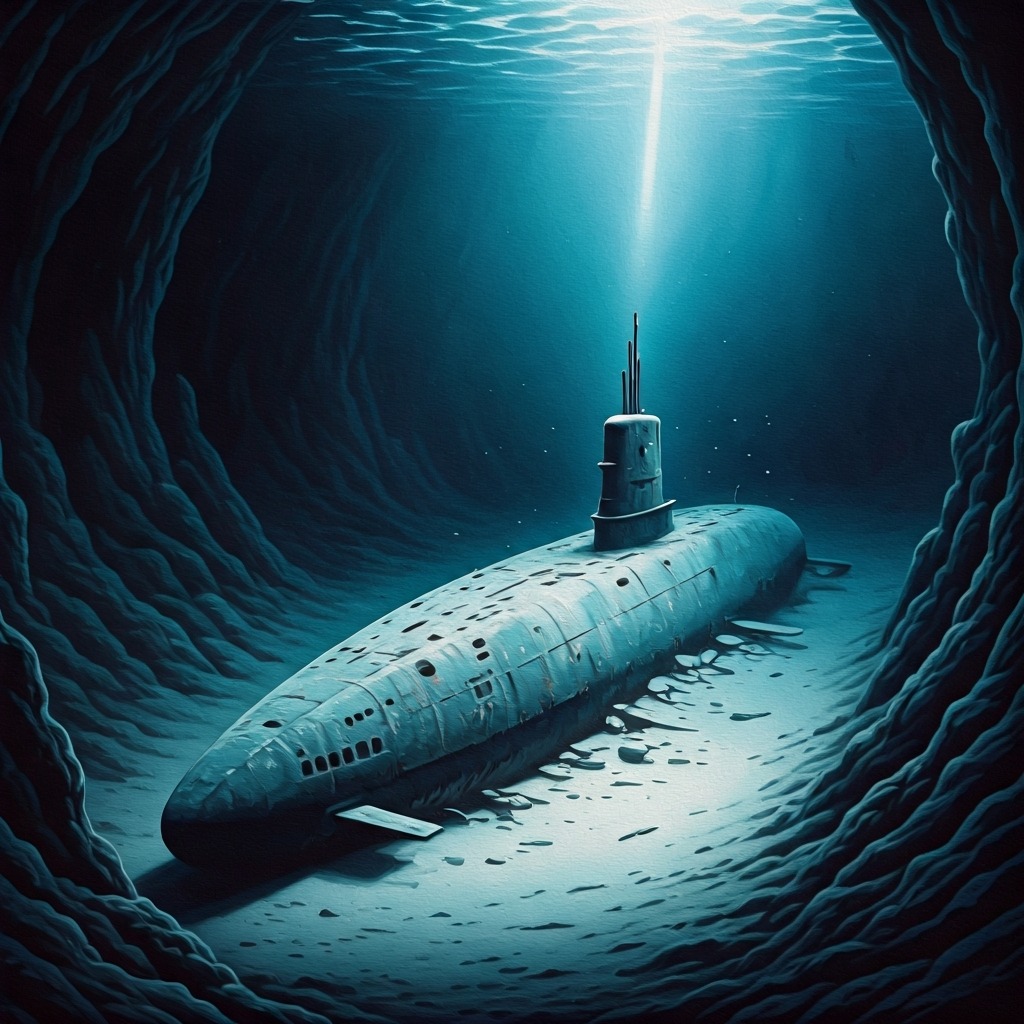
The ocean is a master at keeping secrets, but few are as dark, deep, or heavily guarded as the fate of the USS Scorpion.
Imagine a state-of-the-art nuclear submarine, armed to the teeth and prowling the depths during the most paranoid days of the Cold War. Now imagine it vanishing without a single distress call, leaving behind a silence that would haunt the U.S. Navy for decades. Complete with top-secret military tech, international espionage, and a plot twist that literally rewrote maritime history, the loss of the Scorpion remains one of the most terrifying locked-room mysteries on—or rather, beneath—the planet.
A Vanishing Act in the Deep Blue
Spring, 1968. The Cold War is a simmering powder keg. Commissioned in 1959, the USS Scorpion (SSN-589) was a formidable Skipjack-class nuclear-powered submarine.
On May 22, the Scorpion was gliding through the Atlantic, making its way back to home port in Norfolk, Virginia, following a routine Mediterranean deployment. Aboard were 99 highly trained crew members. That evening, the submarine radioed its position, reporting absolutely nothing out of the ordinary.
And then… total silence.
When the Scorpion failed to surface in Norfolk on May 27, the U.S. Navy launched a frantic, massive search operation. The submarine had vanished without a trace.
The Billion-Dollar Cover Story
It took months of agonizing sweeps before the oceanographic research ship USNS Mizar finally located the wreckage in October 1968. The Scorpion was resting in the pitch-black abyss at a crushing depth of over 9,800 feet, roughly 400 miles southwest of the Azores.
Decades later, the declassification of the search for the Scorpion (and another lost sub, the USS Thresher) revealed a mind-bending historical twist. The Navy’s covert mission to map these two nuclear wrecks actually served as the military cover story for Dr. Robert Ballard’s legendary 1985 expedition that discovered the RMS Titanic. The Navy agreed to fund Ballard’s search for the doomed ocean liner on one strict condition: he had to use his cutting-edge deep-sea tech to secretly survey the Scorpion and Thresher first.
The Crime Scene: 9,800 Feet Down
When Ballard and naval investigators finally examined the wreckage, they were met with a gruesome, mangled scene. The Scorpion was violently torn into three major pieces: the sail, the forward hull, and the aft hull. The extreme damage pointed to a catastrophic implosion caused by immense deep-sea pressure.
But an implosion is merely the physical result of falling below a submarine’s crush depth. The ultimate question—the one that still keeps naval historians up at night—is what initial, catastrophic event caused the vessel to plummet into the abyss in the first place?
Over the decades, four chilling theories have emerged.
Theory 1: The “Hot Run”
The first official Navy Court of Inquiry in 1968 pointed its finger at a terrifying malfunction known as a “hot run.”
This theory suggests that a Mark 37 acoustic homing torpedo accidentally activated inside its launch tube. Standard Navy procedure for a live torpedo in the tube was to whip the submarine into a sharp 180-degree turn, triggering the weapon’s anti-circular run safety mechanism and shutting it down. Proponents of this theory believe the Scorpion managed to eject the live weapon, but the safety mechanism failed. The torpedo then did exactly what it was programmed to do: it sought out and struck the nearest large acoustic target. Tragically, that target was the Scorpion itself.
Theory 2: A Lethal Chemistry Experiment
Later acoustic analyses by naval experts pivoted away from the rogue torpedo theory, suggesting instead that the submarine suffered a massive internal flooding event.
The prime suspect? A catastrophic failure of the Trash Disposal Unit (TDU). If a seal ruptured, high-pressure seawater would have violently flooded the submarine. If that saltwater reached the Scorpion’s massive silver-zinc battery bank, it would have triggered a violent hydrogen explosion. This blast would have instantly incapacitated the crew, leaving the powerless, heavy submarine to sink into the dark.
Theory 3: Cold War Retaliation
In the shadowy world of Cold War espionage, coincidence is rarely just coincidence.
Earlier in 1968, the Soviet submarine K-129 sank in the Pacific Ocean under highly mysterious circumstances. Some historians and naval personnel speculated that the Soviet Union believed the United States was secretly responsible. According to this theory, the Soviets hunted down and sank the Scorpion in a covert act of tit-for-tat retaliation.
While it sounds like the perfect plot for a spy thriller, declassified U.S. naval intelligence and SOSUS (Sound Surveillance System) acoustic data have largely discredited this theory. Underwater microphones picked up the Scorpion’s implosion, but there was absolutely no acoustic evidence of Soviet vessels or enemy torpedo detonations in the vicinity.
Theory 4: Doomed from the Start?
Sometimes, the scariest explanation is the most mundane: systemic structural failure.
The Scorpion had a documented history of mechanical problems. It had recently been rushed through a severely reduced refit process to get it back out to sea, and because of lingering issues, the submarine was operating under a strict restriction on its maximum diving depth.
Most damning of all, the Scorpion had not fully completed its Submarine Safety Program (SUBSAFE) upgrades—a rigorous protocol implemented specifically to prevent disasters after the tragic loss of the USS Thresher in 1963. Did a simple, preventable mechanical failure doom the ship? Many modern experts believe the Scorpion was a ticking time bomb.
The Eternal Patrol
Despite extensive deep-sea surveys, acoustic data analysis, and decades of fierce debate, the U.S. Navy has never definitively declared a root cause for the sinking. The fate of the USS Scorpion remains a tragic mystery locked away at the bottom of the Atlantic.
For the 99 men who lost their lives on May 22, 1968, the Navy simply lists them as being on “eternal patrol.” It is a haunting, enduring reminder of the immense, silent sacrifices made in the dark waters of the Cold War.