When we speak of maritime nightmares, one name inevitably surfaces: the RMS Titanic. But the deadliest shipwreck in United States history didn’t happen on the icy high seas. It happened on a muddy river in the dead of night. It claimed the lives of up to 1,800 souls—surpassing the Titanic’s grim toll. Yet, because of a bizarre twist of historical timing, this apocalyptic event has been almost entirely erased from the national memory.
Eclipsed by an Assassin
Why is the tragedy of the SS Sultana forgotten? It comes down to a single date: April 27, 1865.
The American Civil War was drawing to its bloody conclusion, and the nation’s newspapers were pushed to their absolute limits. President Abraham Lincoln had been assassinated just weeks prior, plunging the country into a state of shock and mourning. To make matters even more chaotic, Lincoln’s assassin, John Wilkes Booth, had been hunted down and killed the very day before the Sultana exploded. The news cycle was simply too saturated with the violent end of a national conflict to focus on a steamboat burning on the Mississippi River.
The Price of a Soul
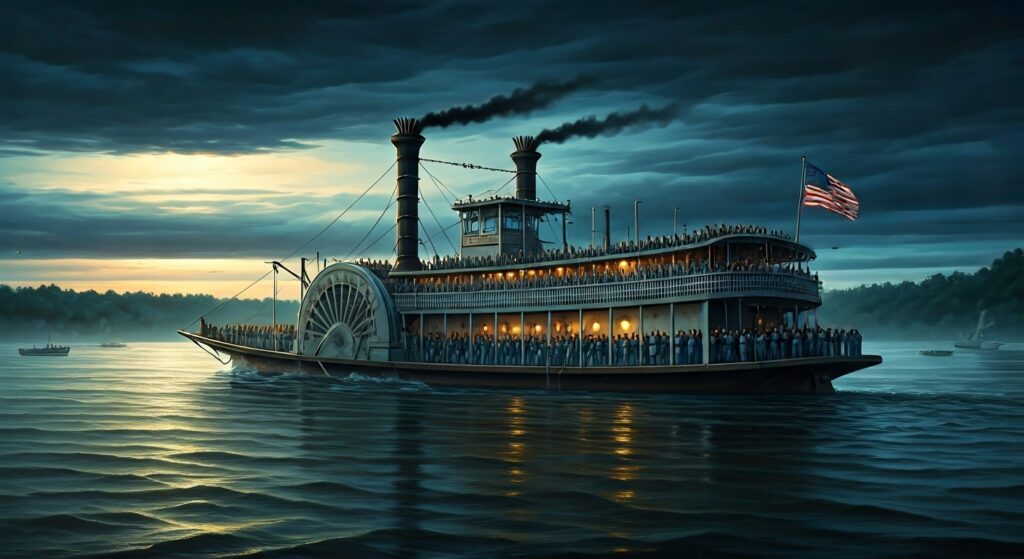
The Sultana was a wooden side-wheel steamboat legally permitted to carry a maximum of 376 passengers. But on that fateful spring voyage, her decks were groaning under the weight of approximately 2,400 people.
The vast majority of these passengers were Union Army prisoners of war, newly released from horrific Confederate prison camps like Andersonville and Cahaba. These men were emaciated, traumatized, and desperate to finally go home.
But they weren’t loaded onto the Sultana out of charity. They were packed onto the ship out of pure, unadulterated greed. The US government was paying steamboat captains a lucrative sum of five dollars per enlisted man and ten dollars per officer to transport the veterans North. For Captain J.C. Mason of the Sultana, every square inch of deck space was a gold mine. He wasn’t about to let a single dollar slip away.
A Ticking Time Bomb
Before the ship even left port, disaster was brewing in the engine room. One of the Sultana’s boilers was leaking and visibly bulging.
Any sane mariner would have halted the voyage and properly replaced the boiler. But Captain Mason was terrified that a delay would cost him his lucrative military transport contract to a competing steamboat. Instead of replacing the faulty equipment, Mason ordered a hasty, inadequate patch job.
He then steered his severely overloaded, top-heavy ship into the Mississippi River. The river was experiencing severe spring floods, and the currents were violent. Pushing the massive, human-laden vessel against the churning, freezing water required immense power, placing catastrophic strain on the hastily patched, bulging boiler.
2:00 AM on the Mighty Mississippi
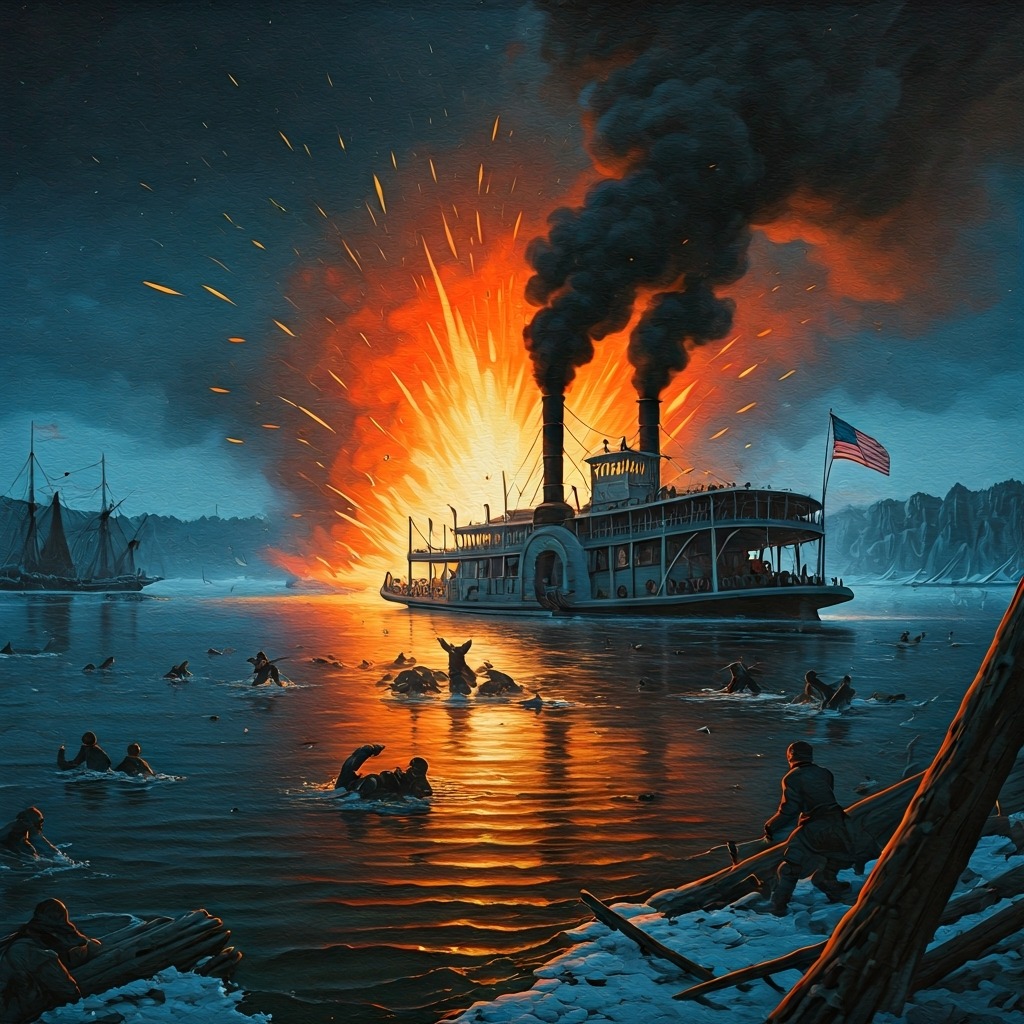
At roughly 2:00 AM on April 27, as the Sultana churned through the pitch-black waters near Memphis, Tennessee, the strain finally proved to be too much.
Three of the boat’s four boilers violently exploded. The blast was apocalyptic. Hundreds of sleeping soldiers were killed instantly as the explosion tore the wooden ship apart, sending jagged shrapnel and scalding steam ripping through the crowded decks.
A massive fire immediately consumed the remaining structure. Survivors faced an impossible choice: burn to death on the collapsing decks, or jump into the freezing, violently churning river. Thousands went into the water. Because these men were already severely weakened and malnourished from their time in Confederate prison camps, they had no strength to fight the current. Many drowned almost immediately, while others slowly succumbed to hypothermia in the dark.
Enemies in the Dark Water
In the midst of this unimaginable horror, a sudden, poignant display of humanity emerged.
Just weeks earlier, the men drowning in the river and the people sleeping on the Memphis shores had been bitter enemies in the bloodiest war in American history. But as the screams echoed across the water, former Confederate soldiers and civilians in Memphis didn’t hesitate. They rushed to the river in skiffs, rowboats, and anything that could float, pulling drowning Union men from the freezing water. In the face of nature’s wrath, the uniforms no longer mattered.
Swallowed by the Earth
Despite the massive loss of life, justice was never truly served. Captain Mason died in the explosion he caused, escaping the consequences of his greed. While a military commission did investigate the officers who allowed the severe overcrowding, their findings were ultimately overturned or ignored. No one was ever held fully accountable.
Even the ship itself vanished. Over the decades, the shifting course of the Mississippi River swallowed the wreckage. The remains of the deadliest maritime disaster in American history lay hidden for over a century, until the Sultana was finally discovered in 1982—buried deep under a soybean field in Arkansas.
Today, it stands as a grim intersection of wartime profiteering, mechanical failure, and tragic historical timing—a ghost ship buried under the dirt, holding onto a story the world was too busy to hear.