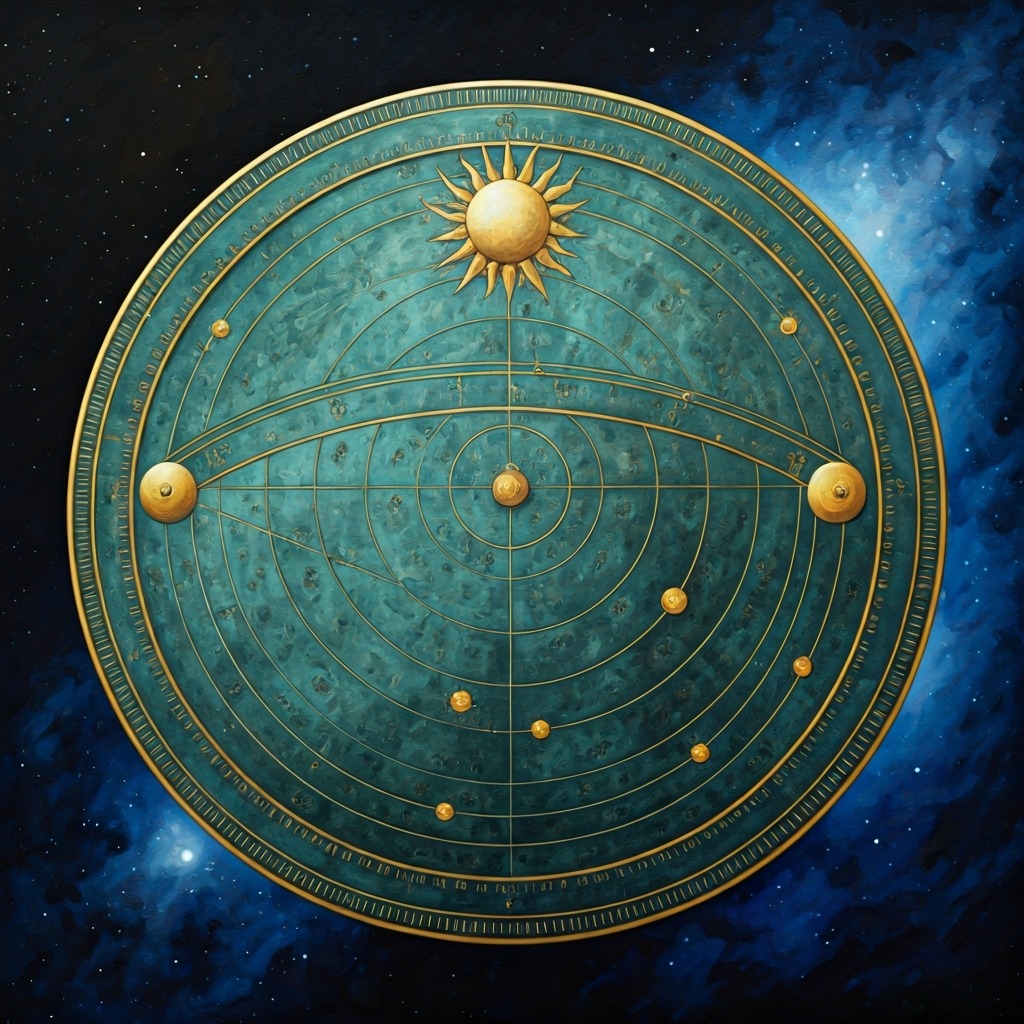
In the dead of night in 1999, deep within a prehistoric German forest, two illegal treasure hunters swept a metal detector over the damp earth of a Saxon hill. When their equipment squealed, they began to dig, expecting to find a few stray coins or rusted relics. Instead, they unearthed a hoard of Bronze Age weapons—and something else. Something utterly anomalous.
Buried among the ancient axes and swords was a heavy, mud-caked metal plate. The looters had no idea they were holding the oldest known concrete depiction of the cosmos in human history. And they certainly didn’t know this single, dirt-crusted disk was about to shatter our entire understanding of the ancient world.
A Midnight Uneathing
For years after its discovery, the artifact vanished into the shadowy criminal underworld. It changed hands in illicit black-market deals, a whispered legend among smugglers, until authorities finally recovered it in a thrilling, high-stakes police sting in Switzerland.
When experts finally brushed away the centuries of dirt, the archaeological community was left breathless. The artifact, now known as the Nebra Sky Disk, is a breathtaking masterpiece. Measuring roughly 30 centimeters across, the bronze disk features a striking blue-green patina, but it is the brilliant gold leaf inlaid across its surface that tells a story.
The golden symbols represent a blazing sun (or perhaps a full moon), a crescent moon, and a distinct cluster of seven stars universally identified as the Pleiades. Two golden arcs curve along the lateral edges, marking the exact horizons where the sun rises and sets throughout the year. At the very bottom rests a curved golden band—a mythic ‘solar barge’ meant to carry the sun across the night sky.
Dating back to approximately 1600 BCE and linked to the Early Bronze Age Unetice culture, the disk was initially celebrated as a stunning piece of prehistoric art. But researchers soon realized it wasn’t just art. It was a machine.
Stealing Time from the Stars
For centuries, historians believed that complex astronomical mathematics began in the sun-drenched ziggurats of Babylon and the Middle East. The Nebra Sky Disk proved them wrong.
When archaeologists and astronomers, notably Harald Meller and Wolfhard Schlosser, cracked the code of the disk, they realized it was a highly sophisticated astronomical calculator. Ancient people faced a massive, existential problem: the lunar year (based on moon phases) is about 11 days shorter than the solar year (based on the seasons). Without a way to adjust the calendar, crucial harvest festivals would eventually drift into the dead of winter, leading to agricultural collapse and starvation.
Meller and Schlosser discovered that the disk functioned as a calculator to harmonize the solar and lunar calendars. It encoded a genius “intercalation rule.” When the crescent moon appeared next to the Pleiades exactly as depicted on the disk, it signaled ancient priests to add a leap month, snapping the lunar and solar years back into perfect alignment.
This astonishingly advanced understanding of the cosmos predates similar Babylonian cuneiform records by nearly a thousand years.
A Map Woven from Distant Lands
When a discovery is this revolutionary, skeptics inevitably come knocking. The artifact was so incredibly advanced that it faced fierce academic backlash. Some researchers flat-out refused to believe Bronze Age Europeans were capable of such sophisticated science, proposing the disk must be a clever modern forgery or, at best, a much later Iron Age creation.
But science has a wonderful way of settling arguments. Researchers subjected the disk to rigorous soil chemistry tests and trace element analyses. The dirt perfectly matched the prehistoric Nebra site, proving its origins. But it was the metals that told the most shocking story of all: the copper hailed from Austria, while the gold was mined all the way in Cornwall, England.
The Nebra Sky Disk was firmly re-established as an Early Bronze Age marvel, proving that prehistoric Europe wasn’t a dark age of isolated, primitive tribes hiding in the woods. They were highly connected master astronomers, traveling vast global trade networks, and looking up at the exact same stars we do—calculating the mechanics of the universe in brilliant, glittering gold.