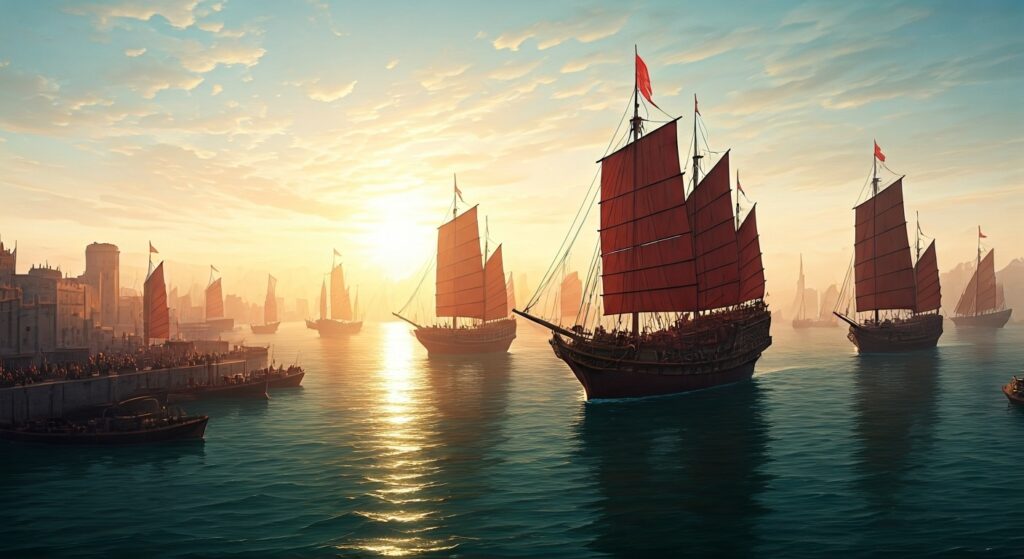
Nearly a century before Christopher Columbus stumbled onto the shores of the Americas with three scurvy-ridden, undersized ships, a shadow was falling across the Indian Ocean. It was an armada so colossal it defied the limits of 15th-century engineering—a floating metropolis of 300 vessels that projected absolute, unassailable power.
And then, at the height of its supremacy, it vanished. Not by the wrath of a storm or the cannons of an enemy, but by the hands of its own creators.
The Captive Commander
To understand this phantom fleet, you must first understand the unlikely mastermind at its helm: Zheng He. Born into a Muslim family in the landlocked mountains of Yunnan, his early life was defined by brutality. Captured as a child by the Ming army, he was castrated and forced into military servitude. Yet, Zheng He possessed a tactical brilliance that could not be caged. He rapidly ascended the ranks, catching the eye of the ruthless Yongle Emperor.
The emperor, having usurped the throne in a bloody civil war, desperately needed to legitimize his reign. He didn’t just want to send a message to the known world; he wanted to orchestrate a display of dominance so staggering it would echo through eternity. He chose Zheng He to deliver it.
Leviathans of the Deep
Between 1405 and 1433, Zheng He commanded seven epic voyages, but “navy” is too small a word for what he led. He moved a floating city.
The fleet carried nearly 28,000 personnel—a staggering manifest of soldiers, diplomats, meteorologists, physicians, and translators. Managing the daily survival of a population the size of a small modern city on the open ocean remains a logistical miracle that would make modern naval commanders sweat.
The crown jewels of this armada were the Baochuan, or Treasure Ships. Historical records describe these wooden leviathans as measuring up to 400 feet long and 160 feet wide, dwarfing European galleons that wouldn’t be built for another hundred years. Equipped with nine masts and revolutionary watertight bulkheads, these ships were floating fortresses. Imagine the psychological devastation of standing in a 15th-century port and watching a wooden vessel the size of a modern football field eclipse the sun.
The Ultimate Imperial Flex
Unlike the European Age of Discovery that would follow, Zheng He’s missions were not driven by a thirst for conquest or colonization. They were pure, unadulterated diplomatic flexes.
Navigating through Southeast Asia, the Indian subcontinent, the Persian Gulf, and the Swahili coast of Africa, the fleet traded silk, porcelain, and gold for exotic spices, ivory, and foreign ambassadors. They didn’t need to conquer foreign lands; they simply needed the world to bow to the reality that the Ming Dynasty was the center of the universe.
In one legendary exchange, the fleet returned from Malindi (modern-day Kenya) with a giraffe. The Ming court, having never seen such a creature, revered it as a mythical Qilin—a divine unicorn signaling heaven’s absolute favor upon the emperor.
The Scorched Earth Erasure
How does an empire that owns the oceans simply walk away? The answer lies in a violent shift of political winds.
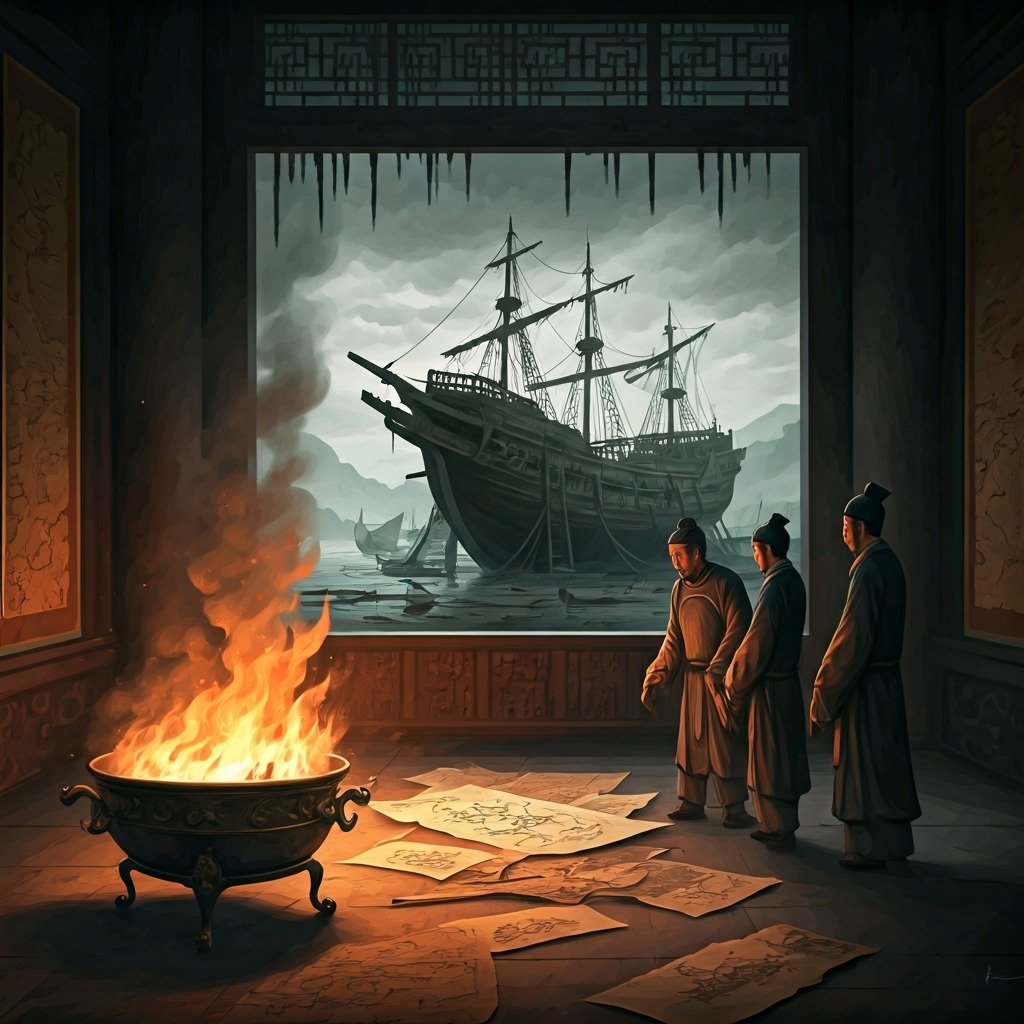
Following the deaths of Zheng He and the Yongle Emperor, conservative Confucian scholars seized control of the Ming court. Viewing the astronomical costs of the Treasure Fleet as a colossal waste of resources, they didn’t just defund the navy—they initiated a scorched-earth campaign of historical erasure.
China pivoted violently into isolationism. The magnificent 400-foot ships were left to rot or actively dismantled. In a move that still haunts historians, the court systematically burned the expedition logs, blueprints, and navigational charts. They deliberately blinded themselves to the outside world, erasing their own supremacy from the annals of history.
By grounding their leviathans and burning their records, the Ming Dynasty inadvertently left the global maritime stage wide open. Decades later, European powers would sail into that very vacuum, forever altering the course of human history. Today, Zheng He’s Treasure Fleet remains a tantalizing ghost story—a glimpse into a wildly different global order that was built, perfected, and then mysteriously deleted by its own architects.