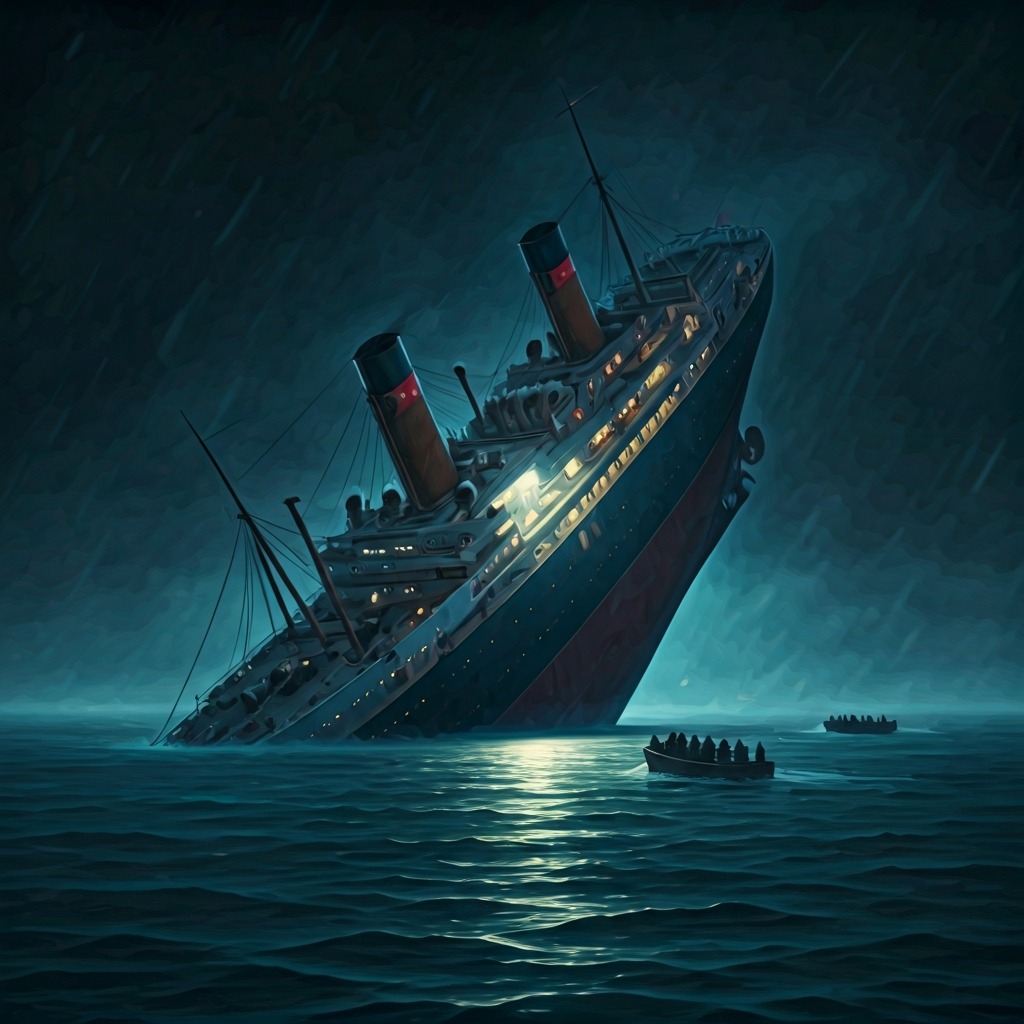
When we speak of maritime disasters, one name dominates the collective imagination: the Titanic. But the deadliest shipwreck in human history didn’t happen in the North Atlantic in 1912. It happened in the freezing, pitch-black waters of the Baltic Sea in 1945. It claimed six times as many lives as the Titanic. Yet, for decades, the world said almost nothing at all.
This is the story of the MV Wilhelm Gustloff.
The Crown Jewel of the Third Reich
The Wilhelm Gustloff wasn’t built for war. Launched in 1937, she was the crown jewel of the Nazi Kraft durch Freude (Strength Through Joy) program. Originally designed as a luxury cruise liner for German workers, she was essentially a floating propaganda tool for the Third Reich, named after an assassinated leader of the Swiss Nazi Party.
But as World War II dragged on, the luxury vanished. The Kriegsmarine (German Navy) requisitioned the ship, stripping away its leisure-class veneer. After a brief stint as a hospital ship, she was docked in Gotenhafen (modern-day Gdynia, Poland) in 1940. For years, she sat stagnant, serving as a floating barracks for U-boat trainees.
Then came January 1945.
A Desperate Flight from the Red Army
The Red Army was rapidly advancing into East Prussia. Word of brutal Soviet reprisals spread like wildfire, inciting absolute panic among German civilians. In response, Grand Admiral Karl Dönitz initiated Operation Hannibal, a massive naval evacuation meant to ferry troops and civilians across the Baltic Sea to western Germany.
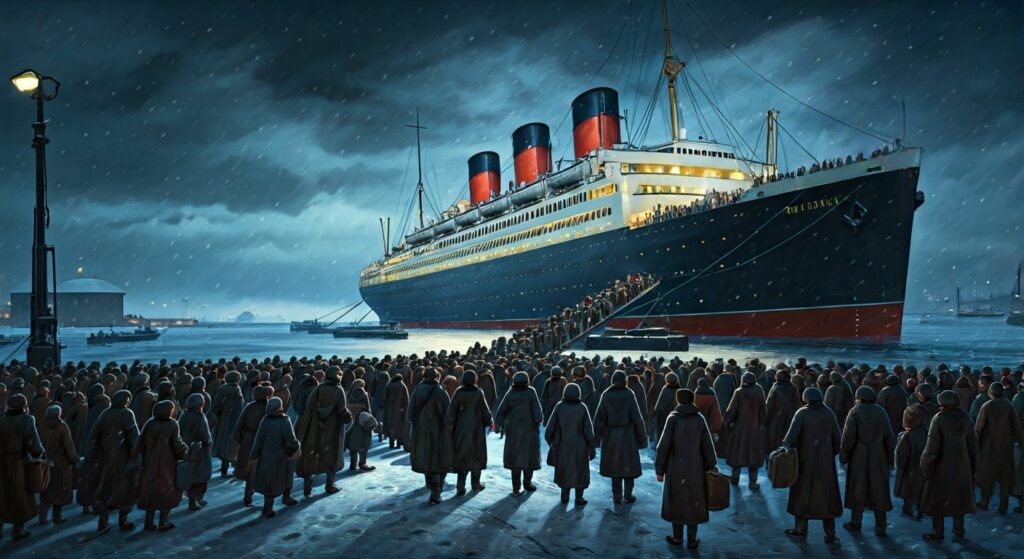
The Wilhelm Gustloff was pressed into service, but the situation on the docks was pure chaos. The ship was designed to hold a maximum of 1,900 passengers and crew. On January 30—coincidentally the 12th anniversary of Hitler’s rise to power and the birthday of the ship’s namesake—desperate refugees swarmed the gangways. The official manifest stopped counting at around 6,000, but modern historians estimate that over 10,000 people were crammed aboard.
The decks were packed shoulder-to-shoulder. Among the terrified masses were an estimated 4,000 to 5,000 children, alongside a contingent of about 1,000 U-boat officers and trainees, and members of the Women’s Naval Auxiliary.
Four Captains and One Fatal Mistake
When the Gustloff finally slipped her moorings, the bridge was a powder keg of conflicting egos. Instead of one clear commander, there were four captains—two from the merchant marine and two military—arguing over the safest route through the treacherous Baltic.
Military commander Wilhelm Zahn wanted to stay in the shallow, coastal waters and run completely dark to avoid Soviet submarines. It was the logical, stealthy choice. But the senior civilian captain, Friedrich Petersen, pulled rank. He insisted on heading into deep water to clear known minefields.
Then, Petersen made a decision that doomed everyone aboard.
After receiving a radio message warning of an approaching German minesweeper convoy, Petersen ordered the ship’s red and green navigation lights to be turned on to avoid a collision in the dark.
The convoy never materialized. But those lights pierced the pitch-black Baltic night, illuminating the massive ship like a beacon.
The Predator in the Pitch Black
Lying in wait beneath the icy surface was the Soviet submarine S-13, commanded by Captain Alexander Marinesko.
When Marinesko spotted the brilliantly lit silhouette of the Gustloff, he quietly maneuvered his submarine into firing position, stalking the leviathan. He ordered four torpedoes loaded and launched. In a grim twist of wartime theater, each torpedo bore a painted dedication.
The first, painted with “For the Motherland,” slammed into the Gustloff’s bow.
The second, “For the Soviet People,” struck directly beneath the drained swimming pool area. Hundreds of Women’s Naval Auxiliary members quartered there were killed instantly.
The third, “For Leningrad,” decimated the engine room, plunging the massive ship into total darkness and cutting all power and communications.
The fourth torpedo, “For Stalin,” jammed in the tube. It was narrowly prevented from detonating inside the submarine, saving the Soviet crew from destroying themselves.
Fifty Minutes of Absolute Hell
Aboard the Gustloff, the reality of the strike was apocalyptic. The impact of the torpedoes plunged the overcrowded, labyrinthine ship into absolute panic.
The conditions outside were a death sentence. The air temperature was roughly 0 degrees Fahrenheit (-18 degrees Celsius), and the water was just above freezing. Because of the extreme cold, many of the lifeboats were frozen solid to their davits and couldn’t be lowered.
In the pitch black, stampedes crushed passengers in the stairwells. Those who managed to jump into the icy Baltic Sea succumbed to hypothermia within minutes.
The Wilhelm Gustloff—a ship meant to symbolize the unbreakable strength of an empire—sank in less than 50 minutes.
German escort vessels rushed into the nightmare and managed to pull around 1,000 survivors from the freezing waters. But the scale of the loss was unfathomable. An estimated 9,343 lives were lost.
Swallowed by the Sea and History
For decades, the tragedy of the Wilhelm Gustloff was swallowed by the sea and by history.
From a cold, military standpoint, the sinking wasn’t considered a war crime. The ship was armed with anti-aircraft guns, wasn’t marked as a hospital ship, and was transporting active military personnel. Under the brutal rules of war at the time, she was a legitimate target. Yet, the staggering loss of thousands of children and civilian refugees makes it a profound humanitarian disaster.
After the war, the sinking was largely ignored. In the Soviet Union, Marinesko was dishonorably discharged due to personal disciplinary issues, only to be posthumously awarded the title Hero of the Soviet Union in 1990. In Germany, a nation overwhelmed by collective guilt for the Holocaust, civilian casualties were rarely mourned publicly.
It wasn’t until Nobel laureate Günter Grass published his 2002 novella Crabwalk that the Gustloff re-entered widespread public discourse, forcing a nuanced look at the final, bloody months of World War II.
Today, the Gustloff remains a chilling reminder that the most dangerous element on the water isn’t the freezing temperatures or the crushing depths. It is the catastrophic weight of human decisions.