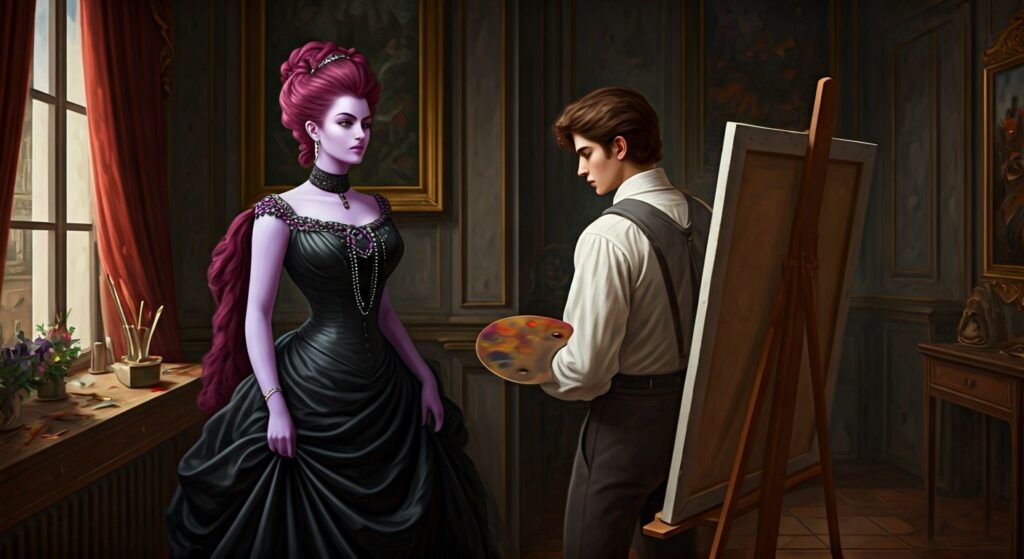
In the ruthless, glittering world of Belle Époque Paris, reputations were built over decades and destroyed in seconds. But in 1884, it didn’t take a scandalous affair or a financial ruin to shatter two lives. It took a single, millimeter-thin piece of jewelry.
Today, John Singer Sargent’s Portrait of Madame X is celebrated as a triumph of sleek, minimalist fashion. But beneath the stark black dress and the subject’s haughty profile lies a cautionary tale of blind ambition, rigid social mores, and a scandal so severe it forced an artist into exile and turned a socialite into a pariah.
The Corpse-Pale Siren of Paris
Before she was an anonymous enigma, she was Virginie Amélie Avegno Gautreau. Born in Louisiana, the American expatriate married a French banker and systematically engineered her transformation into the most notorious “It Girl” in Paris.
Virginie didn’t just want to be beautiful; she wanted to be unforgettable. She possessed a striking, unconventional look that she weaponized with bizarre, dramatic flair. She dyed her hair with henna to achieve a fiery contrast against her skin, which she famously powdered with a lavender-tinted cosmetic. The result was an ethereal, almost corpse-like pallor that fascinated and repelled the Parisian elite in equal measure. She was a walking provocation, and high society couldn’t look away.
A Collision of Egos
Enter John Singer Sargent, another American expatriate desperate to cement his reputation as the premier portraitist of Paris. In an era where wealthy socialites commissioned artists, Sargent flipped the script. Captivated by Gautreau’s bizarre allure, he actively pursued her for a sitting.
He was convinced that capturing her statuesque elegance would guarantee him absolute critical acclaim at the upcoming Paris Salon. It was a collaboration born of pure, unadulterated ambition: the painter hunting for his masterpiece, and the muse demanding her immortality. They settled on a pose and a dress—a sleek, minimalist black gown with a plunging neckline and delicate jeweled straps.
The Millimeter That Ruined Everything
When the painting was finally unveiled at the 1884 Paris Salon, Sargent expected a triumph. Instead, he walked into a bloodbath.
The outrage wasn’t just about her plunging neckline or her arrogant, sculptural pose. It was about one tiny, scandalous detail: in the original version, Sargent painted the right jeweled strap of her gown slipping off her shoulder.
To a modern audience, a fallen strap is nothing. To the conservative upper crust of 1884 Paris, it was a visual bomb detonating in the gallery. It wasn’t viewed as a mere wardrobe malfunction; it was interpreted as a blatant suggestion of undress and sexual availability. Critics lambasted the work as vulgar. The public mocked her lavender skin. The scandal was immediate, ferocious, and utterly devastating.
Exiled by High Society
The backlash was so intense that Gautreau’s mother furiously confronted Sargent, demanding he withdraw the painting from the exhibition to save her daughter’s ruined reputation. Sargent, stubborn and fiercely protective of his work, refused.
But high society always extracts its toll. Gautreau’s carefully cultivated image was shattered. She became a social pariah, retreating from the very spotlight she had spent years chasing. Sargent didn’t fare much better. His Parisian portrait commissions dried up overnight. Chased out by the scandal, he was forced to flee to London, where he had to rebuild his entire career from scratch.
The Secret of Madame X
In a desperate attempt to quell the outrage, Sargent eventually caved to the pressure—partially. He repainted the strap so it rested securely on Gautreau’s shoulder, which is how the masterpiece appears today.
He kept the portrait hidden away in his personal studio for over thirty years. It was his greatest triumph and his most painful memory. Finally, in 1916, he sold the painting to the Metropolitan Museum of Art in New York. But he had one strict condition: the museum had to obscure her name.
And so, Virginie became the enigmatic Madame X.
Sargent later told the museum director it was “the best thing I have done.” He was right. Despite the ruin it brought them both, he immortalized her exactly as she wanted to be seen: bold, beautiful, and forever draped in the intoxicating allure of scandal.