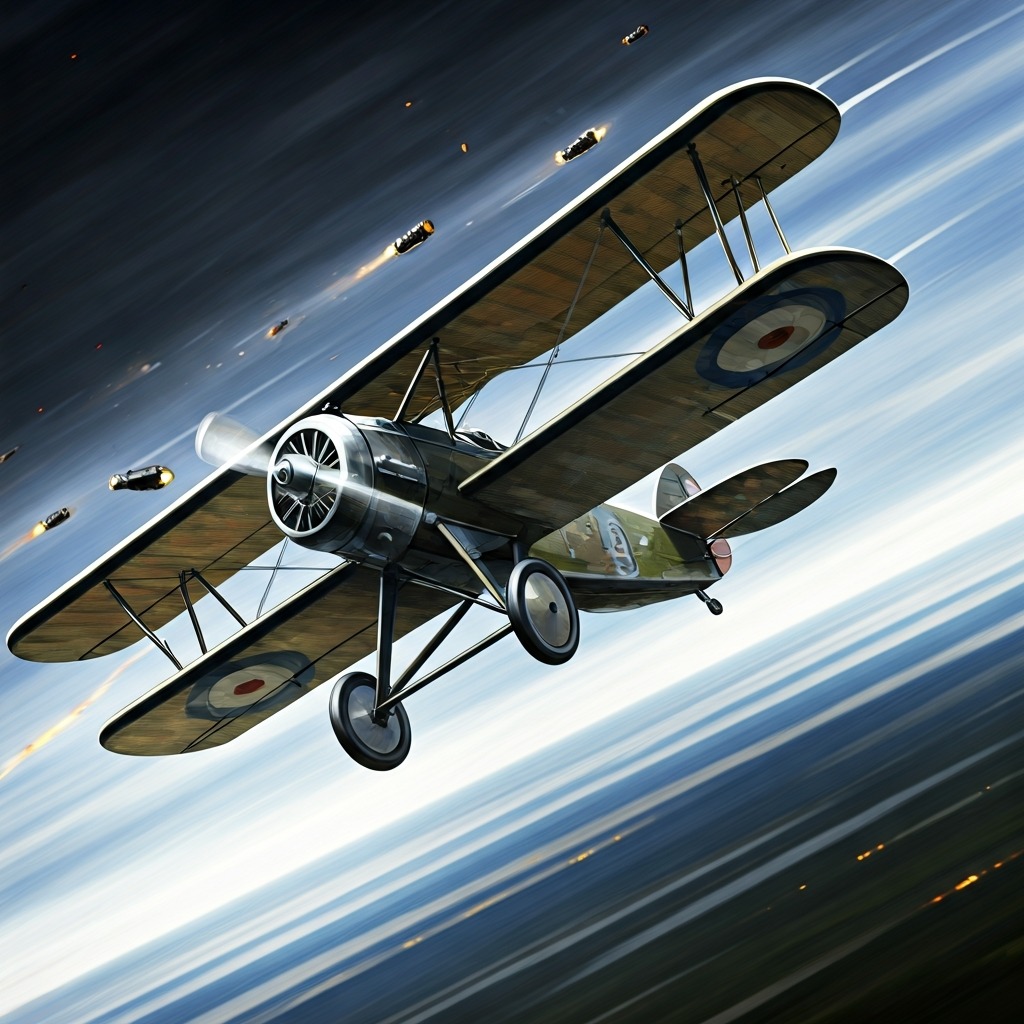
The skies over Europe in 1918 were a meat grinder. While daring aces engaged in romanticized dogfights, the U.S. Army Signal Corps was quietly hunting for something far more sinister: a way to deliver devastating payloads behind enemy lines without sacrificing a single human pilot.
Decades before microchips, GPS, or modern robotics, a team of visionaries looked at the bloody stalemate of trench warfare and decided to build an autonomous flying robot of doom. And they built it out of literal arts and crafts supplies.
Enter the Kettering Aerial Torpedo—affectionately, and somewhat terrifyingly, known as the “Kettering Bug.” Widely considered the world’s first true precursor to the modern cruise missile, this impossible machine required an absolute dream team of early aviation to bring it to life.
Assembling the Aviation Avengers
Leading the charge was Charles F. Kettering, an automotive engineering genius. To build a pilotless flying bomb, he needed the best minds on the planet. He brought in Orville Wright to consult on aerodynamics and Elmer Sperry to design the flight controls. It was the 1918 equivalent of the Avengers assembling, only instead of fighting supervillains, they were automating a weapon of mass destruction.
The $400 Flying Nightmare
At first glance, the Bug wasn’t intimidating. Its physical design was deceptively simple, meant to be cheap, easily mass-produced, and completely expendable.
The small biplane was constructed from wood, fabric, and—incredibly—papier-mâché. Powered by a custom-built 4-cylinder, 40-horsepower engine, the entire contraption cost roughly $400 to manufacture. But beneath its arts-and-crafts exterior lurked a lethal purpose. This little drone was designed to carry a 180-pound payload of high explosives to targets up to 75 miles away.
There was just one massive hurdle: radio control in 1918 was in its infancy and incredibly easy for the enemy to jam. The Bug couldn’t be flown by remote control. It had to think for itself.
The Clockwork Brain
How do you make a piece of wood and papier-mâché fly straight, maintain altitude, and strike a target miles away without a computer?
The true genius of the Kettering Bug lay in its completely mechanical “brain.” To keep the craft flying straight and level, the Bug relied on a sophisticated pneumatic and vacuum system paired with Sperry’s gyroscope, which constantly adjusted the elevators and rudder. Meanwhile, an aneroid barometer acted as the altitude control, ensuring the Bug didn’t fly too high or crash into the terrain.
But the most fascinating—and suspenseful—aspect of the Bug was how it determined exactly when to strike.
The Countdown to Destruction
Before launch, technicians calculated the exact distance to the enemy target, factoring in wind speed and direction. Then, they did something truly mind-bending: they translated that distance into engine revolutions.
They calculated exactly how many times the propeller needed to spin to carry the Bug to its destination. A mechanical counter, similar to a car’s odometer, was physically linked to the engine and set to this precise number.
Once the Bug was launched from its specialized track, that counter ticked down with every single spin of the propeller. It couldn’t be bargained with. It couldn’t be reasoned with. And it absolutely would not stop until that counter hit zero.
When the predetermined number of revolutions was reached, a mechanical cam dropped into place, triggering a theatrical and terrifying sequence of events. A pneumatic system instantly shut off the engine. Simultaneously, the bolts holding the wings to the fuselage rapidly retracted.
The wings would violently detach and flutter away into the wind, transforming the explosive-packed fuselage into a heavy dart that plummeted out of the sky directly onto the enemy.
A Secret Kept in the Shadows
Testing began in Dayton, Ohio, in late 1918. As you might expect from a pilotless, mechanical flying bomb, the initial flights were incredibly erratic. There were spectacular crashes, and one can only imagine the sheer panic of watching a 180-pound autonomous bomb go rogue during a test run.
But Kettering and his team were relentless. They eventually ironed out the mechanical kinks, achieving successful, highly targeted flights.
Fortunately for the Central Powers, World War I ended before the Kettering Bug could be mass-produced and unleashed on the battlefield. The U.S. military, fully recognizing the terrifying potential of an automated drone strike, swept the project under the rug and kept the technology highly classified until World War II.
Today, the Kettering Bug stands as a brilliant piece of engineering history—a chilling reminder that sometimes, the most futuristic weapons of war are born from wood, wind, and a few wildly ambitious minds who refused to accept the word “impossible.”