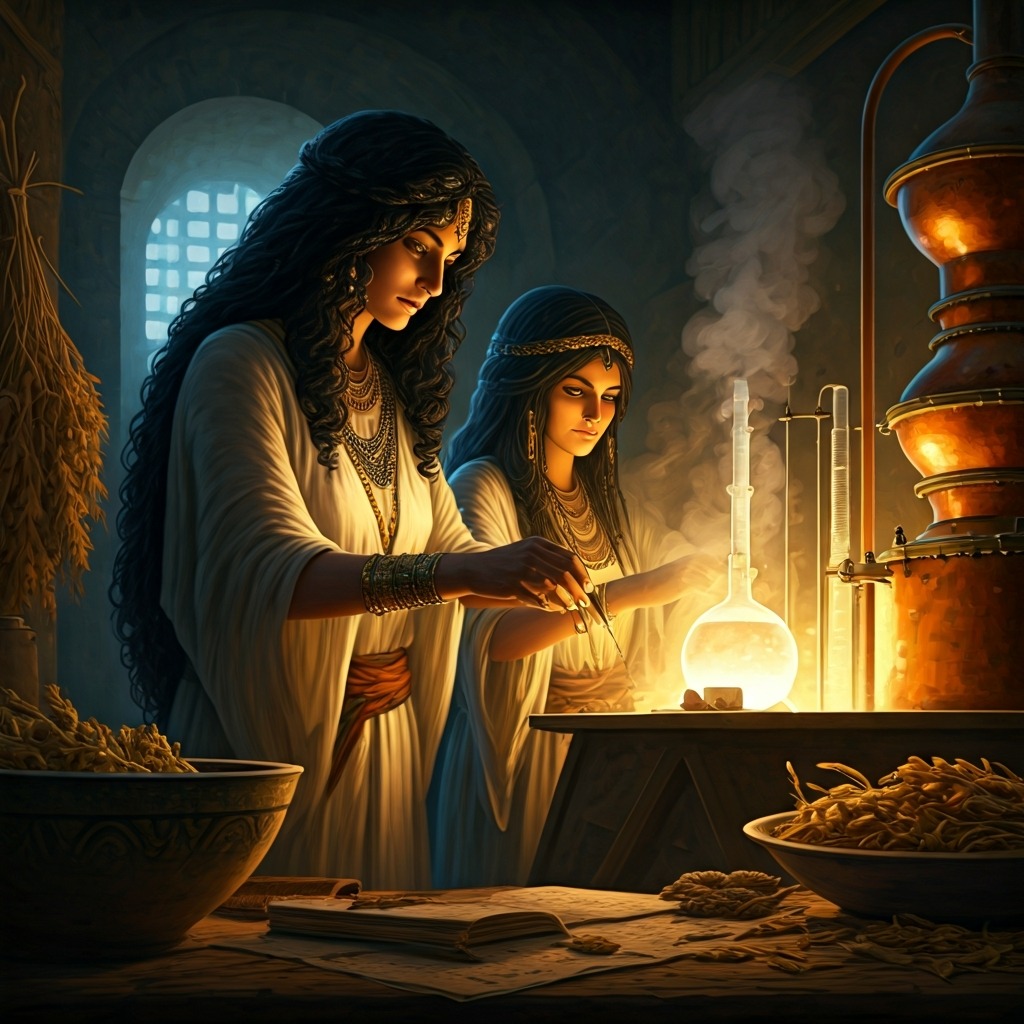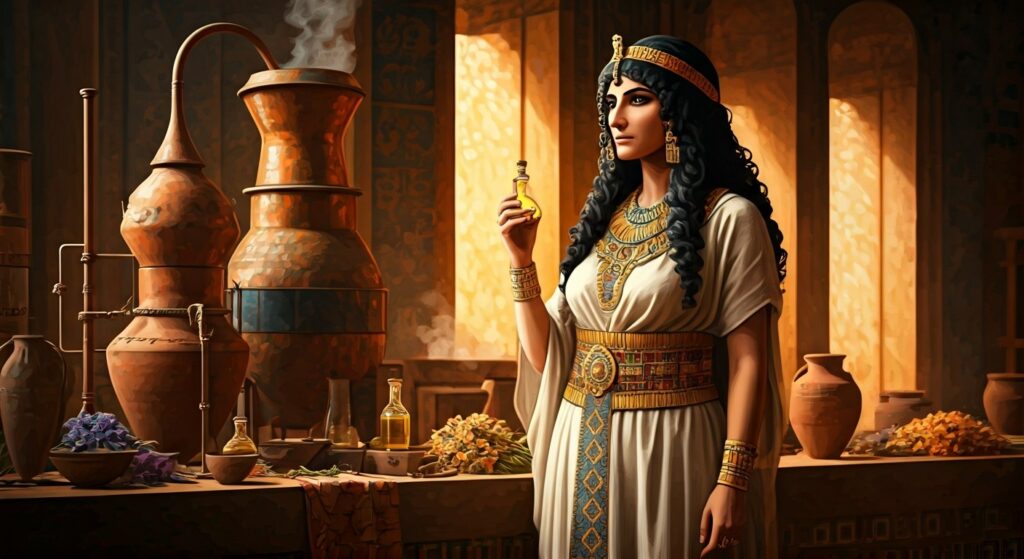
Picture the world’s very first chemist. Who comes to mind? A bearded alchemist toiling in a medieval castle? A Victorian gentleman surrounded by glass beakers? Erase those images completely. The true mastermind behind the dawn of chemistry didn’t wear a lab coat, and she didn’t live in Europe. She was a woman wielding unimaginable power in Babylonian Mesopotamia around 1200 BCE. Her name was Tapputi, and she changed the world.\n\n## The Invisible Architecture of Power\n\nTo understand Tapputi, you must first understand the dangerous, intoxicating world she inhabited. In ancient Mesopotamia, fragrances were not a simple vanity project to mask body odor before a royal banquet. Perfumes were the invisible architecture of power. They held profound religious, medicinal, and political significance. To anoint a king or purify a temple, you needed scents so potent and complex they were believed to bridge the gap between mortals and the divine.\n\nTapputi was no mere mixer of pleasant scents. According to a surviving cuneiform tablet, she held the formidable title of Belatekallim—the female overseer of a royal palace. This was not a ceremonial role. She was a high-status administrator and a master scientist running a vital, highly classified royal enterprise.\n\nBut how did she create these sacred, intoxicating elixirs? That is where the magic ends, and the hard science begins.\n\n## The Secret Laboratory\n\nImagine stepping into Tapputi’s workspace. The air is thick with the heavy, hypnotic aromas of myrrh, balsam, calamus, and cyperus. But amidst the crushed flowers and sticky resins, you wouldn’t just find primitive mortars and pestles. You would find an array of sophisticated, bubbling apparatuses that look shockingly modern.\n\nTapputi is widely celebrated as the world’s first recorded chemist because she didn’t just steep petals in water. She employed groundbreaking chemical techniques that laid the foundational principles of modern science. Cuneiform records detail her pioneering use of distillation, cold extraction, sublimation, and filtration.\n\nMost astonishingly, she is credited with designing and utilizing the earliest known still—an apparatus used to purify liquids through a rigorous process of heating and cooling. She possessed a complex understanding of botanical properties and solvents, utilizing water and early forms of fermented liquids to coax the absolute purest essential oils from her raw materials.\n\nAnd she didn’t just eyeball her concoctions. Tapputi’s meticulous methodology is a breathtakingly early example of the scientific method. She recorded her recipes, the exact measurements of her ingredients, and the specific, repeatable steps of her chemical processes. She wasn’t relying on magic; she was relying on data.\n\n## The Ghostly Assistant\n\nThere is one more detail on that ancient clay tablet that sends a shiver down the spine of modern historians.\n\nTapputi didn’t work alone. The tablet mentions an assistant, another woman whose name has been partially chipped away by the relentless march of time. All that survives of her identity is the ending: “…ninu”.\n\nWe may never know “…ninu’s” full name, but her presence on the tablet is a profound revelation. It proves that the early chemical arts and royal perfumery were a collaborative, female-led enterprise in the ancient world. These women were the quiet architects of an empire’s aura, working side-by-side over boiling vats and complex filtration systems.\n\nThe next time you spritz on your favorite perfume or take an aspirin, look back past the European Enlightenment and the medieval alchemists. The origins of chemistry are deeply intertwined with the brilliant women of 1200 BCE who first figured out how to distill the very essence of the world.