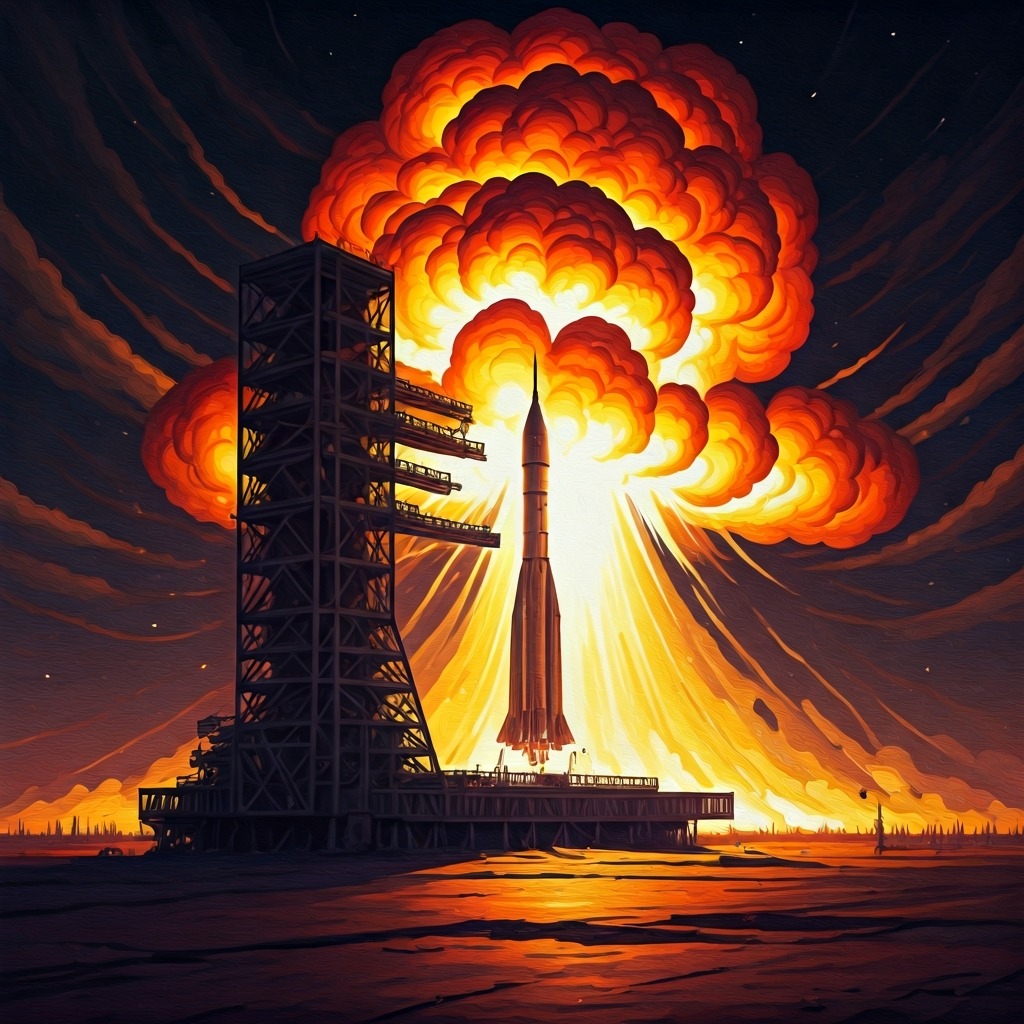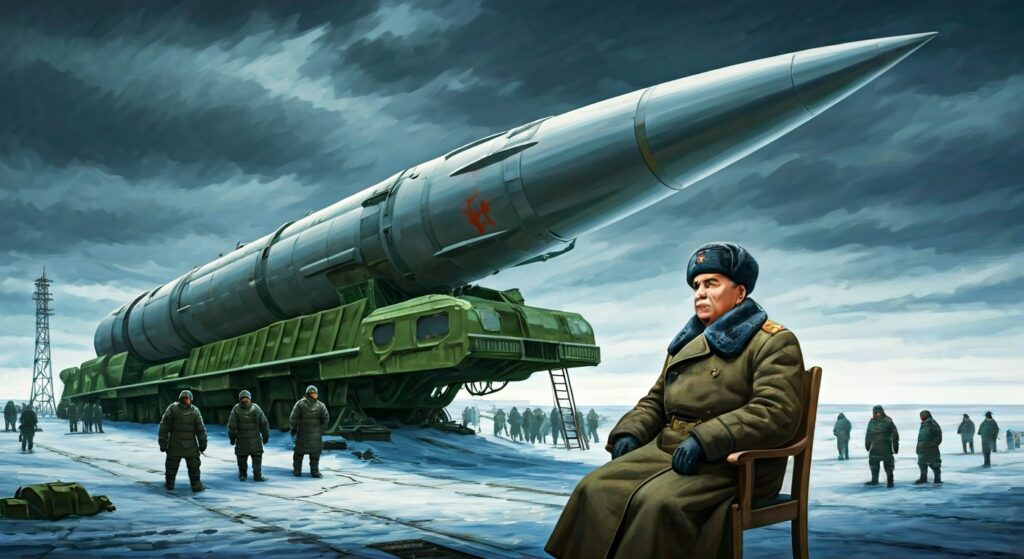
When political hubris collides with the unforgiving laws of physics, the results aren’t just explosive—they are apocalyptic. On October 24, 1960, the Soviet Union triggered the deadliest launch pad accident in the history of space exploration. Yet, for nearly thirty years, the world didn’t even know it happened.\n\n## A Ticking Time Bomb on the Kazakh Steppe\n\nIn late 1960, the Soviet Union was desperate to assert its nuclear dominance over the United States. Premier Nikita Khrushchev was breathing down the necks of his military brass, demanding a new, capable Intercontinental Ballistic Missile (ICBM) to tip the scales of the Cold War.\n\nThe R-16 missile, designed by brilliant engineer Mikhail Yangel, was rushed into development at the Baikonur Cosmodrome. Khrushchev wanted a successful test launch to coincide with the upcoming anniversary of the Bolshevik Revolution on November 7.\n\nThis artificial, politically driven deadline created a deeply toxic atmosphere on the launch pad. Safety protocols were ignored. Checklists were skipped. The crews worked at a breakneck pace with a rocket that utilized hypergolic propellants: unsymmetrical dimethylhydrazine (UDMH) as fuel and a nitric acid derivative as the oxidizer.\n\nThese chemicals are highly toxic, incredibly corrosive, and ignite spontaneously the absolute second they touch each other. No spark required. Once the R-16 was fueled, it could not be safely drained without extensive, time-consuming procedures. Any delay meant a volatile chemical bomb was sitting on the pad, waiting for an excuse to detonate.\n\n## Hubris and the Dead Man’s Chair\n\nOn October 23, the missile was fully fueled, but a series of electrical faults brought the countdown to a grinding halt. Standard procedure dictated that the rocket be drained before anyone went near it. But draining the rocket meant missing Khrushchev’s deadline.\n\nChief Marshal of Artillery Mitrofan Nedelin, the man in charge of the Soviet missile program, made a fatal decision. Against every safety regulation in the book, he ordered technicians to perform complex electrical repairs on the fully fueled, leaking rocket.\n\nTo demonstrate his utter lack of fear and silently pressure the terrified crews to work faster, Nedelin did the unthinkable. He ordered a chair to be brought out to the pad. He sat down just 50 feet from the base of the groaning, highly explosive missile, watching the technicians work.\n\n## A 3,000-Degree Inferno\n\nOn the evening of October 24, dozens of engineers and military personnel swarmed the gantry, desperately trying to fix the electrical faults.\n\nThen, a fateful, cascading error occurred. A technician, trying to reset a sequencer to a pre-launch state, accidentally sent a rogue electrical signal to the missile’s second-stage engine.\n\nBecause the rocket was fully stacked, the second-stage engine fired directly into the fully fueled first stage resting right below it.\n\nThe result was an instantaneous, catastrophic explosion. A massive fireball engulfed the launch pad, instantly vaporizing the men working on the gantry. Temperatures on the pad spiked to an unimaginable 3,000 degrees Celsius. The heat was so intense that the tarmac itself melted, trapping fleeing technicians in a sea of boiling asphalt. Men who attempted to run to the perimeter fence were caught in the expanding shockwave of toxic, burning fuel.\n\nOver 100 Soviet military personnel, engineers, and technicians lost their lives in a matter of seconds. Marshal Nedelin, sitting in his chair just 50 feet away, was incinerated instantly. His remains were only identified later by his partially melted Gold Star of Hero of the Soviet Union medal, his watch, and his shoulder boards.\n\nChief Designer Mikhail Yangel miraculously survived the blast. Why? Because just minutes before the explosion, he had stepped away to a designated bunker to smoke a cigarette. It is perhaps the only time in medical history where a smoking habit definitively saved a man’s life.\n\n## Erased from Existence\n\nAn explosion that killed over a hundred people and vaporized a high-ranking military official should have made global headlines. But this was the Soviet Union at the height of the Cold War.\n\nKhrushchev immediately ordered absolute secrecy. The state apparatus went into overdrive to erase the catastrophe from existence. Official state media announced that Marshal Nedelin had died in a tragic—and entirely fictitious—plane crash. The families of the incinerated technicians were instructed to mourn in absolute silence, forbidden under threat of state retaliation from discussing the true nature of their loved ones’ deaths.\n\nThe truth of the Nedelin Catastrophe remained buried behind the Iron Curtain for nearly three decades. It wasn’t until 1989, under Mikhail Gorbachev’s policy of Glasnost (openness), that the full, horrifying details of the disaster were officially acknowledged and published in the Soviet press.\n\nToday, a solemn memorial stands at Baikonur. The Russian space agency still observes October 24 as a day of silence. To this day, no rockets are ever launched from Baikonur on the anniversary of the tragedy. It is a quiet, enduring reminder that no matter how much political pressure is applied, you simply cannot negotiate with the laws of physics.