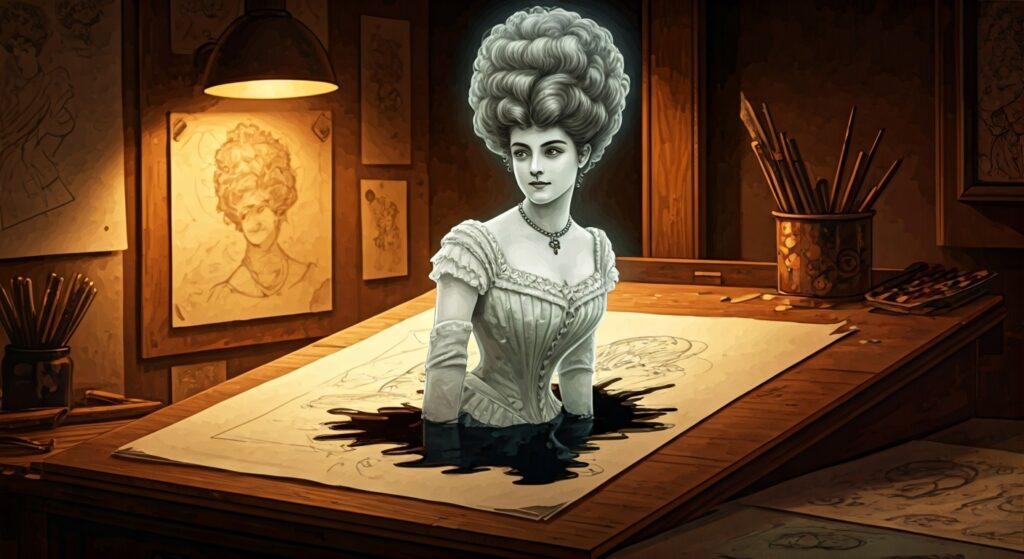
Long before the era of viral influencers and Hollywood starlets, a single “It Girl” held a ruthless monopoly on American beauty. Women starved themselves to mimic her impossible waistline. They bought clothes to match her style and altered their personalities to project her aloof, untouchable confidence. She was the most famous woman in the world.
There was just one chilling detail about her: she didn’t actually exist.
The Phantom in the Ink
In the 1890s, the Gilded Age was dripping with excess, but American femininity was in a state of flux. Enter American illustrator Charles Dana Gibson. With a few masterful strokes of pen and ink, he conjured a phantom. Appearing primarily in magazines like Life, Collier’s, and Harper’s, his creation quickly transcended the page.
Gibson claimed she wasn’t one woman, but a composite of thousands. She was the first true national beauty standard—an idealized, aristocratic, yet distinctly American vision. She stared out from the pages with heavy-lidded, knowing eyes, looking utterly bored by the world and completely in control of it.
The Anatomy of an Illusion
The Gibson Girl did not wear the restrictive, bell-shaped cages of the Victorian era. Instead, she ushered in a dangerous new silhouette: the famous “S-curve.”
This gravity-defying posture was achieved through a specific type of swan-bill corset that violently pushed the bust forward and the hips back. It gave her a statuesque height, a slender waist, and a swan-like neck, all topped off with massive, voluminous hair styled in a towering bouffant.
But it wasn’t all torture. Her wardrobe popularized the “shirtwaist”—a sharply tailored blouse paired with a bell-shaped skirt. It was a practical, elegant ensemble that finally allowed women to move. And move she did.
A Palatable Rebellion
The Gibson Girl was surrounded by an aura of untouchable intrigue. She was the “New Woman”—but a highly sanitized, commercially safe version.
She was college-educated and highly athletic, frequently depicted bicycling, playing tennis, or swinging a golf club. Yet, she was carefully designed to avoid threatening the conservative masses. She remained entirely aloof from the suffrage movement. She didn’t want the vote; she wanted to play tennis and look devastating doing it.
In her illustrated world, men were reduced to tiny, smitten creatures. They scurried around her, fetched her dropped handkerchiefs, and waited in agony for her attention. She was confident, gently mocking, and dominant. Yet, the suspense of her independence always resolved in a traditional, socially acceptable marriage. She was a rebel in a gilded cage.
The Flesh-and-Blood Muses
While the Gibson Girl was a phantom, the women who inspired her were flesh, blood, and scandal.
Gibson’s own wife, Irene Langhorne (sister of the famous Nancy Astor), was a primary muse, injecting Southern belle elegance into the ink. But others stepped into the role and became massive celebrities in their own right. There was Evelyn Nesbit, a famous artist’s model and chorus girl whose life would later spiral into one of the most sensational murder scandals of the century. Then there was Camille Clifford, an actress whose extreme hourglass figure made her the quintessential stage representation of the Gibson Girl in both London and America.
These women blurred the line between reality and illustration, proving that life could, in fact, imitate art with dangerous precision.
The Empire Crumbles
The Gibson Girl sparked a massive, unprecedented merchandising boom. She was arguably the first fictional character to be monetized on a global scale. Her haughty face was plastered on plates, ashtrays, tablecloths, matchboxes, and umbrella stands. Women across the country bought mass-produced shirtwaists to emulate her. She was the unifying cultural touchstone of a rapidly industrializing United States.
But no reign lasts forever.
The sudden downfall of the Gibson Girl wasn’t brought about by a changing fashion trend, but by the brutal reality of World War I. The practicalities of war work made her restrictive swan-bill corsets and high-maintenance, voluminous hair entirely obsolete. Women needed to work in factories, nurse the wounded, and navigate a shattered world. The S-curve was dead.
By the 1920s, the Gibson Girl was swept away, entirely replaced by the Flapper—a radical, boyish, rebellious icon who bobbed her hair, tossed her corset in the trash, and loudly demanded the political equality the Gibson Girl had been too polite to ask for.
Yet, her legacy remains undeniable. The Gibson Girl was the crucial stepping stone between the suffocating Victorian era and the modern woman. She proved that a single image could captivate a nation, redefine femininity, and leave a permanent, ink-stained mark on history.