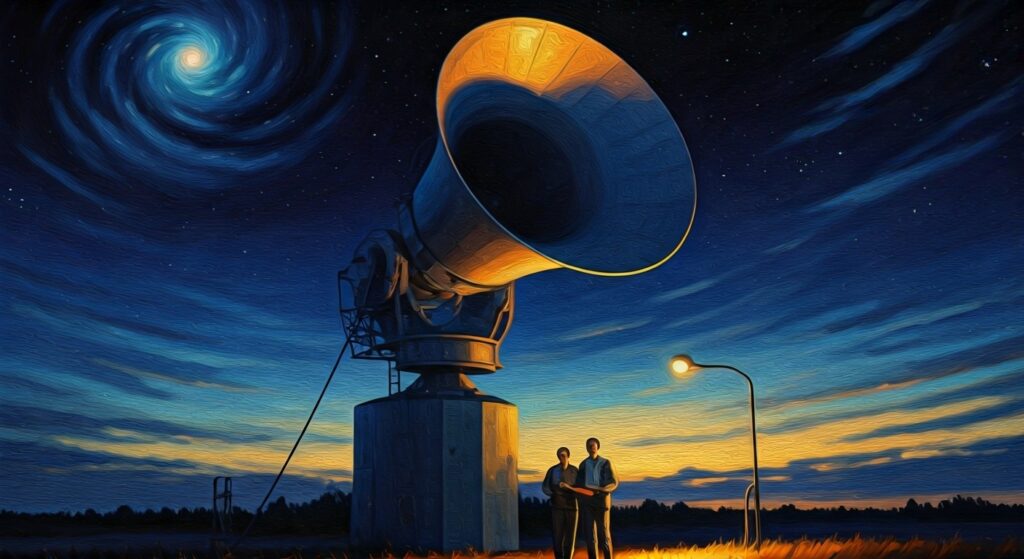
In 1964, two astronomers stood beneath a massive, 20-foot horn-shaped antenna in Holmdel, New Jersey, on the verge of losing their minds. Arno Penzias and Robert Wilson had just been handed the keys to this giant metal ear, originally built to bounce communications off early satellites. Their new mission? To map radio signals from the Milky Way. But before they could listen to the stars, they needed absolute silence. They needed a perfect baseline.
Instead, they got a hiss.
The Phantom Hiss
No matter what the astronomers did, their state-of-the-art instruments picked up a persistent, low-level microwave static. It was a relentless, maddening hum that refused to be tuned out.
What made this static so utterly mind-bending was its eerie uniformity. It didn’t fluctuate when the sun went down. It didn’t change with the seasons. It didn’t even matter which direction they pointed the giant horn. The noise was always there—a steady hum at a wavelength of 7.35 centimeters, hovering just a hair above absolute zero.
Suspect Number One: Urban Sabotage
Rigorous scientists don’t jump straight to aliens or cosmic anomalies; they go through a grounded, tedious checklist.
Was it urban interference? They pointed the massive antenna toward the bustling, radio-noisy skyline of New York City. The static didn’t spike.
Was it secret military radar? No.
Could it be a localized extraterrestrial radio source, like a pulsar or a distant galaxy? Negative. The signal wasn’t coming from a specific star system. It was coming from everywhere all at once. It was as if the fabric of the universe itself was vibrating.
Desperate to find the source of the noise, their troubleshooting eventually led them to peer into the dark throat of the giant antenna itself.
The “White Dielectric” Saboteurs
Inside the highly sensitive equipment, the astronomers found the culprits: a pair of pigeons. The birds had built a cozy nest and completely coated the interior of the horn in a substance that Penzias later delicately referred to in his scientific papers as “a white dielectric material.”
In layman’s terms: pigeon poop.
Convinced that the thermal energy radiating from the birds and their accumulated guano was the source of the mysterious static, the astronomers went into exterminator mode. They trapped the pigeons, mailed them away, and spent hours meticulously scrubbing the “dielectric material” out of the horn. (Because they were homing pigeons, they promptly flew right back to the antenna and eventually had to be permanently removed.)
Finally, the antenna was pristine. Penzias and Wilson fired up the receiver, holding their breath for sweet, golden silence.
The hiss was still there.
“Boys, We’ve Been Scooped”
Unbeknownst to the frustrated astronomers, the answer to their baffling mystery was sitting just 30 miles down the road at Princeton University.
A team of brilliant physicists led by Robert Dicke was actively building a detector to search for this exact signal. Decades earlier, theoretical physicists had predicted that if the universe began with a hot Big Bang, the initial, blinding flash of light wouldn’t have just vanished. Instead, as the universe expanded, that ancient light would have stretched out, cooling down into the microwave spectrum and leaving a faint, uniform background glow throughout the entire cosmos.
Through a mutual colleague, Penzias casually mentioned his infuriating, unfixable static problem. He was advised to give Robert Dicke a call.
When Penzias called the Princeton lab and described the exact temperature and uniformity of the anomaly, Dicke listened quietly. He hung up the phone, turned to his colleagues, and famously delivered one of the greatest lines in the history of science: “Boys, we’ve been scooped.”
The Oldest Light in the Universe
Penzias and Wilson hadn’t found a localized glitch, and they certainly hadn’t found the acoustic signature of pigeon droppings. They had accidentally stumbled upon the Cosmic Microwave Background (CMB)—the lingering afterglow of the Big Bang itself.
This discovery was a monumental paradigm shift. It provided the definitive, smoking-gun evidence needed to prove the Big Bang theory, dealing a fatal blow to the competing Steady State theory. The light Penzias and Wilson detected was the oldest light in existence, emitted roughly 380,000 years after the universe was born, when it finally cooled enough for the first atoms to form and allowed photons to travel freely through space.
For their spectacular, serendipitous discovery, Penzias and Wilson were awarded the Nobel Prize in Physics in 1978.
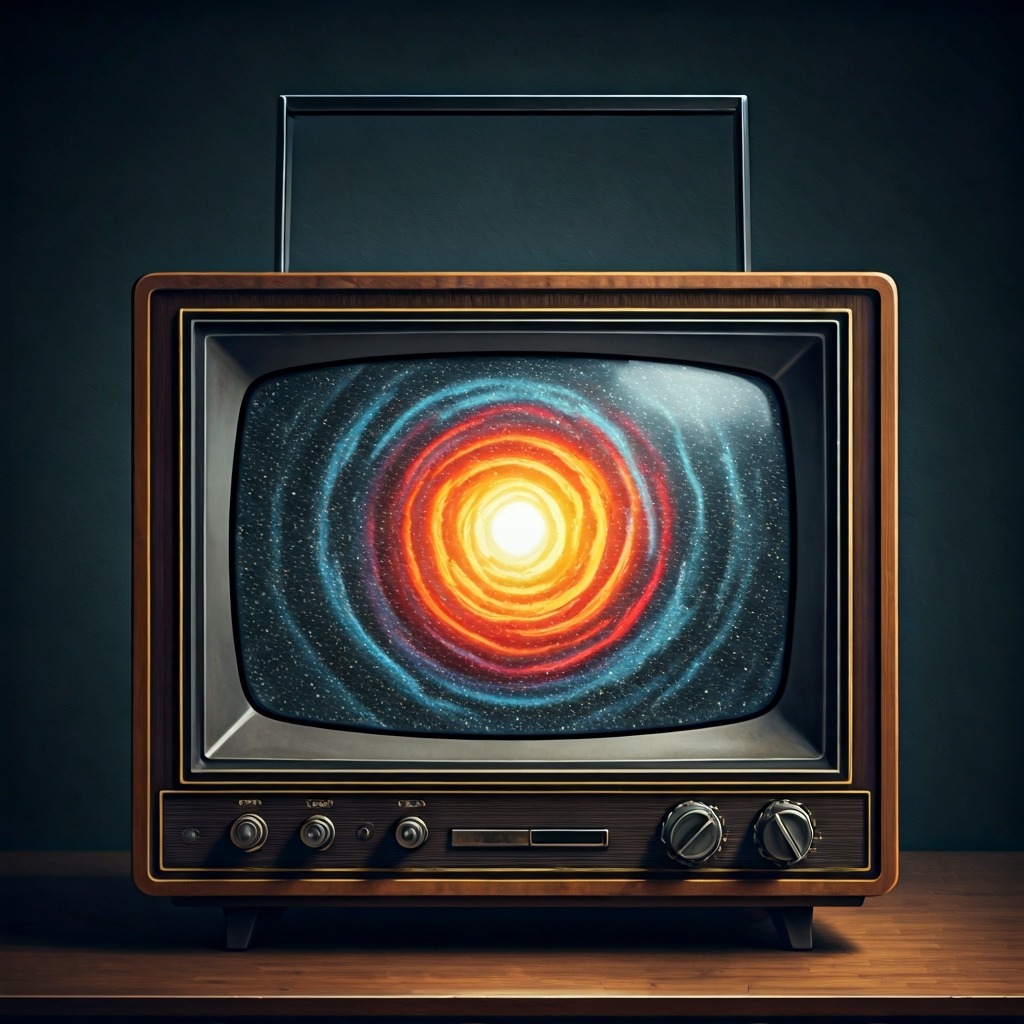
But here is the most mind-bending postscript to this whole saga: this ancient cosmic radiation is still all around us, all the time. If you’re old enough to remember analog televisions, you remember the “snow”—the black-and-white static dancing on the screen when you tuned to an empty channel. About 1 percent of that static was actually the direct result of your living room TV antenna picking up the Cosmic Microwave Background.
You were watching the birth of the universe, right there in your living room.
Sometimes, the most groundbreaking discoveries in human history start with a mess. The next time you’re frustrated by a problem you just can’t seem to fix, take a step back. You might just be looking at the wrong variable. Or, you might have just discovered the secrets of the cosmos hiding right beneath the pigeon droppings.