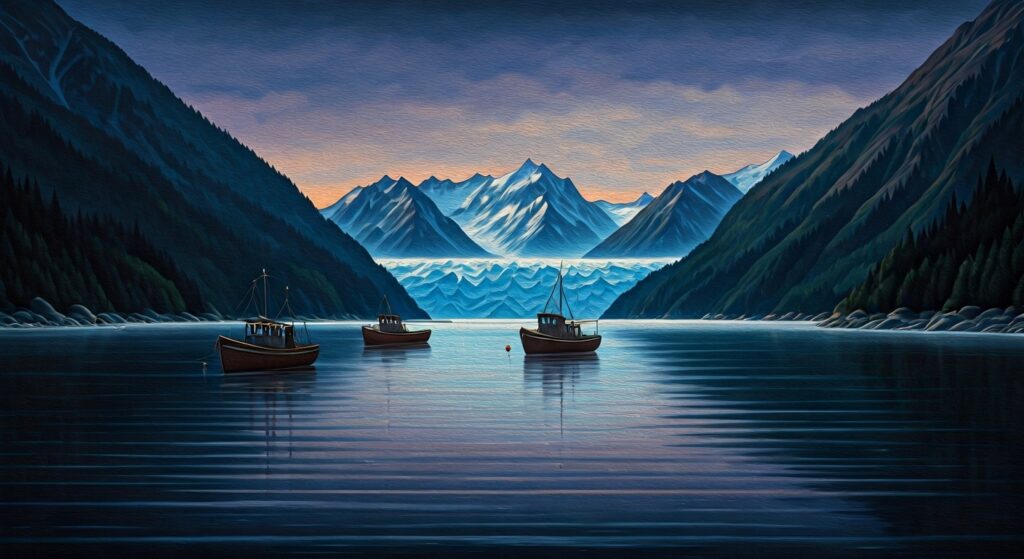
On the evening of July 9, 1958, the remote waters of Alaska’s Lituya Bay were a picture of pristine, untouched serenity. Three small fishing boats bobbed quietly on the glassy surface, their crews turning in for the night under the shadow of towering, glacier-carved mountains. The water was dead calm. But beneath the stillness, the unique topography of the bay was about to act as a catastrophic funnel. The fishermen were sleeping in the barrel of a loaded geological gun, entirely unaware that they were about to witness one of the most terrifying anomalies in human history.
The Mountain That Shattered
At 10:15 PM, the silence was violently torn apart. Deep beneath the earth, the Fairweather Fault ruptured, unleashing a massive 7.8 magnitude earthquake.
The seismic violence ripped through the mountains with deafening force. High above the Gilbert Inlet at the head of the bay, the earth simply gave way. An estimated 30 million cubic meters of rock and glacial ice sheared off the steep, jagged walls. Imagine a solid mass of stone and ice the size of a small city block plunging from an elevation of 3,000 feet directly into the deep, narrow waters below.
It was the geological equivalent of dropping a colossal bowling ball into a bathtub. But the splash it created was something straight out of a nightmare.
A Wave Taller Than the Empire State Building
The impact displaced an unfathomable volume of water in a matter of seconds. The initial splash surged up the opposite wall of the inlet to a mind-bending height of 1,720 feet (524 meters).
Let that sink in: the wave was significantly taller than the Empire State Building. It remains the tallest tsunami ever recorded in modern history. The sheer, unadulterated force of the water stripped away absolutely everything in its path—soil, ancient trees, and dense vegetation—leaving nothing but bare, scoured bedrock in its wake.
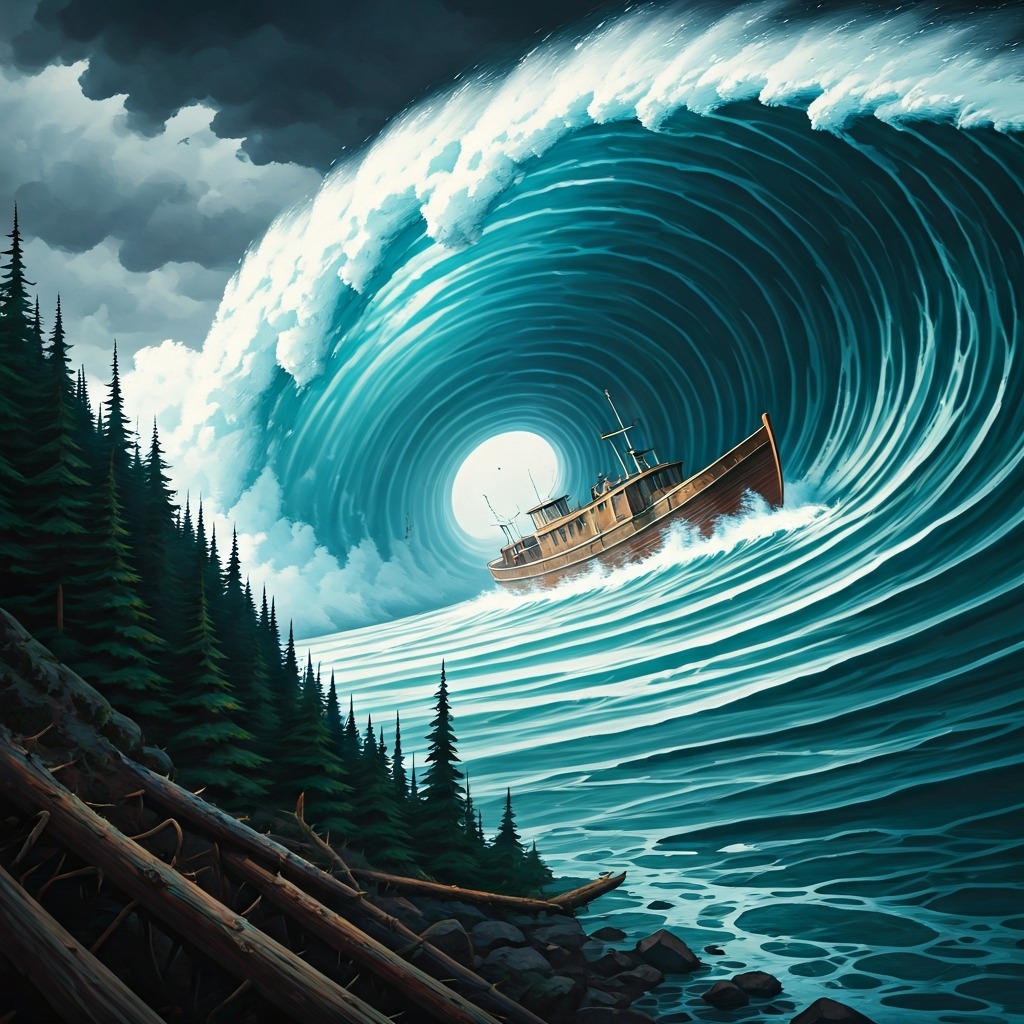
As the water crashed back down to earth, it didn’t just settle. It gathered itself into a localized megatsunami, a 100-foot-tall wall of churning, debris-filled water that began racing down the seven-mile length of the fjord toward the open ocean. And directly in its path were the three anchored fishing boats.
Surfing the Leviathan
The survival stories from that night are so miraculous they defy all logic.
Howard Ulrich and his seven-year-old son, Sonny, were asleep on their boat, the Edrie. Ulrich awoke to the apocalyptic roar of the earthquake and rushed to the deck, only to watch a monstrous wall of water hurtling toward them out of the darkness. There was no time to pull up the anchor. In a split-second decision that likely saved their lives, Ulrich let out all the anchor chain. As the monster wave hit, the Edrie didn’t snap or capsize. Instead, it was miraculously lifted by the massive swell. Ulrich and his son rode the crest of the wave high above the treetops before the boat was violently, but safely, deposited back into the churning water.
Near the mouth of the bay, Bill and Vivian Swanson were anchored on the Badger. The wave hit them with such ferocity that it lifted their vessel stern-first and carried it over the La Chaussee Spit—a forested sandbar—like a surfboard. Bill later recalled looking down at the tops of pine trees as they were swept over the spit. The Badger eventually crashed into the ocean swells and sank, but the couple managed to escape in a small skiff and were rescued hours later.
Tragically, the third boat did not share their luck. The Sunmore, operated by Orville and Mickey Wagner, was swallowed whole by the raging leviathan. Neither the boat nor the Wagners were ever found.
The Scar That Rewrote Science
Before that terrifying night in 1958, the scientific community had a very strict set of rules about how tsunamis worked. Scientists believed they were exclusively generated by the vertical displacement of the seafloor during earthquakes, which typically produced open-ocean waves no higher than a few dozen feet.
Lituya Bay completely rewrote the rulebook. It proved that massive landslides or rockfalls into confined bodies of water could generate megatsunamis of unimaginable, skyscraper-dwarfing heights.
Today, if you visit Lituya Bay, you can still see the “trimline”—a stark, razor-sharp boundary on the mountainside where the 1,720-foot wave stripped away the older, darker forests, leaving only younger, lighter-green vegetation in its wake. It is a permanent, chilling geological scar. A quiet reminder that nature is capable of unimaginable violence, and sometimes, reality is far more terrifying than fiction.