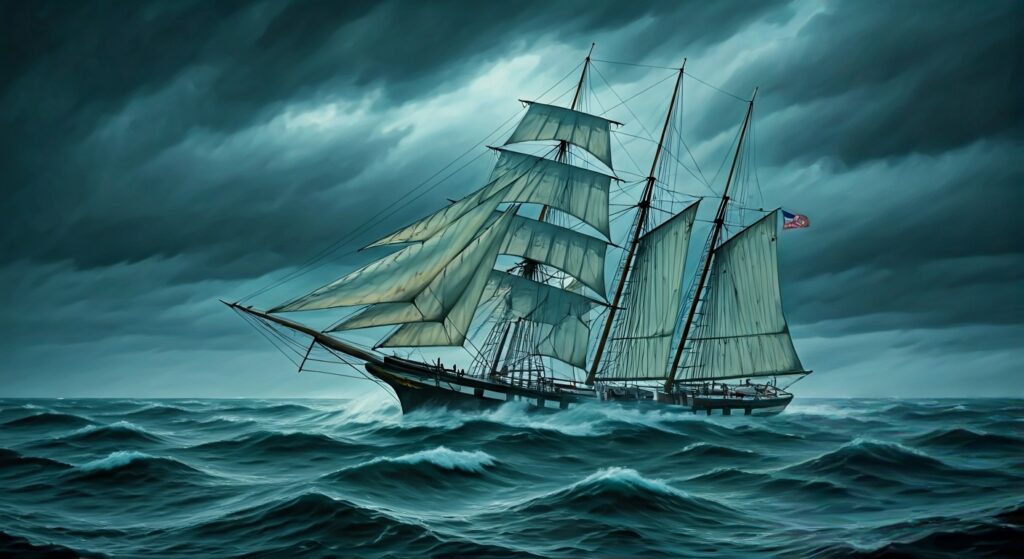
The freezing gales off Cape Hatteras, North Carolina, are unforgiving even on a good day. But on February 4, 1921, they served as the backdrop for a maritime nightmare. When the U.S. Coast Guard finally managed to board the Carroll A. Deering—a massive five-masted commercial schooner run hard aground on the treacherous Diamond Shoals—they braced themselves for a tragedy. Instead, they found an enigma.
A Feast Interrupted
The ship was a ghost town. The sails were still set, billowing uselessly in the violent winter wind. Down in the galley, a hot meal of ribs, peas, and coffee was laid out, seemingly abandoned mere moments before the first bite.
But the crew was gone.
Every personal belonging had vanished. The ship’s log, the navigation equipment, both anchors, and the two lifeboats were missing. Most chilling of all, the ship’s steering equipment had been deliberately smashed with a sledgehammer. The ocean hadn’t claimed the Deering by force—someone had intentionally killed the ship. To understand what happened to the men aboard, investigators had to look back to a sweltering port in the Caribbean, where a toxic mix of bad blood and mutinous whispers sealed their fate.
The Bad Blood of Barbados
Built in 1919, the Deering was a majestic vessel. In August 1920, she departed Norfolk, Virginia, bound for Rio de Janeiro with a heavy cargo of coal. The voyage was cursed from the start. When the original captain fell severely ill, he was replaced by Captain Willis Wormell, a retired veteran of the sea. Wormell needed a first mate, so he hired Charles B. McLellan.
It was a match made in hell. Wormell was an old-school, by-the-book captain; McLellan was a volatile hothead. Throughout the journey south, Wormell constantly complained about McLellan’s insubordination and his physical abuse of the crew.
The powder keg finally caught a spark on the return journey. Stopping in Barbados for supplies, McLellan got blackout drunk and began boasting loudly in the local taverns that he was the one who actually ran the ship, not the old man in the captain’s quarters. His drunken, violent ranting got him thrown in a local jail.
In a fatal error of judgment, Captain Wormell bailed his first mate out, brought him back aboard, and set sail for the eastern seaboard of the United States.
The Wrong Men on the Quarterdeck
The last confirmed sighting of the Deering alive with its crew occurred on January 28, 1921.
A man aboard the ship hailed the Cape Lookout Lightship in North Carolina, shouting over the crashing waves that the Deering had lost its anchors in a violent storm. He asked the lightship keeper to notify the ship’s owners.
But the keeper noticed something deeply disturbing. The man yelling the message didn’t look or act like an officer. Furthermore, the crew was casually milling about on the quarterdeck—an area of the ship strictly reserved for the captain and his officers. In the rigid hierarchy of 1920s maritime law, a crew hanging out on the quarterdeck was a massive, undeniable red flag.
Three days later, the ship was found wrecked in the Graveyard of the Atlantic.
Swallowed by the Graveyard
The bizarre circumstances surrounding the empty ship sparked a massive investigation involving five government departments, including the FBI under the direction of a young Herbert Hoover.
Theories ran wild. Was the ship hijacked by Bolshevik sympathizers? Did ruthless rumrunners murder the crew to steal the vessel for bootlegging? At one point, a message in a bottle washed ashore claiming the ship had been captured by pirates, though federal investigators quickly exposed it as a hoax.
The most logical—and widely accepted—theory remains mutiny. Given the intense animosity between Captain Wormell and First Mate McLellan, and the suspicious, rule-breaking behavior spotted by the lightship keeper, it is highly likely that McLellan and the crew overthrew the captain. Realizing they couldn’t sail a massive stolen schooner into a U.S. port without facing the gallows, they deliberately grounded the ship, smashed the steering, and fled in the lifeboats.
Despite international searches and one of the most exhaustive federal investigations of the era, no trace of the lifeboats, the missing logs, or the crew was ever found. Deemed a hazard to navigation, the haunting wooden skeleton of the Deering was dynamited into the sea. Today, it remains one of the greatest unsolved mysteries in American maritime history—a chilling reminder that the ocean is vast, dark, and excellent at keeping secrets.