If you believe modern reality television holds the monopoly on unhinged drama, you are looking in the wrong century. The Renaissance Vatican was a theater of ruthless ambition, and no family left a more scandalous legacy than the Borgias. But of all the whispered rumors and late-night Vatican secrets, one evening stands alone as the ultimate climax of papal decadence. The date was October 30, 1501. The setting: the heart of the holy world. What happened that night is a story so depraved that historians are still arguing over its reality five centuries later.
Descent into the Pope’s Private Quarters
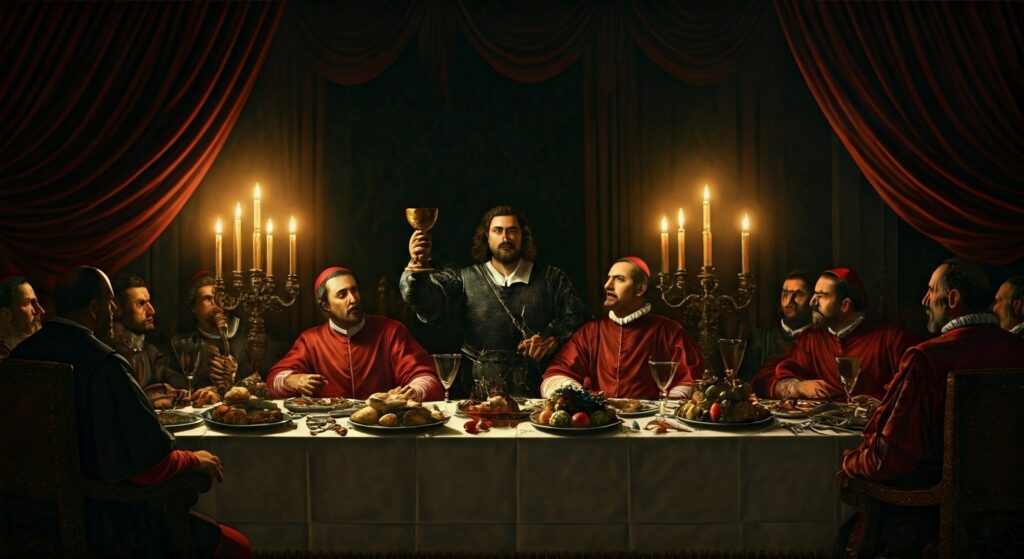
The host of this clandestine gathering was Cesare Borgia, the illegitimate son of Pope Alexander VI and the era’s most feared political mastermind. It was the eve of All Hallows, though the Borgias required no holiday to justify a spectacle. Cesare had arranged a private banquet deep within his personal apartments in the Apostolic Palace.
The guest list was highly exclusive, comprising the highest-ranking men of the papal court and fifty of Rome’s cortigiane oneste—elite courtesans renowned for their sharp wit, staggering beauty, and powerful clientele.
Initially, the evening masqueraded as a standard, albeit lavish, Renaissance feast. Wine flowed endlessly; the food was decadent; the music intoxicating. But as the plates were cleared, the entertainment took a sharp, surreal turn. The courtesans were invited to dance with the guests. Slowly, the heavy silk and velvet gowns slipped to the floor. Soon, the women were dancing entirely naked. Yet, this was merely the prologue to a much darker, more bizarre spectacle.
The Candelabras, the Chestnuts, and the Chaos
As the music swelled to a fever pitch, the servants received a highly unusual command. The massive, glowing candelabras illuminating the banquet tables were brought down and placed directly onto the floor.
Next came the chestnuts.
Handfuls of raw chestnuts were scattered across the stone tiles, rolling dangerously close to the open flames. According to the accounts, the fifty naked courtesans were instructed to drop to their hands and knees, crawling through the fiery maze of hot wax to gather the chestnuts.
Watching this surreal ballet from the shadows were the most powerful figures in Rome: Pope Alexander VI, Cesare Borgia, and, allegedly, Cesare’s sister, Lucrezia. But the “Banquet of Chestnuts” was not merely a visual feast—it was a twisted competition. As the night wore on, the Vatican apartments devolved into an explicit contest. Prizes of fine silk tunics, luxurious cloaks, and exquisite shoes were brought out, awarded to the male guests who could perform the highest number of sexual acts with the courtesans.
The Bureaucrat Who Kept the Receipts
It sounds like the fever dream of a sensationalist playwright or a wild piece of anti-papal fiction. And under normal circumstances, historians would dismiss it as exactly that. But the Banquet of Chestnuts cannot be easily erased from history, entirely because of the man who wrote it down.
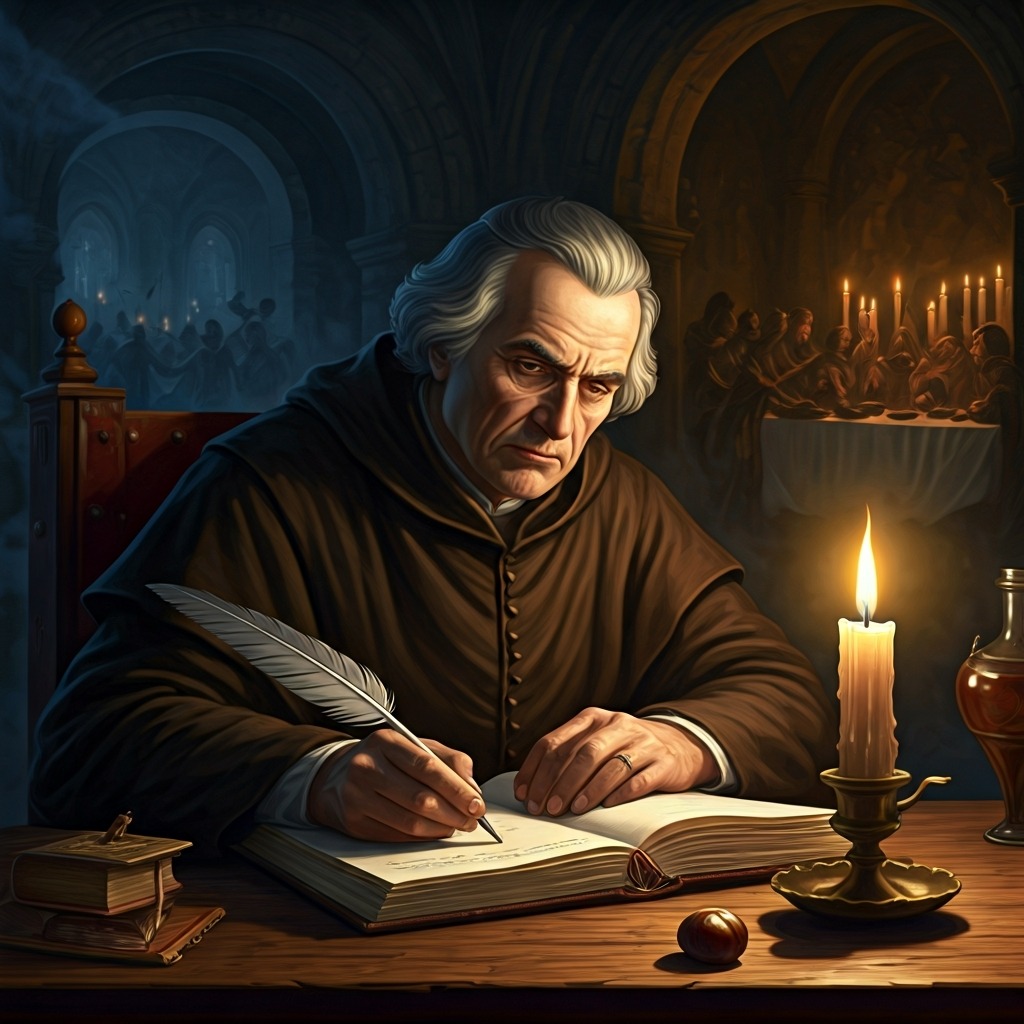
The sole contemporary source for this night of debauchery is the Liber Notarum, the meticulous diary of Johann Burchard. Burchard was no gossipy rival. He was the Papal Master of Ceremonies—the ultimate, humorless bureaucrat of the Vatican. His diaries are legendary for being incredibly dry and obsessively detailed. He recorded the exact length of candles used in mass with the same mundane, administrative tone he used to describe a murder.
Because Burchard was such a literal, uncreative record-keeper, many historians believe his account of the chestnut-gathering is absolute, unvarnished fact. He simply lacked the imagination to invent a story this wildly theatrical.
Historical Smear or Unvarnished Truth?
Yet, the mystery of what truly transpired in those candlelit apartments remains fiercely debated.
Following the Borgias’ spectacular fall from power, Protestant reformers and rival historians weaponized the Banquet of Chestnuts, holding it up as definitive proof of Catholic corruption. It was the perfect narrative to demonstrate that the Vatican had lost its holy way.
Borgia apologists, however, argue that the story reeks of political sabotage. The Borgias had ruthless enemies—most notably the Della Rovere family—who would have stopped at nothing to circulate a fabricated smear campaign.
The most glaring red flag in Burchard’s account? The presence of Lucrezia Borgia. At the time of the banquet, Lucrezia was deep in preparations for her highly strategic marriage to Alfonso d’Este. Given the delicate political tightrope she was walking to secure her new life in Ferrara, it is highly unlikely she would have risked her reputation by sitting in a room watching an explicit contest on her brother’s floor.
So, did the Banquet of Chestnuts actually happen? Was it a literal event recorded by a dry bureaucrat, or a politically motivated exaggeration that spiraled into legend? Like the best historical mysteries, the absolute truth is buried under centuries of rumors, rivalries, and shadows. But whether fact or fiction, the Banquet of Chestnuts remains a brilliant, terrifying mirror of the Renaissance Vatican—a place where power, scandal, and theatrical decadence ruled the night.