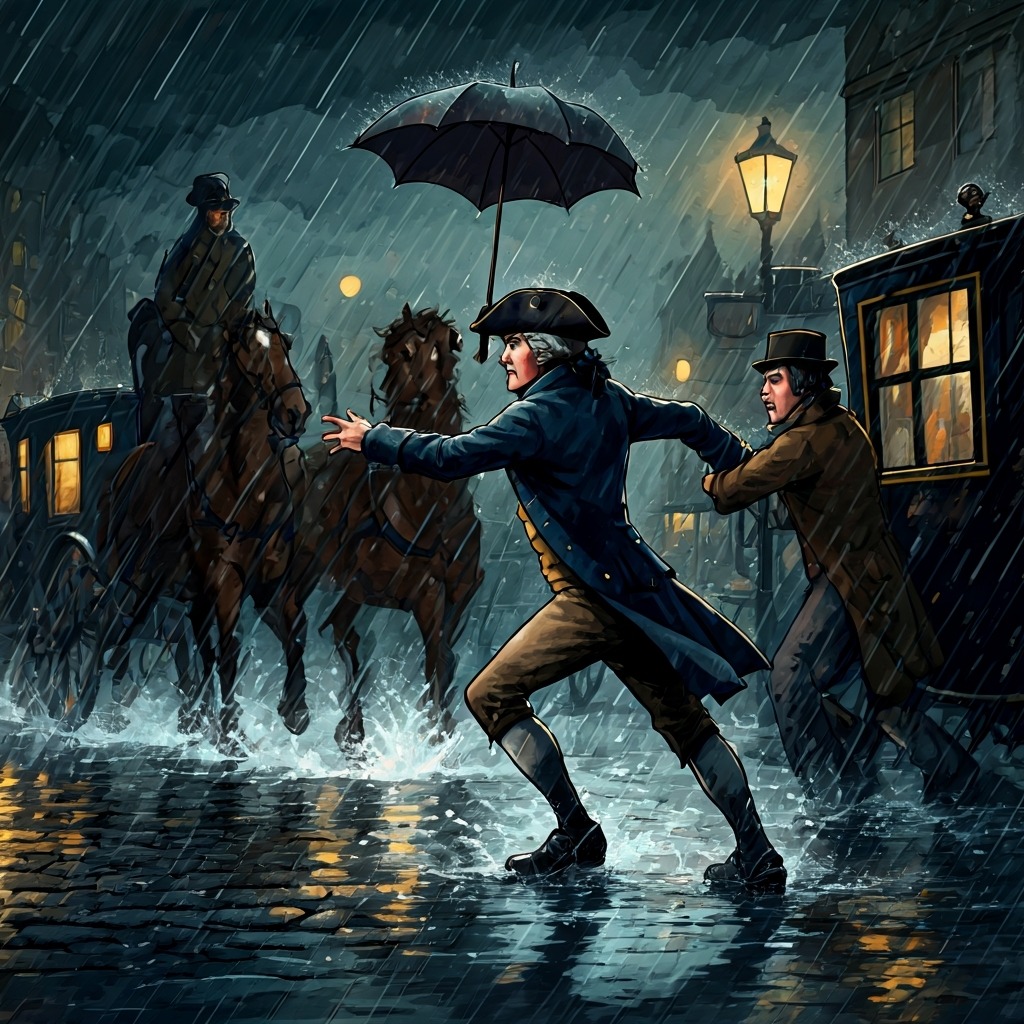
The sky darkens. The first drops fall. You reach into your bag and pull out a cheap, collapsible canopy, popping it open without a second thought. But as you shield yourself from the downpour, you are wielding an object with a dark, scandalous past. Before it was something you accidentally left on the subway, the umbrella was a sacred symbol of ancient bloodlines, a fiercely contested gendered accessory, and the catalyst for a violent street war in 18th-century London.
Let’s open up the hidden history of how we stay dry.
The Canopy of the Gods
If you carried an umbrella 3,000 years ago, you weren’t trying to protect your clothes from a drizzle—you were broadcasting your proximity to the divine.
The word itself betrays its original identity. It derives from the Latin root umbra, meaning shade or shadow. In the blistering heat of ancient Egypt, Mesopotamia, and India, the umbrella functioned exclusively as a parasol. It was a potent, highly regulated symbol of wealth and absolute power. In Egypt, these early sunshades were breathtakingly crafted from interwoven palm leaves and exotic feathers, held aloft over pharaohs to mimic the protective canopy of the heavens.
This exclusivity was lethal. In the ancient Assyrian city of Nineveh, only the reigning monarch was legally permitted to have a sunshade held over him. To possess one as a commoner was an unthinkable usurpation of royal aesthetics—a crime that could cost you your life.
A Lacquered Dynasty
The transition from a sacred sunshade to a pragmatic shield against the rain was a triumph of ancient fashion engineering, and we have the Chinese to thank for it.
By at least the 11th century BC, Chinese artisans began waterproofing their delicate silk and paper parasols. They coated them with thick layers of wax and lacquer, creating the world’s first true rain umbrellas. But even as its function shifted, its status as a strict class marker did not. The Chinese imperial court instituted a rigid, legally enforced color palette. The emperor’s umbrella was an extravagant, multi-tiered masterpiece colored strictly in yellow or red, while the common folk were restricted by law to carrying basic blue.
Social Suicide on a Stick
Despite its ancient pedigree, the umbrella’s introduction to Western society was a total public relations disaster.
While wealthy women in ancient Greece and Rome occasionally used them, the umbrella vanished from Europe during the dark expanse of the Middle Ages. When it finally resurfaced in 16th and 17th-century Italy and France, it was strictly branded as a delicate female accessory.
By the time the umbrella reached 18th-century England, carrying one was the ultimate fashion faux pas for a man. It was heavily stigmatized as an effeminate, “Frenchified” novelty. Worse still, it was a glaring, public admission of poverty. In the rigid class structure of Georgian London, walking in the rain with an umbrella broadcasted to the entire city that you couldn’t afford to hire a horse-drawn carriage. It was social suicide on a stick.
The Eccentric Who Weathered the Storm
Every revolution needs a stubborn visionary, and the umbrella’s savior was Jonas Hanway.
Hanway was an eccentric English traveler, writer, and philanthropist who had spent time in France and Persia, where he noticed men using umbrellas without a shred of social panic. In the early 1750s, Hanway returned to London and made a radical decision: he stepped out into the rainy, cobblestone streets carrying a waterproof umbrella.
The backlash was instant and vicious. Passersby hurled insults and pelted him with rubbish. But the most dangerous threat came from the hackney coachmen. These carriage drivers relied entirely on miserable weather for their income. If Londoners realized they could walk in the rain without ruining their clothes, the coachmen’s profits would evaporate overnight.
The drivers viewed Hanway as an existential threat. They would purposely steer their carriages through deep gutters to splash him with filthy puddle water. The hostility soon escalated to attempted murder. On one particularly dramatic occasion, a furious coachman tried to run Hanway over with his carriage. Hanway, proving that high fashion can double as self-defense, used his heavy umbrella to thrash the driver in the middle of the street.
For nearly thirty years, Hanway stubbornly carried his umbrella everywhere he went. He endured the mockery until, slowly, the jeers faded. By the time he died in 1786, the taboo had broken. Men across England began carrying them, initially calling the accessory a “Hanway.”
Bones of Steel
Hanway fought the social battle, but the Industrial Revolution gave the umbrella its modern armor.
Early European umbrellas were cumbersome, heavy things made of oiled canvas stretched over fragile wood or whalebone ribs. They were clumsy, prone to snapping in the wind, and incredibly awkward to carry. That all changed in 1852 when an English industrialist named Samuel Fox revolutionized the design. Fox invented the ‘U’ shaped steel-ribbed umbrella, a brilliant feat of engineering that made the canopy lightweight, highly durable, and affordable to mass-produce.
Fox’s sleek steel frame transformed the umbrella from a controversial royal sunshade into an essential, democratized tool for everyday life.
So, the next time you pop open your umbrella to shield yourself from a sudden downpour, take a moment to appreciate the history you’re holding. You aren’t just staying dry; you are wielding the ancient shadow of pharaohs, the lacquered engineering of emperors, and the stubborn, street-brawling spirit of Jonas Hanway.