The story of human flight doesn’t begin on a windy beach in Kitty Hawk. It begins over a millennium earlier, on the jagged precipice of a sun-drenched mountain in southern Spain.
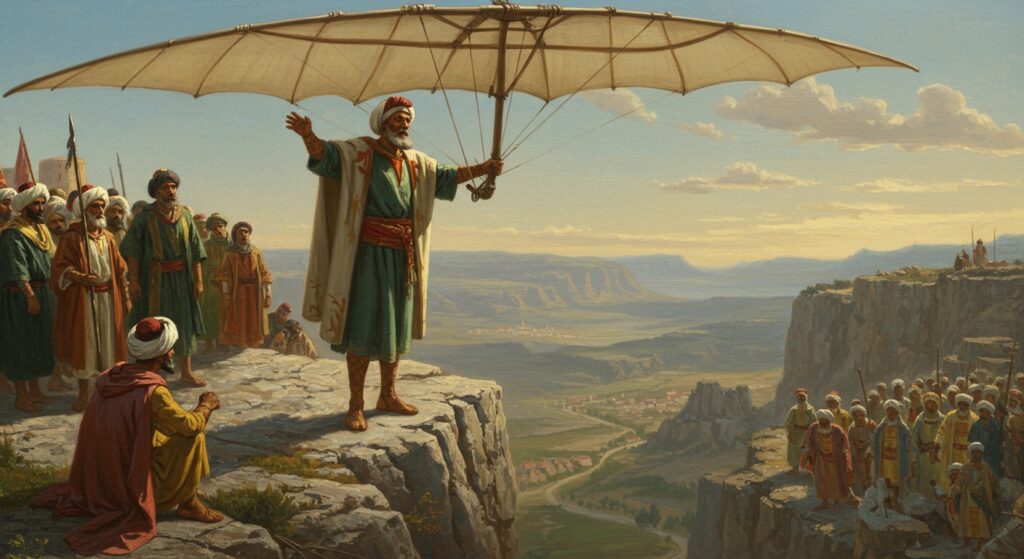
The year is 875 AD. A 65-year-old man stands at the edge of Jabal al-‘Arus—the Mount of the Bride—looking down at the unforgiving rocks below. Strapped to his arms and torso is a bizarre contraption of lightweight wood, fine silk, and real eagle feathers. A massive crowd has gathered at the base of the mountain, murmuring in horrified anticipation. They are convinced they are about to witness a highly elaborate, public suicide.
Instead, they are about to witness history.
This isn’t the myth of Icarus. This is the very real, pulse-pounding story of Abbas Ibn Firnas, a man who looked at the sky and decided it was merely a puzzle waiting to be solved.
The Wizard of Al-Andalus
To understand why a man in his golden years would risk certain death, you have to understand who he was. In the 9th century, the Umayyad Caliphate of Cordoba was the beating heart of the Islamic Golden Age. It was a metropolis of paved streets, running water, and sprawling libraries that held the accumulated knowledge of the world.
In this city of geniuses, Ibn Firnas was a titan. He wasn’t some eccentric daredevil; he was a highly respected polymath, physician, and engineer. He had already revolutionized local industry by discovering a method to manufacture colorless glass from sand and stones. He invented “reading stones”—the ancestors of modern magnifying glasses—and designed a complex water clock called the al-Maqata.
But his most secretive and astonishing creation was hidden inside his own home: a mechanized planetarium that simulated the movement of the stars. He even engineered artificial thunder and lightning to shock and awe his guests.
Ibn Firnas was a man obsessed with the heavens. And eventually, merely looking at the sky wasn’t enough. He wanted to touch it.
Silk, Wood, and a Leap of Faith
For years, Ibn Firnas obsessively studied the flight of birds. He observed how the wind caught their wings and how they rode unseen currents in the air. Applying his formidable engineering mind to biology, he constructed what is now widely considered the first recorded attempt at heavier-than-air human flight.
His machine was a rudimentary glider. He built a lightweight wooden frame, stretched fine silk across it, and meticulously covered the fabric with real eagle feathers.
Standing on the precipice of Jabal al-‘Arus, the 65-year-old inventor took a deep breath. He spread his feathered arms, looked out over the sprawling landscape of Cordoba, and stepped off the edge.
Defying Gravity
For a heart-stopping second, he plummeted. The crowd gasped, bracing for a gruesome end.
But then, a miracle of physics occurred. The silk snapped taut. The wooden frame groaned but held. The eagle feathers caught the updraft, and Abbas Ibn Firnas stopped falling.
He was flying.
Eyewitness accounts from the era report that Ibn Firnas didn’t just fall with style; he remained airborne for several minutes. Some historical whispers claim he soared high above the awe-struck crowd for up to ten minutes, gliding a considerable distance. In that breathtaking span of time, he successfully transitioned the dream of flight from ancient mythology into empirical, scientific reality.
But as the ground began to rush up to meet him, a terrifying flaw in his design revealed itself.
The Crucial Missing Piece
Ibn Firnas was coming in too fast, and he had absolutely no way to slow down.
The descent turned into a nightmare. Without the ability to brake or steer, the inventor slammed violently into the earth. The glorious flight ended in a catastrophic crash landing that left the elderly polymath with severe injuries to his back.
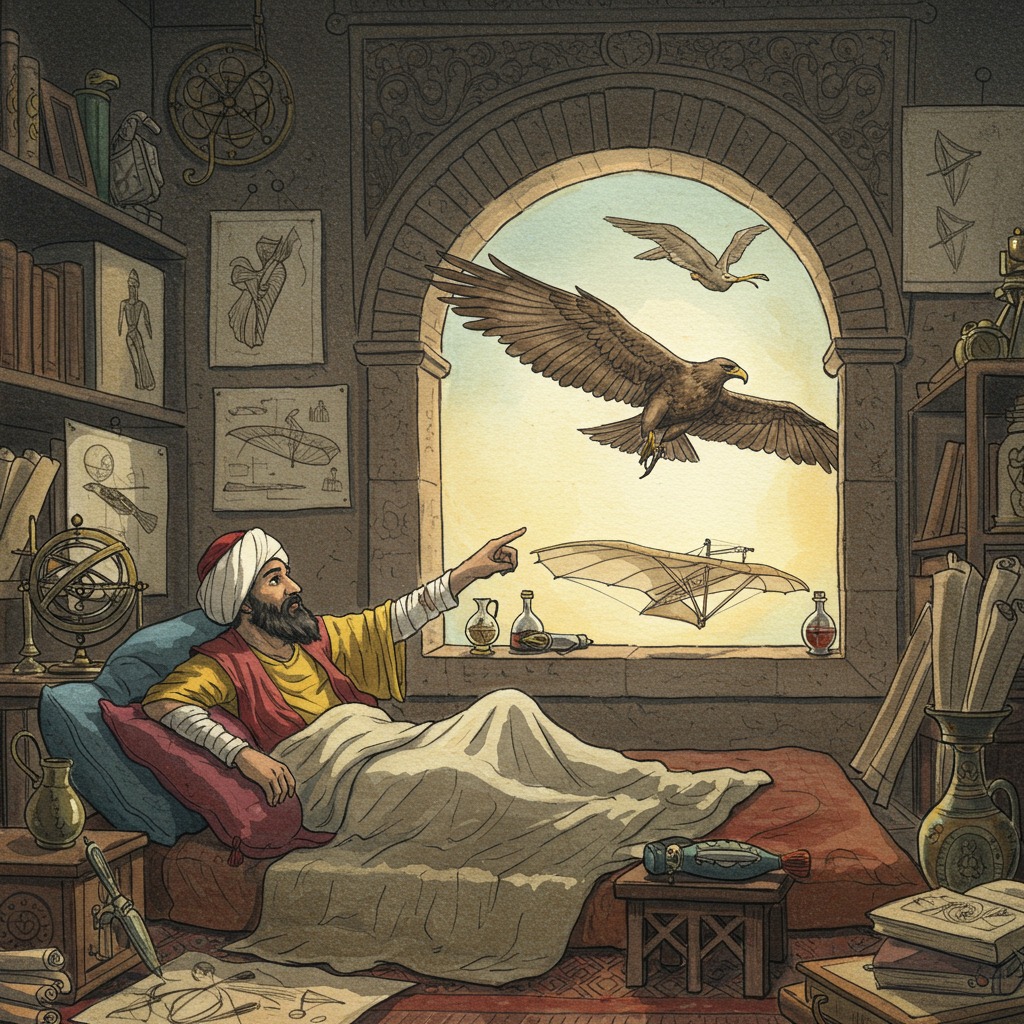
As he lay in bed for months, agonizing over his shattered body, Ibn Firnas didn’t curse the wind or blame the gods. Instead, he did what a true scientist does: he analyzed the data.
In a flash of brilliant insight, he realized exactly what had gone wrong. He had studied the wings of eagles, but he had completely ignored their hindquarters. He had forgotten the tail.
He deduced that birds do not merely use their wings to fly; they use their tails to stall, steer, and create the necessary drag to control their speed during a descent. By omitting a tail mechanism, he had stripped his glider of its landing gear. This painful realization was one of the earliest recorded breakthroughs in the mechanics of flight control.
Saved by a Rival’s Mockery
How do we know the intimate details of a flight that happened over a millennium ago? The survival of this story is a mystery all its own.
The most detailed surviving account comes from a 17th-century Moroccan historian named Ahmed Mohammed al-Maqqari. Because al-Maqqari wrote his prose nearly seven centuries after the event, some modern historians view the exact specifics with cautious skepticism.
However, al-Maqqari didn’t invent the story. He based his writings on primary sources that have since been lost to time, most notably a 9th-century poem by Mu’min ibn Said.
The twist? Mu’min ibn Said wasn’t a friend of Ibn Firnas—he was a bitter court rival. Following the crash, Mu’min wrote a satirical “diss track” in verse, mocking the inventor by claiming he tried to fly “faster than the phoenix.” Ironically, it was this very mockery that provided the concrete historical proof that Ibn Firnas’s audacious leap truly happened.
Today, Abbas Ibn Firnas is rightfully remembered as a pioneer who risked everything to conquer the skies. His name now graces bridges in Spain, airports in the Middle East, and even craters on the Moon. It is a fitting, immortal legacy for the man who dared to fly—even if he forgot how to land.