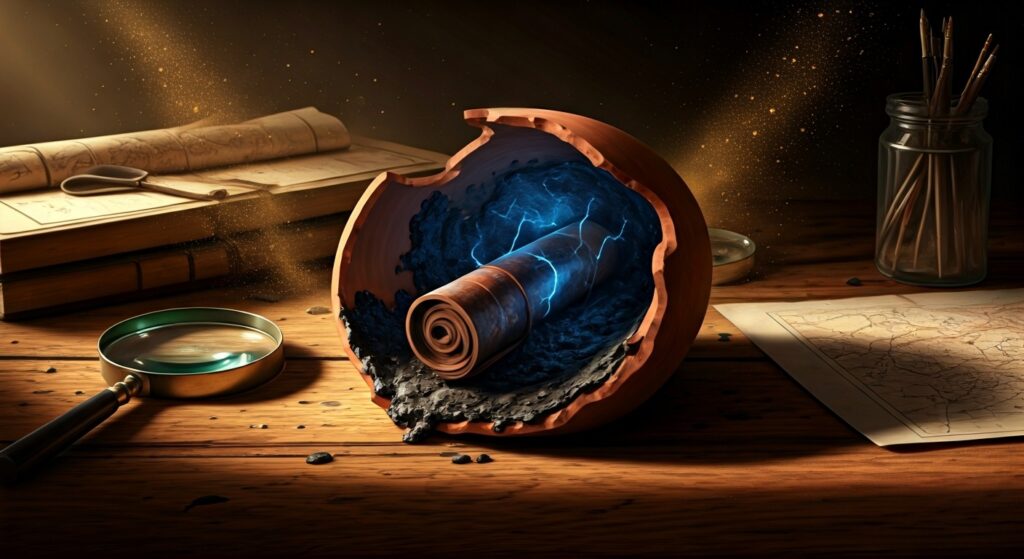
In 1936, beneath the sun-baked sands of Khujut Rabu, just outside Baghdad, archaeologists unearthed a five-inch terracotta pot. It was unassuming. Ordinary. Until they looked inside.
Within the clay walls rested a copper cylinder, meticulously rolled from a single sheet of metal. Suspended perfectly in its center was an iron rod, the entire contraption sealed tight with a thick plug of asphalt. Dated to the Parthian or Sasanian period—somewhere between 250 BC and AD 640—the bizarre artifact sat quietly in a museum until 1940, when German archaeologist Wilhelm König made a startling leap of logic.
Looking at the copper, the iron, and the strange acidic residue left inside, König hypothesized that the artifact was a galvanic cell.
In plain English? He believed he was looking at a 2,000-year-old battery.
The Impossible Machine
König didn’t just throw this theory into the void; he had a practical application in mind. He suggested these ancient batteries were used to electroplate gold onto silver objects.
The most thrilling part of König’s theory was that, from a purely scientific standpoint, it actually worked. If you filled the terracotta jar with an acidic electrolyte available in antiquity—like grape juice, lemon juice, or vinegar—the chemical reaction between the copper and the iron generated a charge.
Researchers in the 1940s built replicas to test the theory. Decades later, even the cast of the television show MythBusters got in on the action. The results were undeniable: the replica devices produced a weak electrical current ranging from 0.5 to 2 volts.
For a fleeting moment, it seemed the ancient Middle East had beaten Alessandro Volta to the invention of the battery by nearly two millennia. The history of technology was on the verge of being completely rewritten.
The Short Circuit
But history is rarely that simple, and this ancient electrical theory had a fatal flaw. In fact, it had several.
Today, the scientific and archaeological communities overwhelmingly reject the battery hypothesis. When researchers looked past the sheer novelty of the idea and examined the physical evidence, the electrical theory completely short-circuited.
First, there was the asphalt seal. It completely covered the top of the iron rod. If this were a battery, there would be absolutely no conductive path to connect a wire without breaking the seal every single time it was used.
Second, if ancient artisans were electroplating gold, where was the equipment? No wires, no ancient electrical terminals, and absolutely no electroplated artifacts from that era have ever been found in the region. Ancient craftsmen were indeed gilding objects, but they used a well-documented, highly toxic chemical process called fire-gilding, which relied on mercury, not electricity.
Finally, the math simply didn’t add up. The electrical output of a single five-inch jar is so minuscule that a massive network of these jars, connected in series, would be required to perform any practical electroplating. No evidence of such a network exists.
Magic, Not Mechanics
If it wasn’t powering an ancient metal-shop, what exactly was the Baghdad Battery?
The truth is far more poetic than a parlor trick of ancient electricity. The most widely accepted explanation among historians is that these jars were storage vessels for sacred scrolls or magical incantations. Similar vessels have been discovered in nearby Seleucia, serving exactly this purpose.
Picture this: a vital piece of papyrus or parchment, inscribed with protective magic or sacred text, is carefully wrapped around the iron rod. It is placed inside the copper cylinder for safekeeping, slipped into the terracotta pot, and sealed tightly with asphalt to protect it from the harsh desert elements.
Over the centuries, the organic material of the scrolls naturally decayed. As the papyrus broke down, it left behind a slightly acidic organic residue. It was this rotting paper—not ancient lemon juice—that caused the mysterious corrosion on the iron rod.
The Baghdad Battery remains a fascinating intersection of ancient materials and modern scientific curiosity. Its ability to hold an electrical charge is a complete, coincidental byproduct of its construction. It wasn’t built to house a spark of electricity; it was built to protect ancient words. And in the grand sweep of history, that might just be the most powerful energy source of all.