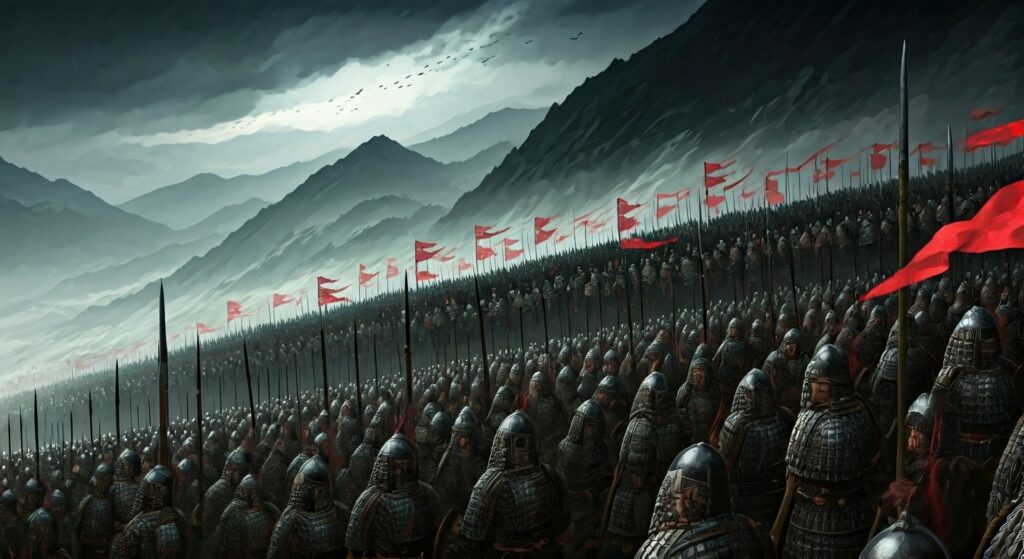
Imagine a military force so colossal that its marching columns stretch for hundreds of miles, a tidal wave of armor and steel poised to swallow an entire kingdom. In 612 AD, the Sui Dynasty unleashed exactly that upon the northern Korean kingdom of Goguryeo. But when this unstoppable, overwhelmingly massive military machine met a commander who knew exactly how to weaponize their own size against them, the result was one of the most terrifying slaughters in human history.
This is the story of the Battle of Salsu, a masterclass in psychological warfare, scorched-earth tactics, and catastrophic environmental engineering.
The Million-Man March to Oblivion
In the early 7th century, the Sui Dynasty had successfully unified China after centuries of chaotic division. Emperor Yang of Sui was hungry for absolute regional dominance, and Goguryeo defiantly refused to bend the knee.
Emperor Yang’s response was to assemble a roster so massive it defies modern comprehension. According to historical records, the Sui invasion force boasted 1.13 million combat troops, supported by millions more in logistical personnel. While modern historians debate the exact figures—feeding that many people is a logistical nightmare that would bankrupt a modern nation—there is no denying the Sui army was an apocalyptic force of humanity.
Yet, when this massive army hit the Liao River and the fortress of Liaodong, they slammed into a brick wall. Frustrated by the grinding stalemate, Emperor Yang called an audible. He detached an elite strike force of 305,000 men, led by generals Yuwen Shu and Yu Zhongwen, to bypass the border forts and march straight for the Goguryeo capital of Pyongyang.
They believed it would be a swift, glorious decapitation strike. They had no idea they were walking into a meticulously laid trap.
Chasing a Phantom
Defending Goguryeo was General Eulji Mundeok. Eulji knew that engaging 305,000 elite troops in a pitched battle would be statistical suicide. So, he simply refused to fight.
Instead, he orchestrated a brilliant campaign of scorched earth and psychological torment. He ordered his troops to engage the Sui army and immediately retreat. He feigned defeat, faked surrenders, and pulled the Sui forces deeper into hostile, barren territory. At one point, Eulji’s forces reportedly “retreated” seven times in a single day.
To the arrogant Sui generals, it looked as though they were routing a cowardly enemy. In reality, Eulji was stretching the Sui supply lines to their absolute breaking point. The Sui soldiers were lugging incredibly heavy equipment, their rations were rapidly depleting, and every step forward took them further from safety. They were starving, exhausted, and chasing a ghost.
The Ultimate Insult
As the Sui army finally neared Pyongyang, Eulji Mundeok decided to conduct his own reconnaissance. Under the guise of a diplomatic envoy negotiating a surrender, he strolled directly into the belly of the beast: the Sui camp.
While the Sui commanders believed they were finally securing their victory, Eulji was secretly taking inventory. He noted the hollow, sunken eyes of the soldiers. He saw the empty supply wagons. He realized this “elite” army was running on fumes.
After returning safely to his own lines, Eulji sent a famously mocking poem directly to the Sui commander, Yuwen Shu:
“Your divine plans have plumbed the heavens; Your subtle reckoning has spanned the earth. You win every battle, your military merit is great. Why then not be content and stop the war?”
It was a masterpiece of 7th-century psychological warfare, carrying a chilling subtext: I know you are starving. I know you cannot breach my capital. You have already lost.
Realizing they had been completely outmaneuvered and were facing an impenetrable city with zero food, Yuwen Shu ordered his army to retreat.
A Watery Grave at Salsu
The retreat was exactly what Eulji Mundeok had been waiting for.
As the starving, demoralized Sui army marched back toward China, they had to cross the Salsu River (the modern-day Chongchon River). When they arrived, the water level was surprisingly low. It looked like an easy ford. But the shallow water was no act of nature.
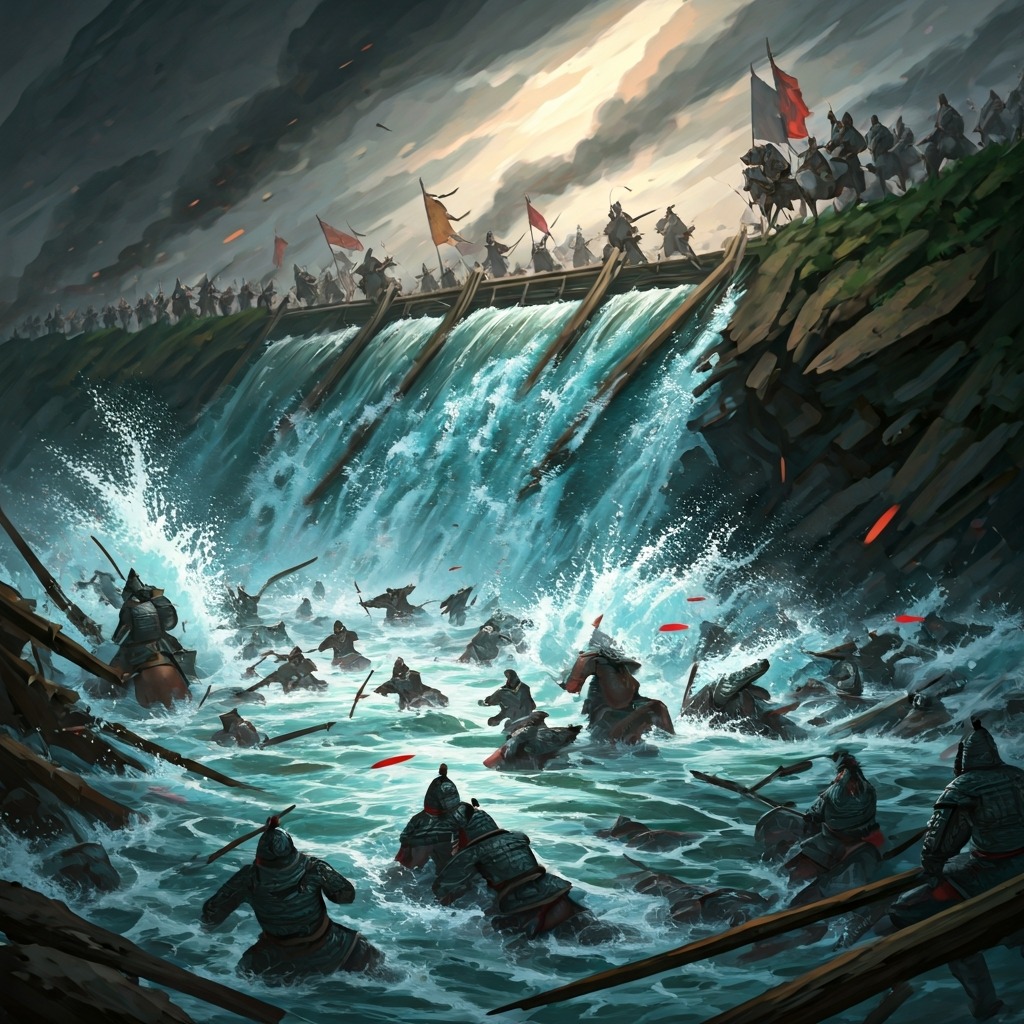
Miles upstream, hidden from the Sui scouts, Eulji Mundeok had ordered his men to construct a massive earthen dam. He had literally altered the hydrology of the region to set the ultimate snare.
The Sui forces began to cross. When they were halfway across the riverbed—their formations bottlenecked, sluggish, and completely vulnerable—Eulji gave the signal.
They breached the dam.
A catastrophic wall of water roared down the river valley. It slammed into the Sui army, instantly sweeping away thousands of men and severing the massive force in two. Panic erupted. Men weighed down by heavy armor and weakened by starvation had no chance against the churning floodwaters.
As the river swallowed the vanguard, Goguryeo cavalry and infantry descended from the surrounding hills to finish the job.
The Collapse of an Empire
What followed was not a battle; it was an absolute slaughter. The Goguryeo forces ambushed the chaotic, drowning remnants of the Sui army, turning the retreat into a complete rout.
The statistics of this defeat are staggering. Out of the 305,000 elite Sui troops who had crossed the Yalu River to take Pyongyang, a mere 2,700 men survived to limp back to the Liaodong Peninsula. It remains one of the most devastating casualty rates in the history of warfare.
The Battle of Salsu was more than a military victory; it was a dynasty-ender. The catastrophic loss of 300,000 elite troops, combined with the astronomical financial cost of the campaign, completely bankrupted the Sui government. Widespread peasant rebellions ignited across China. Just six years later, in 618 AD, Emperor Yang was assassinated, and the Sui Dynasty collapsed entirely, paving the way for the Tang Dynasty.
Today, General Eulji Mundeok is revered as one of Korea’s greatest national heroes—a brilliant tactician who used dirt, water, and a sarcastic poem to annihilate an empire.