The mud of Brittany was already slick with the blood of a proxy war, but on a crisp spring morning in 1351, sixty men gathered to spill even more—by choice. History is littered with battles of grand strategy and sweeping conquests, but few encounters match the sheer, visceral intimacy of the Combat of the Thirty. It was a bizarre, bloody, and entirely unnecessary showdown that proves the medieval era was just as dramatic, petty, and ruthless as the legends suggest.
A Challenge Born in a Toxic Proxy War
To understand the carnage, you have to look at the War of the Breton Succession—a messy, localized proxy conflict baked right into the middle of the even messier Hundred Years’ War. Brittany was being torn apart by two rival factions: the French-backed House of Blois and the English-backed House of Montfort.
By March of 1351, the local peasantry was bearing the absolute worst of the devastation. Enter Jean de Beaumanoir, the captain of the French-supported Blois faction at Josselin Castle. Sick of watching the countryside burn and his people suffer, Beaumanoir issued a chillingly formal ultimatum to his rival, Robert Bemborough, the captain of the English-supported Montfortist faction at Ploërmel Castle.
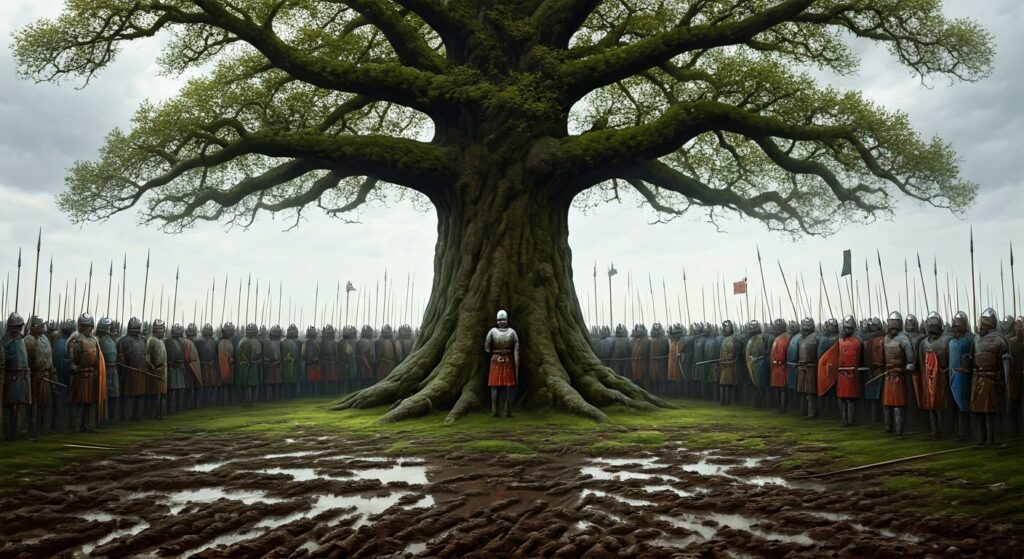
Beaumanoir’s proposition was simple but deadly: a judicial combat to settle their differences once and for all, keeping collateral damage to a minimum. They agreed to a highly choreographed, 30-on-30 deathmatch at the Chêne de Mi-Voie—the Halfway Oak—a solitary tree situated perfectly between their two fortresses.
The Ultimate 30-on-30 Throwdown
On March 26, 1351, the two sides met at the oak tree. Beaumanoir arrived with a squad of thirty strictly Breton knights and squires. Bemborough rolled up with a hardened, mixed mercenary crew of English knights, squires, and several German, Flemish, and Breton fighters.
The rules of engagement were steeped in a strict chivalric code. They were to fight entirely on foot. Their weapons of choice? A brutal, heavy assortment of swords, daggers, battle-axes, and spears.
When the signal was given, the sixty men slammed into each other in a chaotic, grinding melee of steel and armor. There was no grand strategy, no flanking maneuvers—just thirty-on-thirty hand-to-hand combat in the mud. It was grueling, suffocating, and incredibly bloody. As the hours dragged on, armor grew impossibly heavy. Men collapsed from sheer exhaustion as much as from their gaping wounds.
Halftime, Wine, and a Legendary Taunt
Then, the unthinkable happened. The battle became so physically taxing that both sides mutually agreed to call a time-out.
Right in the middle of a deathmatch, the surviving combatants separated. They sat down on the blood-soaked grass, removed their dented helmets, tended to their injuries, and literally drank wine together. It was a surreal moment of chivalric respect amidst absolute butchery.
During this bizarre intermission, a heavily bleeding and exhausted Beaumanoir asked for a cup of water. His companion, the ruthless Geoffroy du Bois, looked at his captain and delivered what remains one of the darkest, most metal taunts in recorded history:
“Drink thy blood, Beaumanoir, and thy thirst will pass.”
It was exactly the kind of grim motivation needed to get a medieval knight back on his feet.
Breaking the Rules (and the Shield Wall)
When the recess ended, the slaughter resumed with renewed ferocity. The turning point finally came when a French fighter struck down the English captain, Robert Bemborough, and the merciless Geoffroy du Bois stepped in to finish him off.
You might expect the loss of their captain to cause the English-backed mercenaries to scatter. Instead, it galvanized them. The surviving Montfortist fighters locked their shields together, forming a tight, impenetrable defensive circle like a steel porcupine. The exhausted French Bretons threw themselves against the wall of shields, but they couldn’t break through. The deathmatch had devolved into a grueling stalemate.
That is, until a French squire named Guillaume de Montauban decided he was done playing by the rules.
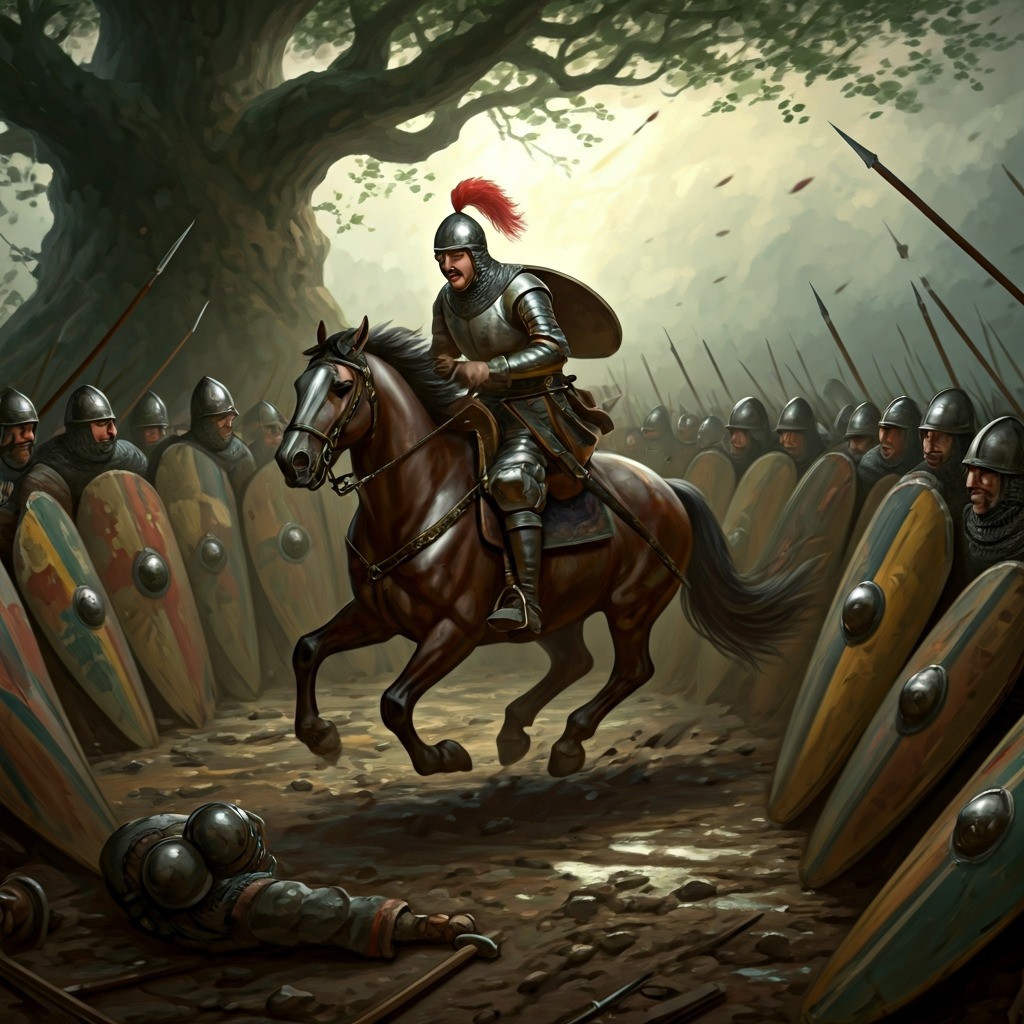
While everyone else was fighting on foot—as explicitly agreed upon in their sacred chivalric contract—Montauban quietly slipped away from the melee. He found his warhorse, mounted up, and rode at full speed directly into the English line. The sheer, terrifying mass of the armored horse shattered the exhausted mercenaries’ defensive formation.
Was it cheating? Absolutely. Did it work? Flawlessly.
With their shield wall broken, the English fighters were quickly overwhelmed. By the end of the day, the French emerged victorious. Nine English combatants lay dead—including Bemborough—and the rest were taken prisoner. The French lost at least three of their own men, though every single survivor on both sides was grievously wounded.
The Legend of the Halfway Oak
Here is the most tragic irony of this entire bloody saga: the Combat of the Thirty had absolutely zero impact on the outcome of the War of the Breton Succession. The war dragged on for over a decade more. Geopolitically, the 30-on-30 brawl was entirely pointless.
Yet, the medieval world absolutely lost its mind over the spectacle. It was instantly mythologized as the absolute pinnacle of chivalric virtue and bravery. Contemporary poets wrote epic ballads about the clash, and the famous 14th-century chronicler Jean Froissart recorded the bloody details for eternity, ensuring the men who fought at the Halfway Oak would never be forgotten.
It was a battle that changed nothing, yet became everything—a testament to an era where honor, blood, and a single oak tree could capture the imagination of a continent.