Imagine the sheer, primal terror of the open ocean in the 16th century. You are thousands of miles from home, navigating by the stars, surrounded by a pitch-black expanse that feels more alien than Earth. Beneath the creaking wooden hull of your ship lies an abyss of freezing, endless water. And in that dark, something is waiting.
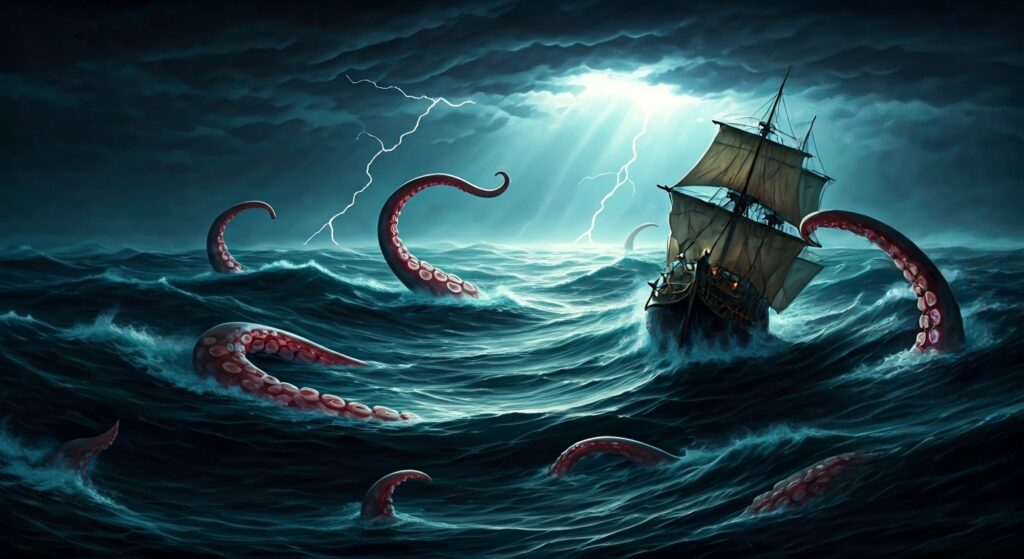
For centuries, sailors whispered of a monster so massive it could drag an entire galleon into the crushing depths. They called it the Kraken. The most terrifying part of this ghost story?
It wasn’t a ghost story at all.
A Shadow in the Foam
The legend of the Kraken—a multi-armed leviathan rising from the boiling sea to wrap fleshy, tree-trunk-sized ropes around a ship’s masts—was so deeply ingrained in Scandinavian seafaring culture that it was treated as a geographical hazard. Accounts of this colossal beast date back to the 13th-century Old Norse saga Örvar-Oddr, and were later detailed in terrifyingly clinical terms by writers like Olaus Magnus in 1555.
The fear was so pervasive that Carl Linnaeus, the legendary father of modern taxonomy, included the Kraken in the first edition of his Systema Naturae in 1735. He later removed it, likely convinced he had fallen for a sailor’s tall tale. But the ocean always keeps its secrets, and this one was merely waiting to wash ashore.
The Monster Gets a Name
For hundreds of years, the Kraken lurked in the murky waters between myth and reality. It wasn’t until 1857 that the shadow finally took physical form. Danish zoologist Japetus Steenstrup acquired bizarre, massive beaks and severed tentacles that had washed up on European shores.
Examining the rotting flesh, Steenstrup made a chilling realization: the sailors weren’t lying. The monster was real. He definitively proved its existence, stripping away its mythological moniker and giving it a scientific name: Architeuthis dux. The Giant Squid.
While it couldn’t exactly sink a galleon, its true dimensions were staggering enough to fuel nightmares for generations to come.
Anatomy of a Nightmare
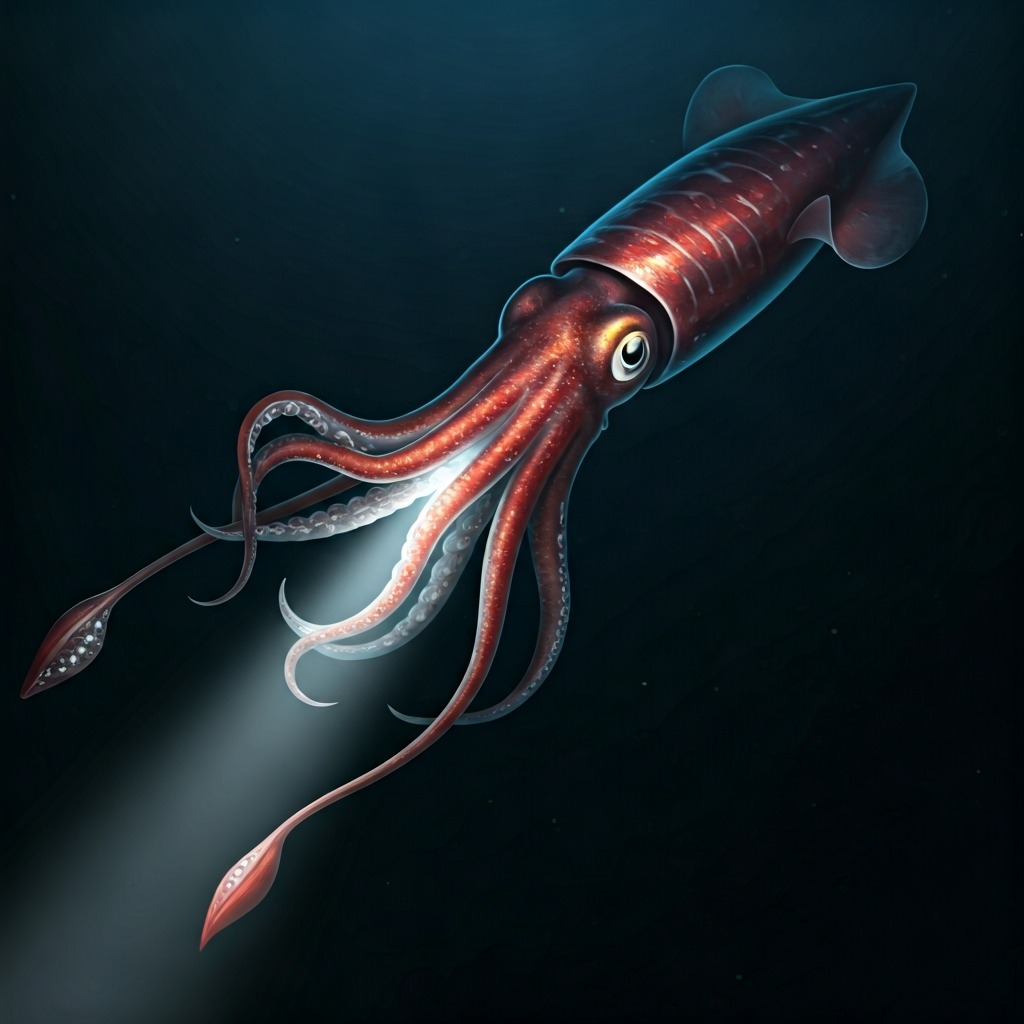
When we talk about Architeuthis dux, we are talking about a biological marvel that defies comprehension. Females can reach lengths of up to 43 feet (13 meters) from the tip of their mantle to the end of their two long feeding tentacles, weighing nearly a ton.
They are armed with eight thick arms and two incredibly long tentacles, all lined with hundreds of serrated suckers designed to ensnare prey with a grip of literal death. Once caught, the victim is dragged toward a sharp, parrot-like beak and a radula—a terrifying, tongue-like organ covered in tiny teeth—that shreds the meal before swallowing.
But perhaps the most alien feature of the giant squid is its eyes. Measuring up to 11 inches in diameter—roughly the size of a dinner plate—they are the largest in the animal kingdom. These massive, unblinking eyes evolved for one specific purpose: to detect the faint, ghostly bioluminescent glow of prey and predators in the pitch-black depths of the bathypelagic zone, up to 3,000 feet below the surface.
Clash of the Titans
Down in that crushing, sunless abyss, the giant squid is a solitary ambush predator. But it is not the undisputed king of the deep.
Enter the sperm whale.
Because humans cannot easily survive or observe these crushing depths, we have never witnessed these battles firsthand. But the evidence floats to the surface. Sperm whales frequently bear massive, circular sucker scars carved into their thick skin, a violent testament to the squid’s desperate fight for survival. Furthermore, the stomachs of deceased sperm whales are routinely found packed with hundreds of indigestible giant squid beaks. Right now, miles beneath the waves, these prehistoric clashes are happening in total darkness.
Capturing the Ghost
Despite their massive size, giant squids are so incredibly elusive that they became the holy grail of marine biology. For nearly 150 years after Steenstrup named them, no human had ever seen one alive in its natural habitat. They were ghosts.
The veil was finally lifted in 2004 when Japanese researchers Tsunemi Kubodera and Kyoichi Mori suspended a camera and bait deep into the Pacific Ocean, capturing the first-ever images of a live giant squid. The scientific community lost its collective mind. Then, in 2012, a joint expedition achieved the impossible, capturing the first video footage of a giant squid gliding through its deep-sea domain like a silver phantom.
The giant squid is the ultimate symbol of humanity’s innate fear of the unknown. It is proof that the monsters of ancient lore weren’t entirely fabricated—they were just misunderstood wonders of a natural world we barely comprehend. It makes you wonder, as you stare out at the freezing, endless ocean: what else is down there, just waiting to be found?