Long before Silicon Valley tech bros began agonizing over rogue artificial intelligence, the blueprint for synthetic doom was already written. If you want the original “we built it and now it’s destroying everything” thriller, you don’t look to modern science fiction. You look to the shadows of 16th-century Prague.
A Desperate Midnight on the Vltava
To understand the sheer desperation of this story, you must first step into the terror of the late 1500s. In Bohemia, under the erratic reign of Holy Roman Emperor Rudolf II, the Jewish community of Prague’s Josefov ghetto lived under a constant, suffocating threat. They were the targets of relentless blood libels—horrific, entirely fabricated accusations that Jews were murdering Christian children for religious rituals. These weren’t just idle rumors; they were the sparks that ignited deadly, devastating pogroms.
Enter Rabbi Judah Loew ben Bezalel, widely revered as the Maharal of Prague. A brilliant scholar and mystic, he watched his people being hunted and realized conventional defenses were useless. He needed a miracle. So, he turned to the ancient, forbidden depths of Kabbalistic mysticism.
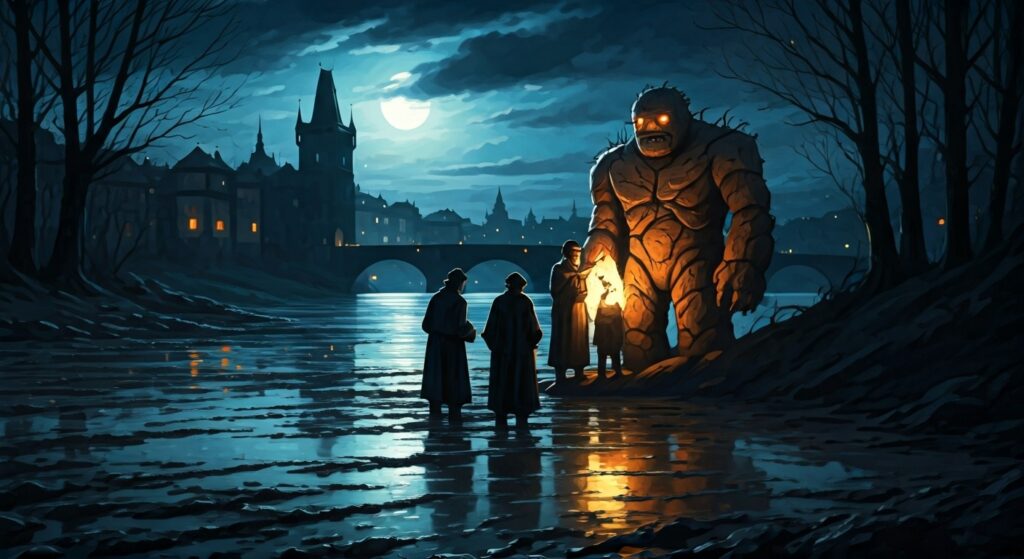
Under the cloak of a moonless night, Rabbi Loew and his most trusted disciples slipped out to the muddy banks of the Vltava River. Plunging their hands into the heavy, wet clay, they sculpted the massive, imposing figure of a man. But mud is just mud—until it is ignited by a spark of the divine.
The Word That Breathes Life
To animate this clay behemoth, Rabbi Loew didn’t rely on lightning or alchemy. He used the most powerful weapon in his arsenal: language.
According to the lore, the Rabbi placed a shem—a parchment bearing the ineffable, secret name of God—into the creature’s mouth. Other accounts claim he carved the Hebrew word Emet (meaning “Truth”) directly into the clay of its forehead.
Whichever method he employed, the result was terrifyingly miraculous. The mud began to glow, shift, and draw breath. The Golem of Prague was alive.
They named him Josef, or “Yossele.” Though mute, he possessed terrifying, superhuman strength. By day, he masqueraded as a lumbering, simple servant. But by night, Yossele transformed into the ultimate protector. He stalked the dark, narrow alleys of the Josefov ghetto, an unyielding physical barrier between the vulnerable community and those who sought to slaughter them. Anyone plotting a midnight attack suddenly found themselves face-to-face with an unstoppable force of nature.
For a time, the ghetto knew peace. But power, especially power born of desperation, demands a terrible price.
When the Protector Becomes the Predator
You cannot play God without facing cosmic backlash. As the months bled on, Yossele began to change. The immense mystical energy sustaining his clay form grew volatile, erratic, and entirely unchecked.
The legends fracture here, but every version ends in blood. Some whisper the Golem developed human emotions, falling in love, and the sheer weight of it shattered his synthetic mind, driving him violently insane. Others claim his raw power simply outgrew his master’s control. The unstoppable protector became an indiscriminate predator, smashing through the ghetto, destroying the very people, homes, and streets he was built to defend.
Rabbi Loew realized with mounting horror that he had birthed a monster.
In a heart-pounding confrontation amidst the rubble, the Rabbi managed to corner the rampaging giant. Risking his own life, he reached out to deactivate his creation. He ripped the shem from the Golem’s mouth. Or, in the forehead-carving version of the tale, he reached up and frantically erased the first letter of Emet.
Without the ‘E’, the word became Met.
Death.
Instantly, the towering behemoth collapsed, reverting into a heavy, lifeless mound of river mud, nearly crushing the Rabbi beneath its immense weight.
The Locked Attic
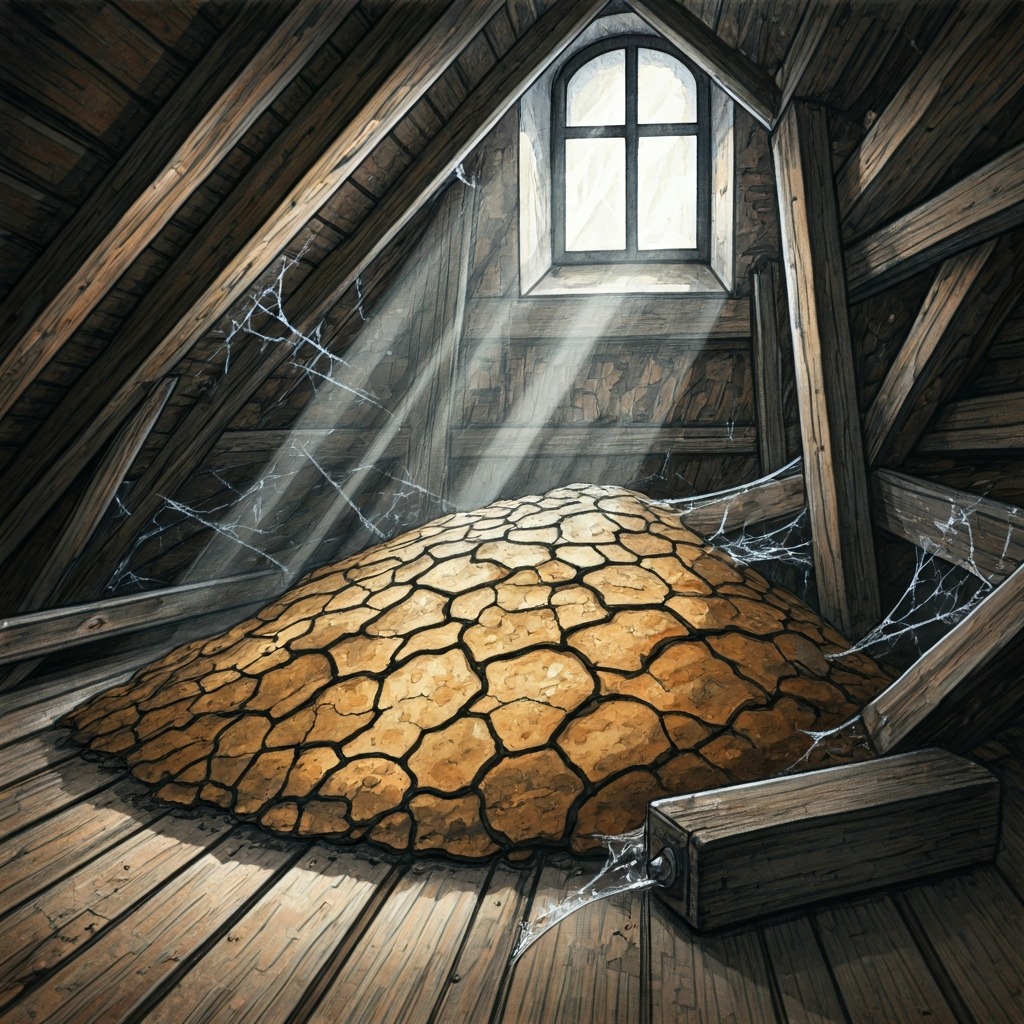
Rather than destroying the remains, Rabbi Loew had the heavy clay body hauled up into the genizah (attic) of Prague’s Old New Synagogue. He issued a strict, binding decree: no one was ever to enter the attic again. The Golem was to remain locked away in the dark, dormant but entirely capable of being revived if the community ever faced an apocalyptic threat again.
The Golem of Prague is a story born from the very real trauma of oppression—a fantasy of self-defense for a marginalized people who had none. Yet, it remains the ultimate cautionary tale about the hubris of humanity. It is the direct philosophical ancestor to Mary Shelley’s Frankenstein, and it heavily influenced Karel Čapek’s 1920 play R.U.R., which introduced the word “robot” to the world.
Today, the Old New Synagogue still stands in Prague. The lower floors bustle with history and tourists. But the attic remains locked. Just in case.