I was standing in line at a cafe this morning, trying to slip my phone into my trousers, when my fingers hit a dead end. A stitched-up, utterly useless flap of fabric. A fake pocket.
If you think the lack of pockets in women’s clothing is just a harmless oversight by modern designers, you are the victim of a centuries-old conspiracy. The missing pocket isn’t just a daily frustration—it is a calculated theft. For centuries, the sudden, suspicious diminishment of women’s pockets has been a quiet battleground for female independence, privacy, and societal control.
Let’s open the sartorial cold case.
The Secret Sanctuaries Beneath the Silk
Before the late 17th century, both men and women carried their belongings in bags tied around their waists. But as men’s clothing evolved to integrate sleek, sewn-in pockets into coats and breeches, women’s fashion took a decidedly more covert path.
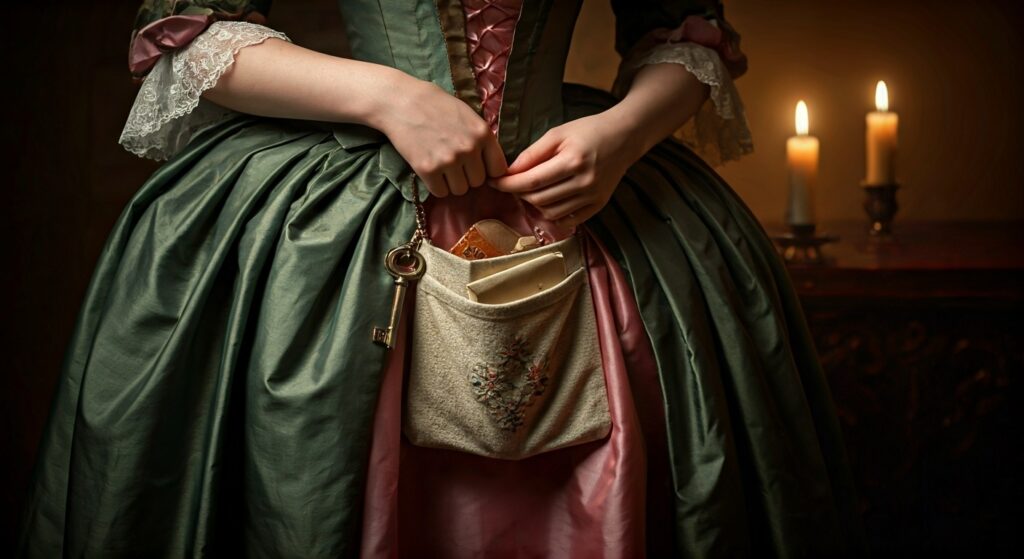
Welcome to the Golden Age of pockets. Women wore large, detachable pouches tied around their waists, hidden beneath heavy layers of petticoats and skirts. Accessed through stealthy slits in the outer garments, these tie-on pockets were incredibly spacious and entirely private.
Imagine it as a hidden arsenal. A woman could carry a vast array of items: heavy iron keys, money, small books, food, and scandalous personal letters. Because they were worn so close to the body, they were a woman’s ultimate sanctuary. The sheer volume of secrets those women carried would rival any modern espionage thriller.
Witches, Smugglers, and the Fear of the Unseen
But privacy breeds paranoia. In an era where women had virtually no legal rights to property or autonomy, a hidden pocket was one of the only spaces a woman could truly call her own, unmonitored by a husband or father. Patriarchal authorities were terrified of what they couldn’t see.
What exactly was she hiding in the dark folds of her skirts?
During periods of intense superstition, the private contents of a woman’s pocket—herbs, charms, or unusual trinkets—could be weaponized against her in court as evidence of witchcraft. The mystery of the pocket became a matter of life and death. Later, in the 18th and 19th centuries, these hidden caverns were associated with female subversion. Authorities feared women were using them to hide revolutionary tracts, smuggle stolen goods from rising urban shops, or even conceal poisons. The pocket, quite simply, represented a dangerous, unchecked level of female autonomy.
It had to go.
The Silhouette That Stole Female Autonomy
The death blow to the pocket came disguised as high fashion.
Following the French Revolution, the fashion world drastically shifted. The new “Empire” silhouette emerged, featuring high waistlines and sheer, clinging fabrics inspired by Greco-Roman antiquity. There was simply no physical room to hide a bulky, tie-on pouch without ruining the sleek, columnar lines of the dress.
Women were suddenly forced to carry their belongings in tiny, external bags called reticules. This transition was profound and devastating. It dragged women’s possessions out of the private, hidden sphere and thrust them into the public eye. Because reticules were so small, they drastically reduced what a woman could carry. The message was clear: a woman stepping out into the world should not be self-sufficient. She should rely on a man to carry her items and pay for her expenses.
The Radical Act of Empty Hands
By the late 19th and early 20th centuries, the lack of functional pockets became a focal point for early feminists. The logic was simple: if you want to control a demographic, occupy their hands. If you want to liberate them, give them pockets.
The Rational Dress Society, founded in 1881, aggressively argued against restrictive clothing. But the true rebellion happened during the Suffragette movement of the 1910s, where pockets became highly politicized weapons. The famous Suffragette suit was a marvel of subversive tailoring, designed with up to eight functional pockets.
For these women, a pocket was a loud declaration of independence. It allowed them to carry their own money, political pamphlets, and personal items without the burden of a handbag. It left their hands entirely free to march, hold protest signs, and distribute literature.
The Dior Betrayal and the Modern Illusion
While the World Wars temporarily brought practical, pocketed clothing back to women as they entered the industrial workforce, the liberation was short-lived.
Post-war fashion quickly reversed the trend, prioritizing aesthetic control over female utility. Designers like Christian Dior introduced the hyper-feminine, heavily cinched “New Look.” Sealing the fate of modern women’s clothing, Dior famously declared: “Men have pockets to keep things in, women for decoration.”
Couple this ideology with a booming post-war handbag industry that had a massive economic incentive to keep women’s pockets small or non-existent, and the trap was set. Today, the frustratingly shallow or entirely fake pockets in our tailored pants and jeans are the direct legacy of this history.
So, the next time you try to slip your phone into a pocket that doesn’t exist, remember: it isn’t just a bad design. It is the ghost of a centuries-old fear that a woman with her hands free and her secrets hidden is a woman who cannot be controlled.