I’ll admit it: I am ruthlessly competitive at board games. There is something deeply satisfying about a flawless rulebook—a system where every mechanic is perfectly balanced to prevent any one player from steamrolling the rest.
But the greatest rulebook in American history wasn’t written on parchment by men in powdered wigs. It was woven in beads, born in the shadows of a total solar eclipse, and it fundamentally changed the world.
Welcome back to Riveting History Daily. I’m Isabella, and today we are diving into a centuries-old political thriller: the creation of the Great Law of Peace.
An Endless Cycle of Blood
Long before European galleons pierced the horizon of North America, the forests of present-day New York were consumed by a terrifying cycle of violence. The Mohawk, Oneida, Onondaga, Cayuga, and Seneca nations were locked in generations of bitter blood feuds. A single murder demanded retribution, sparking a perpetual, bloody chain reaction of retaliation and grief.
Into this chaotic abyss stepped a visionary known as the Peacemaker (Dekanawida). He carried a radical, seemingly impossible mission: to unite the warring factions under a single, unbreakable alliance based on three pillars—Peace, Power, and Righteousness.
But he couldn’t do it alone. He recruited Hiawatha, a fiercely persuasive orator, and Jigonhsasee, a brilliant diplomat who would become known as the Mother of Nations. Together, this trio embarked on a perilous diplomatic mission to convince hardened warriors to lay down their weapons.
The Day the Sun Vanished
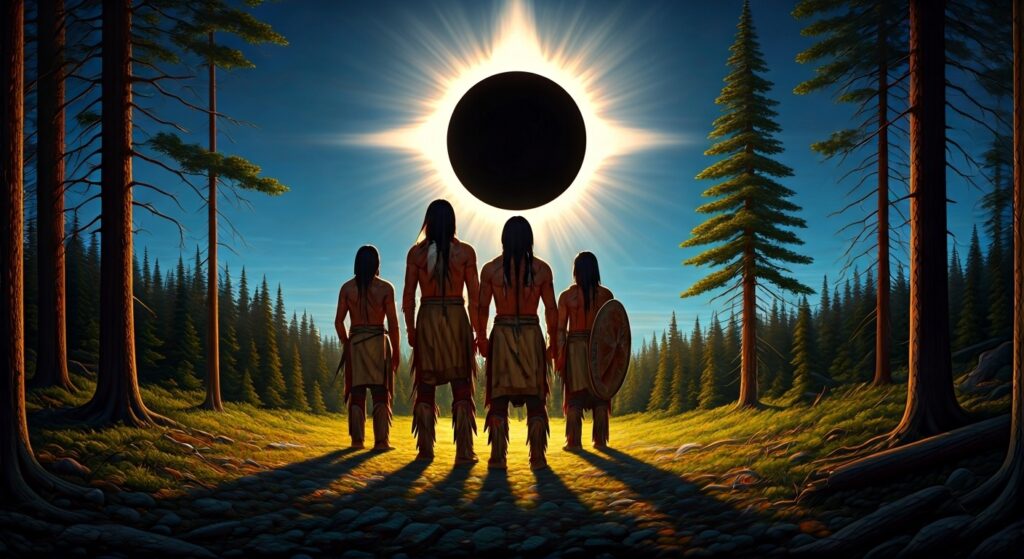
The exact date this grand alliance was forged was long shrouded in mystery, with estimates ranging from the 12th to the 15th century. But oral tradition offered a tantalizing clue: during a critical moment of negotiation to finalize the confederacy, the sky suddenly went black. The sun was swallowed whole, plunging the day into an eerie, twilight darkness.
By tracing astronomical data, researchers pinpointed a precise cosmic event: a total solar eclipse over the region in August 1142 AD.
Imagine the sheer awe of that moment. The cosmos themselves seemed to halt, sealing the treaty. The five nations buried their weapons of war beneath the roots of a massive white pine—the Tree of Peace—and the Haudenosaunee (Iroquois) Confederacy was born.
The Mothers Who Held the Reins
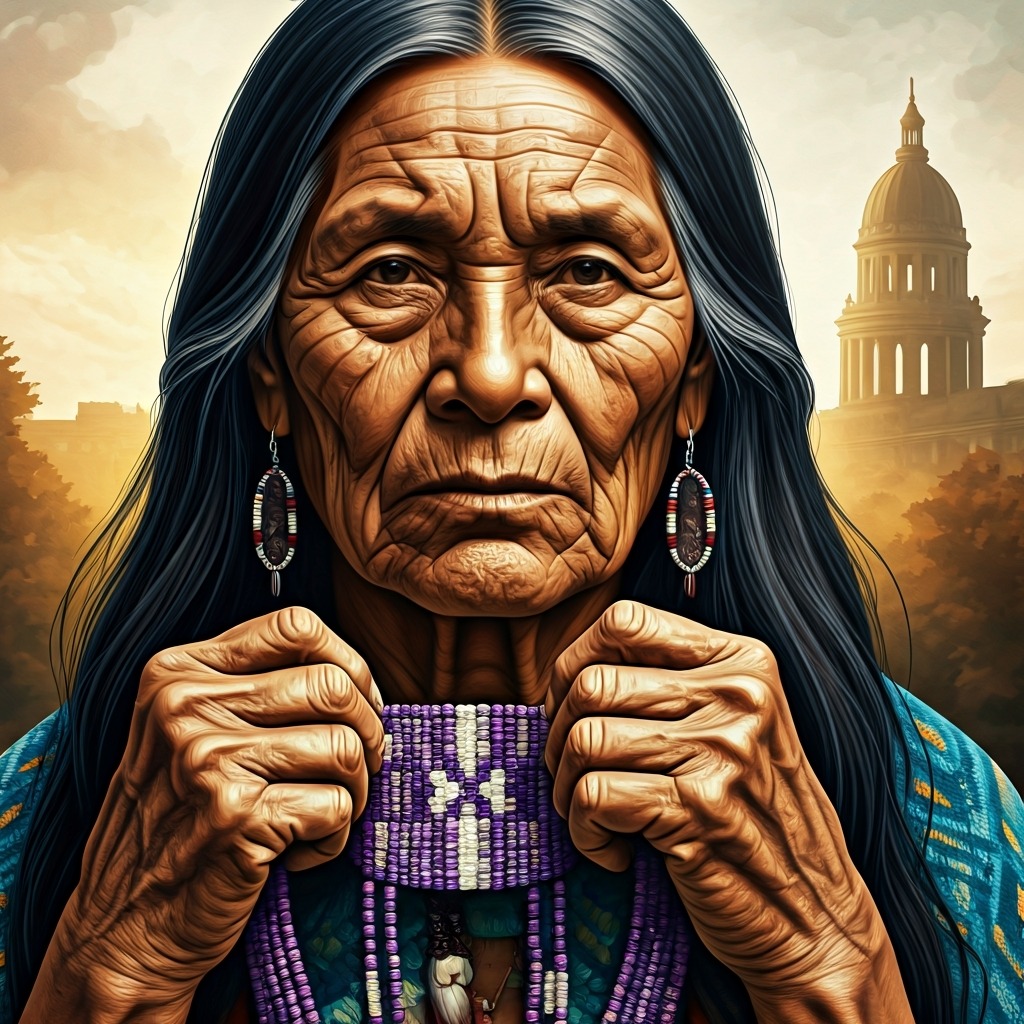
The oral constitution they created, the Gayanashagowa (The Great Law of Peace), is a masterpiece of political engineering. Because there was no written alphabet, the constitution was memorized and transmitted through intricate wampum belts, most notably the Hiawatha Belt, a stunning visual representation of the five nations united.
Under this system, the Haudenosaunee built a highly sophisticated federalist government. Each nation maintained strict control over its own internal affairs—much like modern US states. Matters of national importance or inter-nation disputes were handled by a Grand Council of fifty sachems (chiefs).
But here is the detail that rewrites everything we assume about early democracies: the Great Law of Peace was deeply matrilineal.
While the fifty sachems on the Grand Council were men, they didn’t hold the ultimate power. That belonged to the Clan Mothers. These women held the exclusive authority to nominate the chiefs—and to ruthlessly monitor their behavior. If a chief acted selfishly, ignored the will of the people, or violated the Great Law, the Clan Mothers issued three warnings. If he didn’t listen, they possessed the constitutional power to “knock the horns off his head”—stripping him of his title and replacing him.
It was a flawless system of checks and balances. Furthermore, passing a law required strict consensus, not just a simple majority. Every voice had to be heard, debated, and integrated until absolute agreement was reached.
The Printer and the Stolen Blueprint
Fast forward to the 18th century. The American colonies were a fragmented, squabbling mess, highly vulnerable to outside threats.
During the 1744 Treaty of Lancaster, an Onondaga leader named Canassatego looked at the disorganized colonial governors in pity. He urged the colonies to unite, demonstrating his point with a powerful metaphor: a single arrow can be easily snapped in half, but a bundle of arrows bound together is unbreakable.
Sitting in the colonies, a printer named Benjamin Franklin took careful note. Franklin was deeply inspired by the Haudenosaunee model of governance. When he drafted the 1754 Albany Plan of Union—which served as an early, vital blueprint for the United States Constitution—he leaned heavily on the federalist structure he had observed in the Great Law of Peace.
It took over two centuries for the US government to formally admit this intellectual debt. Finally, in 1988, the US Congress passed a concurrent resolution acknowledging the Haudenosaunee Confederacy’s direct influence on the development of the US Constitution.
The Forgotten Half of Democracy
But the Founding Fathers were selective borrowers. They cherry-picked.
While they happily lifted the concepts of federalism, representative councils, and a separation of powers, they left out the Confederacy’s most egalitarian principles. The Founding Fathers completely ignored the political authority of women, locking them out of the democratic process for another century and a half. They also scrapped the requirement for absolute consensus, opting instead for a faster, but inherently more divisive, majority rule.
Today, the Great Law of Peace isn’t just a museum relic; it remains a living, functional constitution for the Haudenosaunee. It stands as one of the oldest continuous participatory democracies on Earth, a profound indigenous philosophy that masterfully balances individual liberty with collective responsibility.
So, the next time you hear someone marvel at the “invention” of American democracy, you can correct the record. The blueprint didn’t start in Philadelphia. It started centuries earlier, woven in beads, beneath the branches of the Tree of Peace.