In the blood-soaked theater of 16th-century Japan’s Sengoku period, warlords survived through a ruthless combination of military might and paranoid vigilance. Trust was a luxury no leader could afford. But what happens when a masterless operative is so exceptionally lethal, so utterly uncontainable, that his mere existence threatens the entire balance of power? Enter Kato Danzo.
Known as “Flying Kato,” Danzo (c. 1503–1569) was no ordinary shinobi. He was a master of genjutsu—the dark, psychological art of illusion. Blurring the line between elite spy, stage magician, and supernatural sorcerer, Danzo possessed a terrifying skillset. To the modern mind, his feats were masterclasses in psychological warfare and sleight of hand. To the deeply paranoid warlords of the 1500s, they were a death sentence waiting to happen.
The Deadly Price of Skepticism
Danzo first forged his dark legend in the dusty streets, utilizing mass hypnosis so advanced it was indistinguishable from dark magic. His most famous parlor trick was a spectacle of mass manipulation: standing before a mesmerized crowd, Danzo appeared to swallow a live bull whole.
The audience watched in terrified awe—except for one skeptical heckler. Breaking the collective trance, the man loudly pointed out that Danzo wasn’t swallowing anything. He was simply sitting on the beast’s back, holding a gourd in front of his face to obscure the crowd’s vision.
Humiliated but fiercely cunning, Danzo didn’t argue. He simply smiled and bided his time.
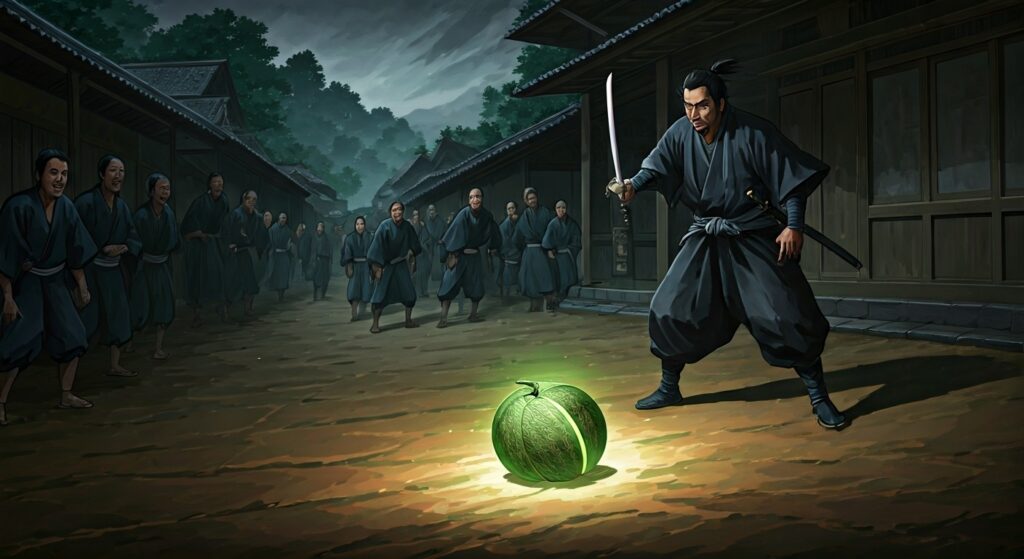
Days later, Danzo returned to the same square to perform a new feat. He planted a melon seed in the dirt. Right before the audience’s eyes, the plant rapidly sprouted, grew twisting vines, and bore a massive, ripe melon. In a flash of blinding steel, Danzo drew his blade and sliced the magical fruit perfectly in half.
At that exact millisecond, the skeptical heckler from days prior—who had been watching from the front row—collapsed. His severed head tumbled from his shoulders and rolled into the dirt. Danzo had made his point: his illusions were deadly real, and crossing him was a fatal mistake.
The Impossible Heist
With a terrifying reputation bolstered by rumors that he could effortlessly leap high castle walls and use large kites for aerial reconnaissance, Danzo decided to cash in on his infamy. He traveled to Echigo Province to offer his services to the legendary daimyo Uesugi Kenshin.
Intrigued but naturally skeptical, Kenshin demanded a rigorous tryout. He challenged the illusionist to steal a highly prized weapon from the estate of his most heavily guarded retainer, Naoe Kanetsugu.
This was an impossible task. Kanetsugu’s compound was locked down tighter than a vault, swarming with elite samurai patrols and aggressive guard dogs. Yet, Danzo didn’t just bypass the medieval security—he dismantled it like it wasn’t even there. He slipped into the estate, retrieved the prized blade, and vanished into the night.
But Danzo wanted to prove a point. To demonstrate exactly how deeply he had penetrated Kanetsugu’s defenses, he also kidnapped a young servant girl from the innermost chambers of the compound, delivering both her and the weapon straight to Kenshin’s feet.
The Curse of Absolute Competence
In any normal scenario, pulling off a flawless, impossible heist guarantees you the job. But Danzo severely underestimated the profound paranoia of Sengoku warlords.
When Kenshin saw the weapon and the terrified girl, he wasn’t impressed—he was horrified. He reasoned that if this masterless operative could effortlessly bypass his elite security, there was absolutely nothing stopping Danzo from slipping into Kenshin’s own bedchamber to take his head.
A lone wolf with skills that rendered castle walls and armed guards entirely useless wasn’t an asset in a military hierarchy built on rigid loyalty; he was an uncontrollable, existential threat. Deeming Danzo too dangerous to live, Kenshin secretly ordered his immediate assassination.
A Fatal Game of Shadows
Realizing his prospective master was suddenly trying to kill him, Danzo utilized his legendary evasion skills to escape Echigo. He fled to Kai Province, seeking refuge and a lucrative contract with Kenshin’s arch-rival, the brilliant tactician Takeda Shingen.
Shingen was arguably the most cautious man in Japan, maintaining his own elite, highly secretive intelligence network known as the Mitsumono. When Danzo arrived at his doorstep, Shingen’s internal alarms deafened him.
The warlord faced a terrifying dilemma. Either Danzo was a double agent sent by Kenshin to infiltrate his ranks, or his supernatural reputation was entirely real—making him a wild card that no warlord could ever truly leash. Driven by the exact same cold, pragmatic paranoia as his rival, Shingen made his choice.
In 1569, Kato Danzo was ambushed by Shingen’s retainers. The man who could fly over walls and swallow bulls was finally cornered. His head was struck from his shoulders, reportedly by the fierce samurai Baba Nobuharu.
Danzo’s demise wasn’t born out of malice, but out of the brutal reality of his era. In a world held together by predictable military structures and absolute control, a man who could break all the rules simply couldn’t be allowed to play the game.