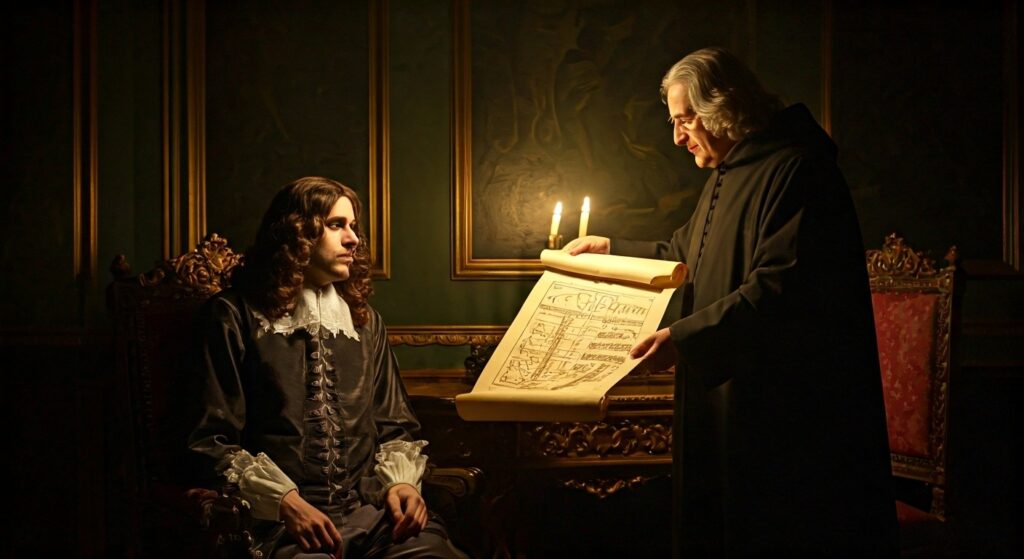
Picture the dimly lit parlor of a 17th-century Italian prince. The air is thick with myrrh and an unshakable, suffocating despair. The prince is suffering from a melancholy so profound that no court jester, no lavish feast, and no traditional apothecary’s remedy can pull him from his waking nightmare. He is a prisoner of his own mind, slipping further into the dark.
Desperate, his handlers turn to the brilliant, albeit highly eccentric, German Jesuit scholar Athanasius Kircher. A polymath who dabbled in everything from magnetism to early germ theory, Kircher did not prescribe a soothing lullaby or a vibrant symphony to heal the royal mind.
Instead, in his 1650 opus Musurgia Universalis, he drafted a schematic for an instrument that would go down in history as one of the most grotesque inventions ever conceived. He prescribed the Katzenklavier.
The Architecture of a Nightmare
At first glance, the Katzenklavier—or Cat Piano—looked like a standard, elegant keyboard. But if you were to peer behind its pristine wooden veneer, you wouldn’t find taut strings or brass pipes.
You would find a row of live felines.
According to Kircher’s horrifyingly detailed design, these cats were to be meticulously curated and arranged in a cage based on the natural pitch of their meows. Their tails were to be stretched out and pinned firmly beneath the keys of the piano. When the musician pressed a key, a sharp nail would strike or pull the corresponding cat’s tail.
The result was not music, but a chorus of agonizing yelps.
The sheer cruelty of the visual is enough to make anyone shudder. Yet, the true mystery lies in why Kircher designed this torture device. It was never intended for musical entertainment.
Shock Therapy for a Royal Soul
Kircher’s dark invention was, in fact, a radical medical treatment. The underlying theory was rooted in the primitive, experimental nature of early psychology. Kircher believed that the sheer absurdity of the screaming cats, combined with the shocking, unpredictable cacophony, would jolt the Italian prince out of his catatonic depression.
The goal was to force the royal to laugh—or at least react—breaking the impenetrable wall of his melancholy through pure, unadulterated shock value. It was a violent sensory overload designed to reset a broken mind.
The Doctor Will Hear You Now
You would think that as the centuries passed and humanity grew more enlightened, the Katzenklavier would be relegated to the dustbin of bad ideas. But the cultural drama of this macabre instrument wasn’t over.
In the early 19th century, the concept was resurrected by Johann Christian Reil, a highly influential German physician who actually coined the term “psychiatry.” Reil wasn’t treating a sad prince; he was looking for a cure for patients suffering from severe dissociation and an inability to focus.
Reil theorized that patients lost in their own mental reveries needed to be violently anchored back to reality. He suggested the Cat Piano as the ultimate cure. He believed that the bizarre visual of the trapped felines and the harsh, jarring noises would forcibly capture a patient’s wandering attention, pulling them from their psychological void back into conscious reality.
A Phantom Menace
So, did the screams of the Katzenklavier ever actually echo through the halls of a European estate or a 19th-century asylum?
Thankfully, the answer is no. Despite the detailed historical descriptions and the earnest medical theories of men like Kircher and Reil, there is absolutely no evidence that a working cat piano was ever constructed. It remains a grotesque thought experiment—a phantom instrument that exists only in the shadows of early, often cruel, psychiatric history.
Today, the Katzenklavier survives merely as a piece of dark cultural trivia, a fascinating, eerie reminder that sometimes the most terrifying monsters in history aren’t hiding under the bed. Sometimes, they are written into our medical texts, waiting for someone to press the keys.