An Impossible Discovery
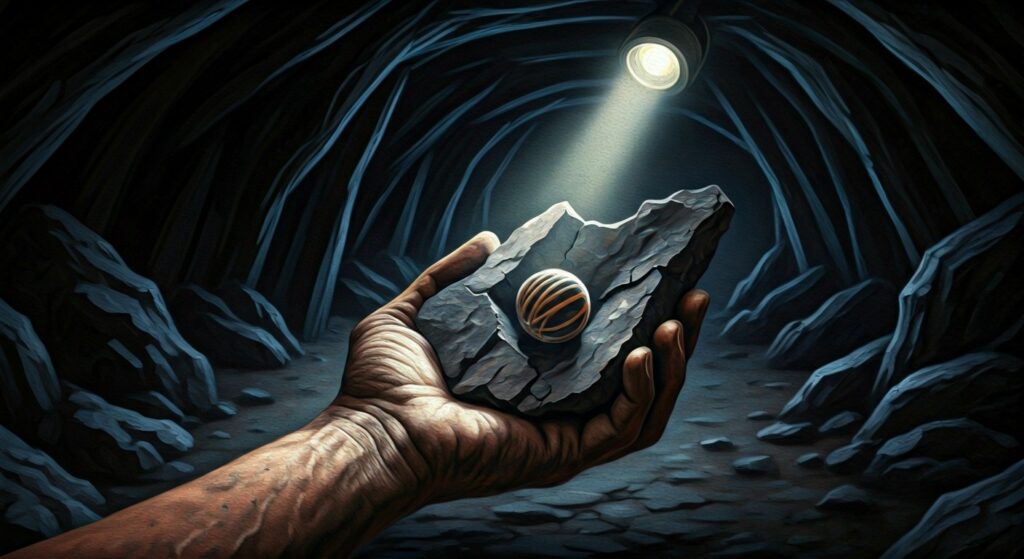
Deep within the pyrophyllite mines of Ottosdal, South Africa, workers cracking open the ancient earth stumbled upon something that defied all logic. Resting in the dust were small, metallic-looking spheres. They fit perfectly in the palm of a hand, and running precisely around their equators were parallel, concentric grooves. To anyone looking at them, they appeared undeniably manufactured—machined by intelligent hands.
There was just one problem: the rock encasing them was three billion years old.
Billions of years before the first hominids walked the earth, and long before the reign of the dinosaurs, something—or someone—apparently left behind these strange little globes. Welcome to the enigma of the Klerksdorp Spheres.
Fingerprints of the Gods?
Ranging from a few millimeters to several centimeters across, these enigmatic objects quickly became the stuff of legend. How could nature carve perfectly straight, parallel lines around a sphere? The short answer for many was that it couldn’t.
The spheres were rapidly championed as the ultimate Out of Place Artifacts (OOPArts). Proponents of ancient aliens and lost civilizations seized upon the discovery, arguing it was definitive proof of highly advanced beings operating on Earth billions of years before humanity even existed. Rumors spun wildly out of control: the spheres were allegedly forged from a mysterious, unscratchable metal, and balanced with such microscopic perfection that even modern aerospace engineers couldn’t replicate them.
It is a thrilling, goosebump-inducing narrative. The idea that we are holding the remnants of a three-billion-year-old civilization is intoxicating. But as is often the case with history, the truth hidden in the dirt is far more fascinating than the fiction.
The Earth’s Secret Forge
When geologists finally put the Klerksdorp Spheres under the microscope, they didn’t find the handiwork of extraterrestrials. Instead, they uncovered a breathtakingly complex natural phenomenon known as concretions.
Picture the young Earth as a giant, slow-cooking oven. Concretions form when minerals precipitate around a central nucleus—like a tiny grain of sand or a shell fragment—within a host sediment. For the Klerksdorp Spheres, this host was volcanic ash that settled during the Precambrian era, part of a geological formation known as the Dominion Group. As minerals built up layer by layer over millions of years, they formed these hardened, spherical masses long before the surrounding ash itself hardened into rock.
Shattering the Alien Illusion
But what about the machine-like grooves? And the unscratchable alien alloy?
Science quickly unraveled the myth. First, the spheres are rarely perfectly round. While sensationalized photos highlight the most symmetrical examples, the vast majority pulled from the mines are flattened, elongated, or fused together in lumpy masses.
Furthermore, their composition isn’t a mysterious cosmic alloy. They are typically made of naturally occurring hematite, wollastonite, or pyrite—completely debunking the legend of an unscratchable super-metal.
The most captivating feature—the equatorial grooves—has a brilliantly simple explanation. When the volcanic ash originally settled three billion years ago, it formed in fine-grained horizontal layers, known as bedding planes. As the concretions grew inside the ash, they incorporated these existing horizontal laminations into their structure. Over countless millennia, differential weathering wore away the softer layers of the stone at a different rate than the harder layers, leaving behind the striking, parallel grooves that look so artificial to our modern eyes.
The Ultimate Architect
The Klerksdorp Spheres aren’t the smoking gun of an ancient alien race, but their reality is far more profound. They stand as a breathtaking testament to the intricate, counterintuitive, and deeply weird beauty of natural geological processes. The Earth doesn’t need extraterrestrial intervention to create masterpieces; it just needs volcanic ash, a few minerals, and three billion years of patience.