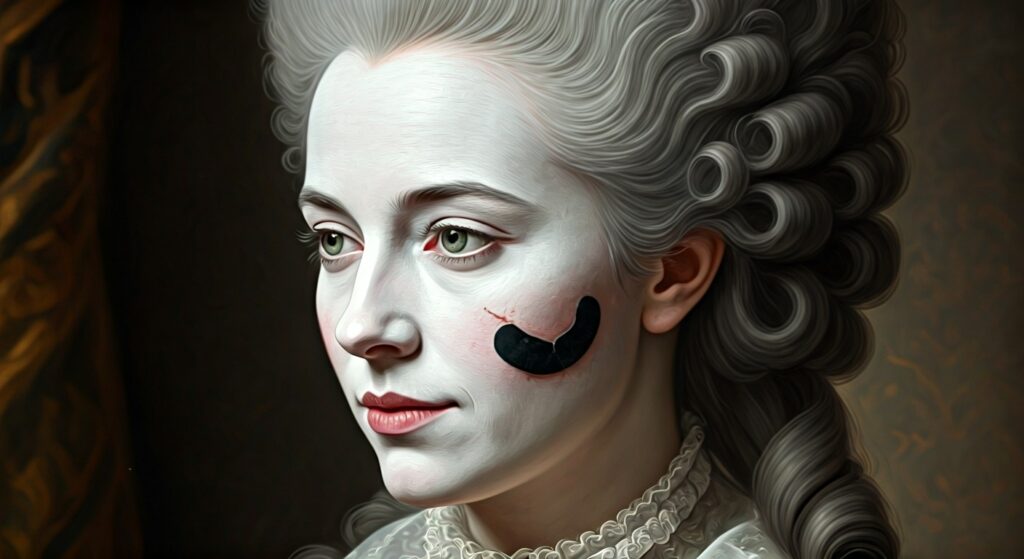
Picture the Palace of Versailles at the height of its 17th-century glory. The courtiers are draped in yards of rustling silk, their hair powdered to towering perfection, their faces painted a stark, porcelain white. They look like living dolls, untouched by the grueling outdoor labor of the peasant class.
But if you stepped just a little closer to these glittering aristocrats, you would notice something peculiar. Dotted across their pale faces, necks, and chests were tiny, stark black shapes made of velvet, silk, or taffeta. They looked like artificial beauty marks. The French called them mouches—literally translated to “flies.”
To the untrained eye, these tiny black stars, crescent moons, and diamonds were simply the ultimate accessory of a chic aristocrat. But beneath the velvet lurked a grim, flesh-eating secret.
The Flesh-Eating Secret
Behind closed doors, the 17th and 18th centuries were not pretty. Europe was being ravaged by two merciless plagues: smallpox and the “Great Pox” (an era-appropriate term for syphilis). If you were lucky enough to survive these horrific diseases, you rarely escaped with your looks intact. Survivors were left with severe facial scarring, deep pockmarks, and weeping open sores.
For an aristocracy whose entire social currency relied on looking flawless, this was social suicide.
Enter the mouche. To maintain the illusion of divine beauty, nobles began taking mastic tree resin and gluing small patches of black velvet directly over their scars and lesions. The stark black fabric served a brilliant dual purpose: it completely obscured the rotting flesh beneath, and it provided a sharp, dramatic contrast to the toxic, white lead-based makeup (ceruse) they slathered on their faces.
In its earliest, most medical form, a patch used strictly to hide a blemish was aptly named la recéleuse—the concealer. It was the ultimate, literal cover-up.
A Silent Language of Seduction
Leave it to the French court to take a medical necessity and turn it into high fashion. As the trend exploded, mouches transcended their grim origins. You didn’t even need a syphilis scar to wear one anymore; you just needed to be fashionable.
Aristocrats began carrying them in boîtes à mouches—exquisite, jewel-encrusted patch boxes that contained tiny mirrors and tweezers for emergency reapplications during royal balls. The shapes became wildly extravagant. Why wear a simple circle when you could glue a velvet silhouette of a horse-drawn carriage to your cheek?
But the true intrigue of the mouche lay in what it didn’t say out loud. In a court where privacy was entirely nonexistent and marriages were strictly tedious financial transactions, courtiers needed a way to silently broadcast their romantic desires. The placement of your velvet patch became a highly sophisticated, unspoken language:
- Near the eye: You were La passionnée (the passionate one), signaling a deep, burning desire.
- Beside the mouth: You were La coquette (the flirt), teasing anyone who caught your eye.
- On the cheek: You were La galante (the gallant), openly receptive to a romantic proposition.
- On the nose: You were L’effrontée (the brazen one), projecting a cheeky, unapologetic attitude.
- On the forehead: You were La majestueuse (the majestic), untouchable, dignified, and of the highest status.
The Killer in the Cleavage
Perhaps the most dramatic placement was the patch positioned strategically on the breast, or nestled deep within the cleavage. This placement was known as L’assassine—the killer. It was designed to draw the eye downward and deliver a fatal, metaphorical blow to an admirer’s heart.
The patches were so effective at communicating allegiance that they even bled into politics. In neighboring England, the placement of a beauty patch could literally start a fight. Women wore patches on the right side of their face to signal support for the Tory party, and on the left for the Whigs. In France, the sheer volume and style of your patches could visually align you with specific royal favorites or cutthroat social cliques.
The Guillotine’s Cure for Vanity
The bizarre, beautiful culture of the mouche peaked during the reign of Louis XV, a time of unparalleled excess. But like all extreme trends, it was destined for a dramatic collapse.
When the French Revolution erupted in 1789, looking like a wealthy, idle aristocrat was no longer just unfashionable—it was a quick ticket to the guillotine. The powdered wigs, the toxic lead makeup, and the velvet patches abruptly vanished. Society shifted toward a more “natural” beauty standard, and as medical treatments slowly improved, the desperate need to hide pox scars faded away.
Today, the mouche remains one of history’s most fascinating paradoxes. It was a symbol of the ultimate aristocratic refinement, born entirely out of the desperate need to hide rotting flesh. A glamorous illusion that proves beauty truly is only skin deep—especially when that skin is falling apart.