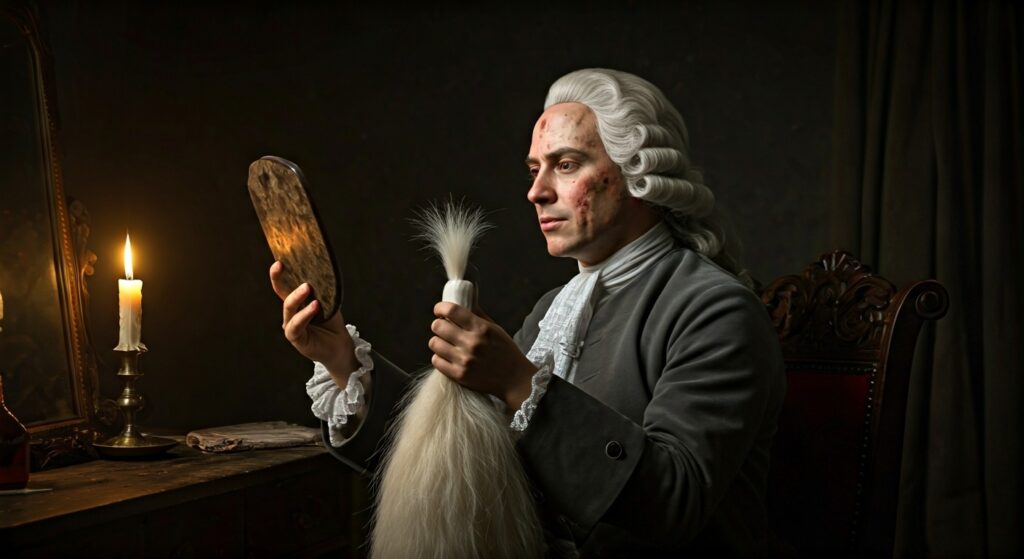
When we picture the opulent courts of 17th-century Europe, one image reigns supreme: the towering, snowy-white powdered wig. Today, we view these massive hairpieces as the ultimate symbol of aristocratic elegance and high fashion. But peel back the pristine, lavender-scented curls, and you will find a dark, foul-smelling secret. The powdered wig was not born from a desire for haute couture. It was a desperate, filthy cover-up for a massive public health crisis.
A Plague Disguised as Prestige
To understand the birth of the wig, we must travel back to the late 15th century. During this era, a thick, flowing mane of hair was the ultimate aesthetic flex—a vital symbol of youth, virility, and aristocratic status. But a dark shadow was creeping across the continent. A massive syphilis epidemic was sweeping through Europe, and without the miracle of modern antibiotics, the disease progressed with terrifying, unchecked brutality.
One of the most prominent and socially devastating symptoms of this new plague was patchy, unpredictable hair loss, accompanied by facial rashes and foul-smelling open sores. Suddenly, baldness wasn’t just a matter of unlucky genetics; it was a neon sign pointing directly to a shameful, highly stigmatized affliction. To avoid total public ruin, the afflicted began strapping on long hairpieces. These early wigs were not fashion statements—they were medical bandages, desperately designed to hide bloody sores and bald spots from a judging society.
The Vain Kings Who Crowned a Continent
So how did a shameful medical secret transform into the most mandatory fashion accessory in European history? The answer lies in the fragile egos of two incredibly powerful men.
King Louis XIV of France—the legendary Sun King—began losing his hair at the tender age of seventeen. For a monarch whose entire brand was built on absolute, divine authority, going bald as a teenager was a public relations nightmare. Terrified that his thinning hair would shatter his illusion of invincibility, Louis hired a staggering 48 royal wigmakers to craft massive, elaborate hairpieces to save face.
Shortly after, his cousin across the English Channel, King Charles II, realized he had a similar problem. Desperate to conceal his own prematurely graying and thinning hair, Charles adopted the towering French style.
In the royal courts, the king’s word—and wardrobe—was law. The nobility immediately shaved their heads and strapped on massive perukes to mimic their monarchs. Before long, the trend trickled down to the merchant classes. The wig entirely shed its association with disease and morphed into the ultimate symbol of wealth and power.
A Crawling, Stinking Crown of Wealth
If you think modern hair care is exhausting, imagine maintaining a 17th-century peruke. Early wigs were crafted from horse, goat, or human hair. They were incredibly heavy, notoriously difficult to clean, and quickly became a breeding ground for pests.
Wigs routinely became infested with lice and absorbed the foul odors of a society that did not prioritize daily bathing. Imagine the stench of unwashed animal hair mingling with aristocratic sweat in a crowded, candle-lit ballroom.
To combat the unbearable smell, wearers began coating their wigs in finely ground starch powder. Heavily scented with lavender, orange flower, or cloves, this powder acted as a primitive dry shampoo and deodorizer, soaking up the grease and masking the stench. This white powder gave the wigs their signature snowy appearance. The bigger the wig, the more expensive it was to maintain—which is exactly where we get the term “bigwig” to describe someone of immense wealth and importance.
The Guillotine and the Taxman
The powdered wig reigned supreme over European high society for over a century, but every dramatic trend must meet a dramatic end.
By the end of the 18th century, the cultural winds shifted violently. In France, the Revolution made walking around with a giant, powdered symbol of aristocratic wealth on your head a very quick way to meet the guillotine. Survival meant blending in with the revolutionaries, and the wigs were promptly tossed into the fire.
Meanwhile, in Britain, the trend was killed not by the blade, but by the bureaucrat. In 1795, Prime Minister William Pitt the Younger introduced a heavy tax on hair powder. The cost of maintaining the snowy-white aesthetic skyrocketed, effectively killing the fashion overnight. Men returned to their natural hair, and the towering, lice-infested peruke was relegated to the history books.
The next time you watch a historical drama and see a room full of dashing dukes in powdered wigs, remember the truth. Beneath all that pristine, lavender-scented starch lies a history of vanity, disease, and a desperate need to hide an ugly reality.