It was 1904, and the California Development Company was staring down the barrel of financial ruin. Desperate to save their crumbling empire, a team of engineers made a fateful, cost-cutting decision. They bypassed a crucial safety measure, assuming they could outsmart nature. Instead, they accidentally unleashed a geographical apocalypse, swallowing a desert whole and birthing a toxic leviathan that still haunts Southern California today.
This is the terrifying testament to early 20th-century frontier capitalism, immense hubris, and the most disastrous shortcut in American history.
The Barren Abyss
To comprehend the sheer scale of this disaster, you must first picture the Salton Sink in the late 1890s. Plunging 235 feet below sea level in the unforgiving Colorado Desert, this massive, arid depression was a bone-dry alkaline wasteland. For centuries, it had been a hostile void.
But where most saw a barren abyss, ambitious developers saw an empire.
Led by engineer Charles Rockwood, the California Development Company (CDC) looked at the nutrient-rich, sun-baked soil and realized it lacked only one ingredient: water. With a stroke of brilliant PR, they rebranded the harsh desert as the lush-sounding “Imperial Valley.” Their grand vision was to construct the Alamo Canal, divert water from the mighty Colorado River, and transform the wasteland into an agricultural goldmine.
For a brief, shining moment, the gamble paid off. Settlers flocked to the valley, crops exploded from the dirt, and the CDC raked in a fortune. But nature rarely tolerates a rigged game for long.
The Fatal Cut
By 1904, the CDC’s miracle was drying up. The original canal had become heavily choked with silt, strangling the water flow. Newly settled farmers watched their crops wither under the relentless sun and furiously demanded the water they had paid for. Facing imminent bankruptcy, the company’s engineers panicked.
To save time and money, they ordered a temporary diversion cut directly into the western bank of the Colorado River, just south of the Mexican border.
Then, they made a catastrophic miscalculation. To cut costs, the CDC opted not to install protective headgates on the new trench. They arrogantly assumed they could simply bulldoze dirt back into the hole before the spring floods arrived. It was the engineering equivalent of leaving a bank vault wide open to save on the cost of a lock.
Unleashing the Leviathan
Nature did not respect the CDC’s budget constraints.
The winter of 1904 brought unprecedented, unseasonal flash floods, immediately followed by a massive spring snowmelt roaring down from the Rocky Mountains. The Colorado River swelled into a raging monster and slammed directly into the unprotected cut.
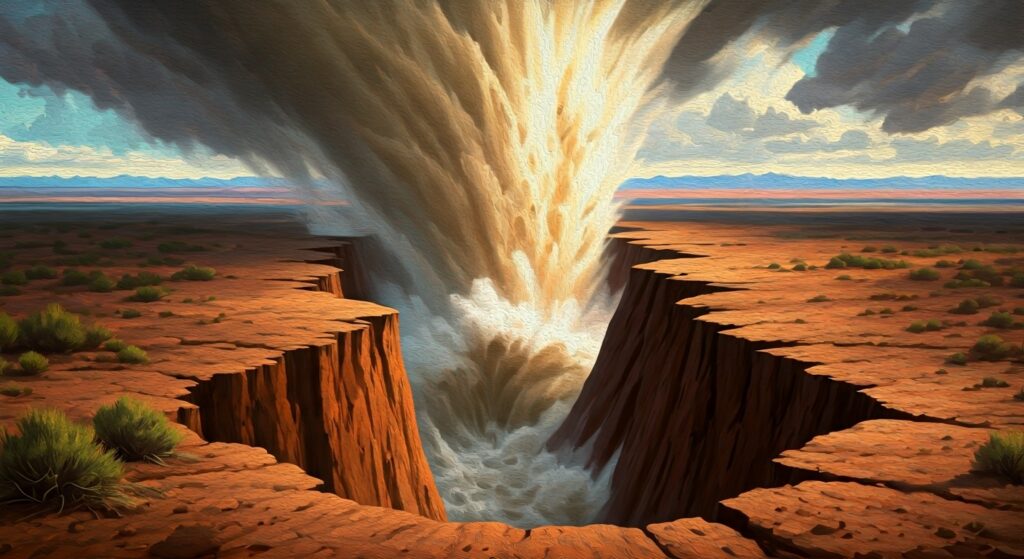
The soft desert soil didn’t stand a chance. The surging water violently eroded the banks, ripping the modest 50-foot ditch into a roaring, mile-wide chasm.
Then, the unthinkable happened. The entire volume of the mighty Colorado River abandoned its ancient course to the Gulf of California. Taking the path of least resistance, the river violently pivoted and rushed downhill—directly into the Salton Sink.
For two agonizing years, the river poured into the basin. It birthed massive waterfalls in the middle of the desert, carving deep canyons that would become the New and Alamo rivers. The raging torrent swallowed everything in its path, drowning a salt-mining operation, flooding the indigenous lands of the Torres-Martinez tribe, and completely wiping out the tracks of the Southern Pacific Railroad.
The Desperate Stand
The California Development Company went spectacularly bankrupt trying to plug the apocalypse they had unleashed. The monumental burden of stopping the river fell to the very people whose infrastructure was currently underwater: the Southern Pacific Railroad.
Railway magnate Edward H. Harriman realized they were facing a total geographical collapse. His tracks were being repeatedly relocated to higher ground just to outrun the rising inland sea. Harriman authorized a desperate, unprecedented feat of emergency engineering.
Mobilizing fleets of trains and thousands of laborers, the railroad built massive trestles directly over the roaring breach. In a frantic, round-the-clock race against the current, they backed up train car after train car, dumping thousands of tons of rock, gravel, and clay into the rapids. They had to plug the mile-wide hole faster than the raging river could wash their efforts away.
Millions of dollars and several failed attempts later, the breach was finally sealed in February 1907. The Colorado River was forced back into its natural channel. But the landscape was forever scarred.
A Beautiful, Toxic Mirage
When the dust settled, the disaster had left behind California’s largest lake: a shimmering body of water measuring 15 by 35 miles, now known as the Salton Sea.
At first, this man-made mistake masqueraded as a miraculous ecological oasis. Millions of migratory birds flocked to its shores. By the 1950s, developers—blind to the lessons of the past—marketed the Salton Sea as a “desert Riviera.” Hollywood elites flocked to the desert to boat, water ski, and sip cocktails on the beach.
But the Salton Sea was doomed from the moment it was born.
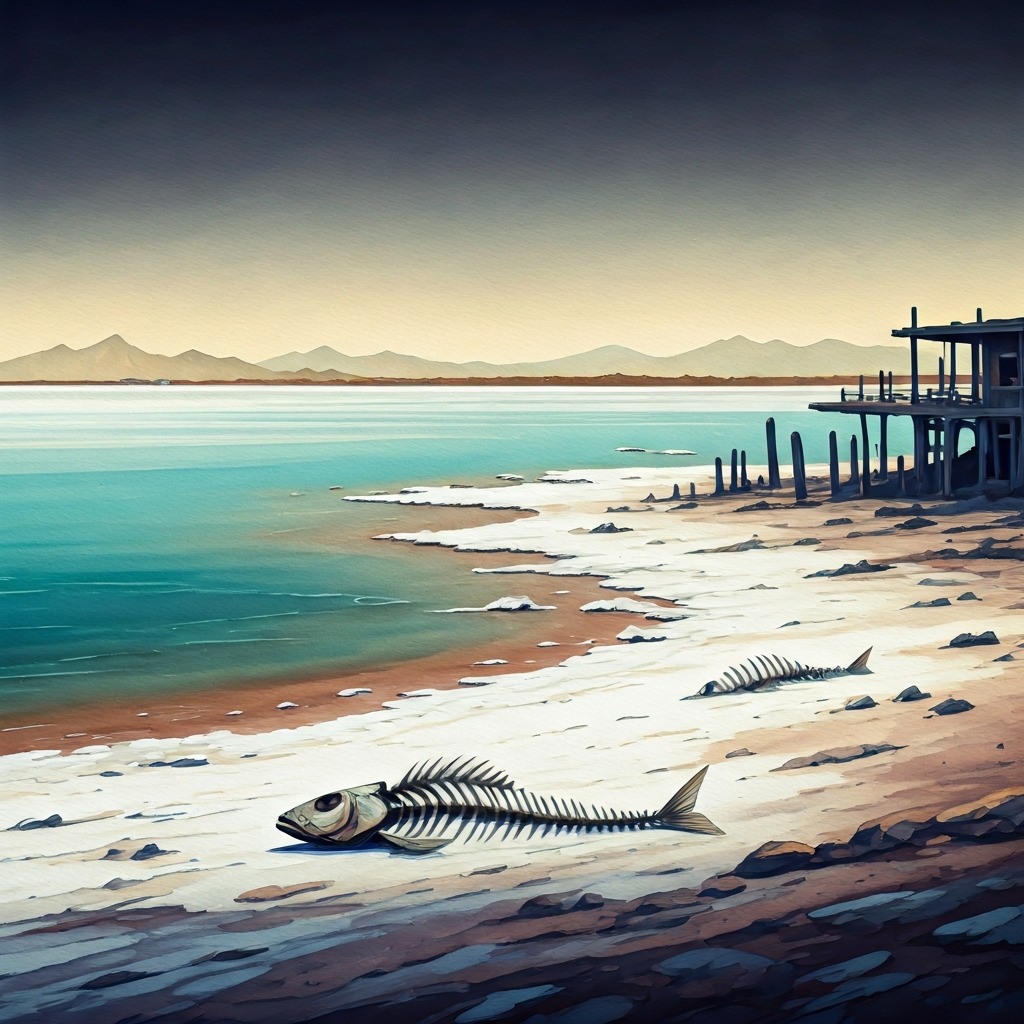
As a terminal lake with no outlet, it was fed entirely by agricultural runoff laden with heavy fertilizers and pesticides. Its salinity skyrocketed. By the late 20th century, the glamorous Riviera had devolved into an ecological nightmare, marked by horrifying, massive die-offs of fish and birds that littered the shores with rotting carcasses.
Today, as the sea slowly evaporates, it exposes a toxic playa. Desert winds whip this dried, chemical-laden mud into hazardous dust storms that severely impact the health of surrounding communities.
What began as a desperate shortcut to save a few bucks in 1904 birthed a century-long, slow-motion environmental tragedy. It remains a chilling reminder: when humanity arrogantly tries to bend nature to its will on the cheap, nature always collects the debt.