The Grave in the Mountains
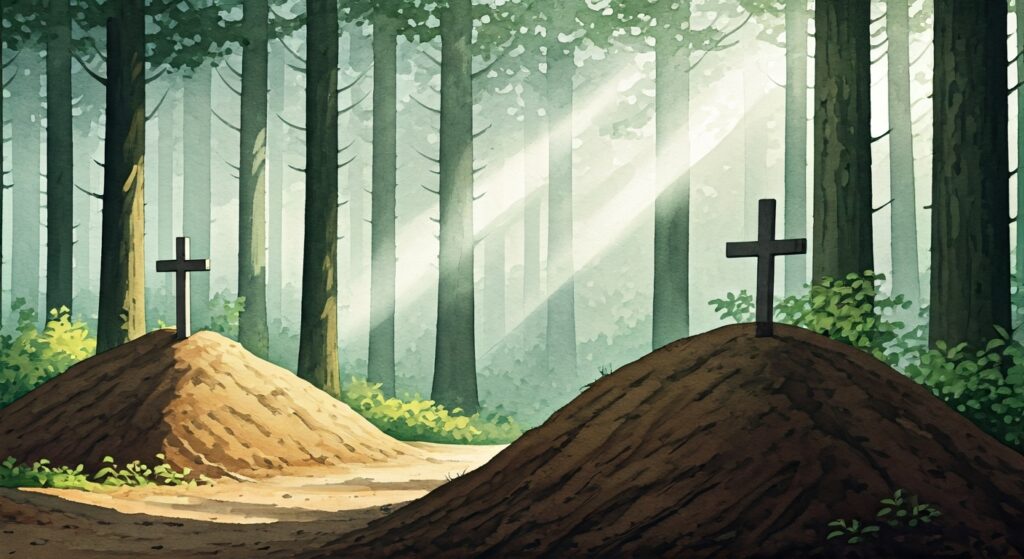
Deep in the mist-shrouded mountains of Aomori Prefecture, Japan, lies the quiet agricultural village of Shingō. To the passing traveler, it looks like any other aging rural town, a place defined by its sprawling forests and pungent garlic farms. But hidden among the ancient trees sit two large dirt mounds, each marked by a stark, weathered wooden cross.
According to a mind-bending local legend, you are not looking at a mere monument. You are standing before the final resting place of Jesus Christ.
The Ultimate Decoy
To understand how the Christian Messiah supposedly ended up buried in a remote Japanese mountain village, one must unravel what locals claim is the greatest decoy operation in human history.
According to the folklore of Shingō, Jesus did not die on the cross at Golgotha. As the Roman authorities closed in, his younger brother—known in local legend as Isukiri—stepped forward, volunteering to take his place. It was the ultimate sacrifice, a cosmic bait-and-switch that allowed the true Messiah to slip through the fingers of the empire.
Fleeing the Middle East, Jesus embarked on a grueling, clandestine exodus. He did not travel empty-handed. In a macabre testament to his survival, he carried a lock of the Virgin Mary’s hair and the severed ear of his martyred brother.
The logistics of his alleged escape route are nothing short of epic. The legend claims he traversed the brutal, frozen expanse of Siberia, sailed across the icy waters to Alaska, and eventually navigated his way down to the Japanese archipelago. Why Japan? Because, according to this audacious alternate history, Jesus had already spent his “lost years”—the biblically undocumented period between the ages of 21 and 33—studying theology in the Land of the Rising Sun.
From Savior to Garlic Farmer
Upon returning to Japan, the man who once preached to thousands in the Levant decided to permanently step out of the messianic spotlight.
He settled in the village of Shingō, which was known at the time as Herai. Shedding his divine mantle, he completely rebranded, adopting the Japanese name Daitenku Taro Jurou. He married a local woman named Miyuko, fathered three daughters, and lived out the rest of his days not as a spiritual revolutionary, but as a humble garlic farmer.
There were no more miracles. No walking on water, no multiplying of loaves. Just a quiet, agrarian life tending to the soil until he passed away of natural causes at the staggering age of 106. Today, the two dirt mounds in the village represent his grave, alongside a second mound holding the relics of his brother Isukiri and the Virgin Mary.
A Glitch in the Historical Matrix
Where did this extraordinary narrative originate? You won’t find it in any ancient scrolls passed down by village elders. The origins of the tale trace back to 1936, when a Shinto priest and self-proclaimed “cosmo-archaeologist” named Kiyomaro Takeuchi allegedly discovered a set of ancient texts known as the Takenouchi Documents.
Written in a supposed ancient Japanese script, these texts claimed to reveal the true, hidden history of the world—including Jesus’s trans-Pacific escape.
Mainstream historians universally dismiss the Takenouchi Documents as an elaborate 20th-century hoax, born from an era of intense Japanese nationalism and mystical syncretism. It was a time when fringe thinkers were eager to center Japan in the global historical narrative. In a twist of fate that feels almost too convenient, the original documents were destroyed during the firebombing of Tokyo in World War II, leaving behind only modern transcriptions.
Echoes of the Levant
It is easy to write the entire legend off as a pre-war fabrication. But before closing the book entirely, proponents of the mystery point to a series of bizarre local anomalies that feel like glitches in the historical matrix.
First, there is the old name of the village: Herai. Some linguists and historians argue it is an uncanny corruption of the word “Hebrew.”
Then, there are the customs. Historically, the locals of Shingō practiced traditions that were entirely alien to the rest of Japan. They swaddled their infants in woven baskets, a practice highly reminiscent of the biblical story of Moses. Even more striking, they traditionally marked the foreheads of newborns with a charcoal cross to ward off evil spirits.
If that isn’t strange enough, the village has a traditional folk song called “Nanya Doyara.” The lyrics have absolutely no discernible meaning in the Japanese language. Yet, some enthusiasts claim that if you listen closely, the cadence and phonetics perfectly mirror an ancient Hebrew chant.
The Cross-Cultural Convergence
Today, Shingō Village doesn’t shy away from its eccentric claim to fame; it embraces it.
Visitors can explore the “Kirisuto no Sato” (Christ’s Hometown) museum, purchasing Jesus-themed merchandise right alongside the village’s famous locally grown garlic. But the undisputed highlight occurs every June during the Kirisuto Matsuri, or Christ Festival.
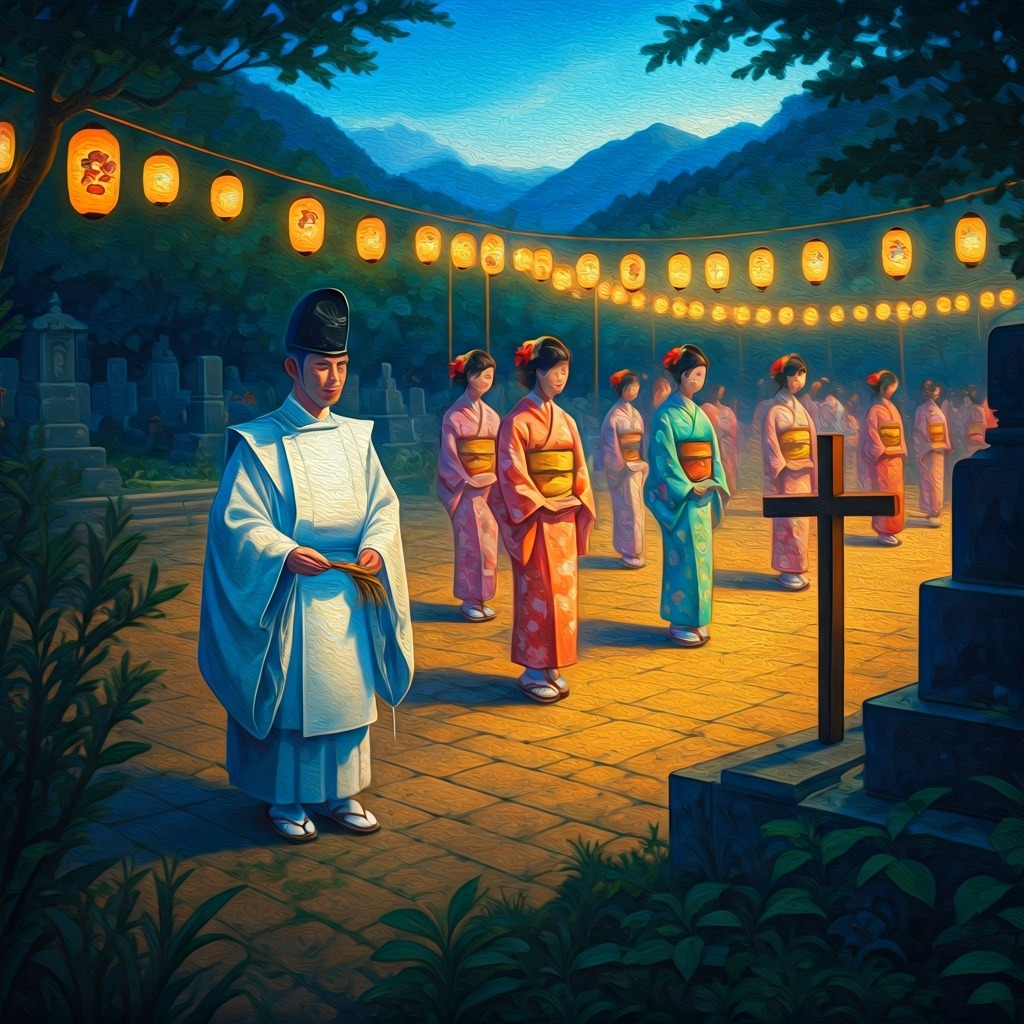
It is, without a doubt, one of the most fascinating displays of religious syncretism on the planet. During the festival, a Shinto priest solemnly blesses the grave of Jesus Christ, followed immediately by local women in traditional summer kimonos performing a Buddhist-style Bon dance around the wooden crosses.
Theologically, it is a massive heresy. Historically, it is a textbook case of pseudo-history. But culturally, it is a masterpiece. The villagers of Shingō don’t necessarily believe the legend is literal historical truth. Instead, they view it as a unique heritage—a whimsical narrative that brings tourism, economic life, and a deep sense of pride to a remote, aging town. It stands as a testament that sometimes, history isn’t just about what actually happened; it’s about the wild, incredible stories we choose to tell, and the communities those stories build.