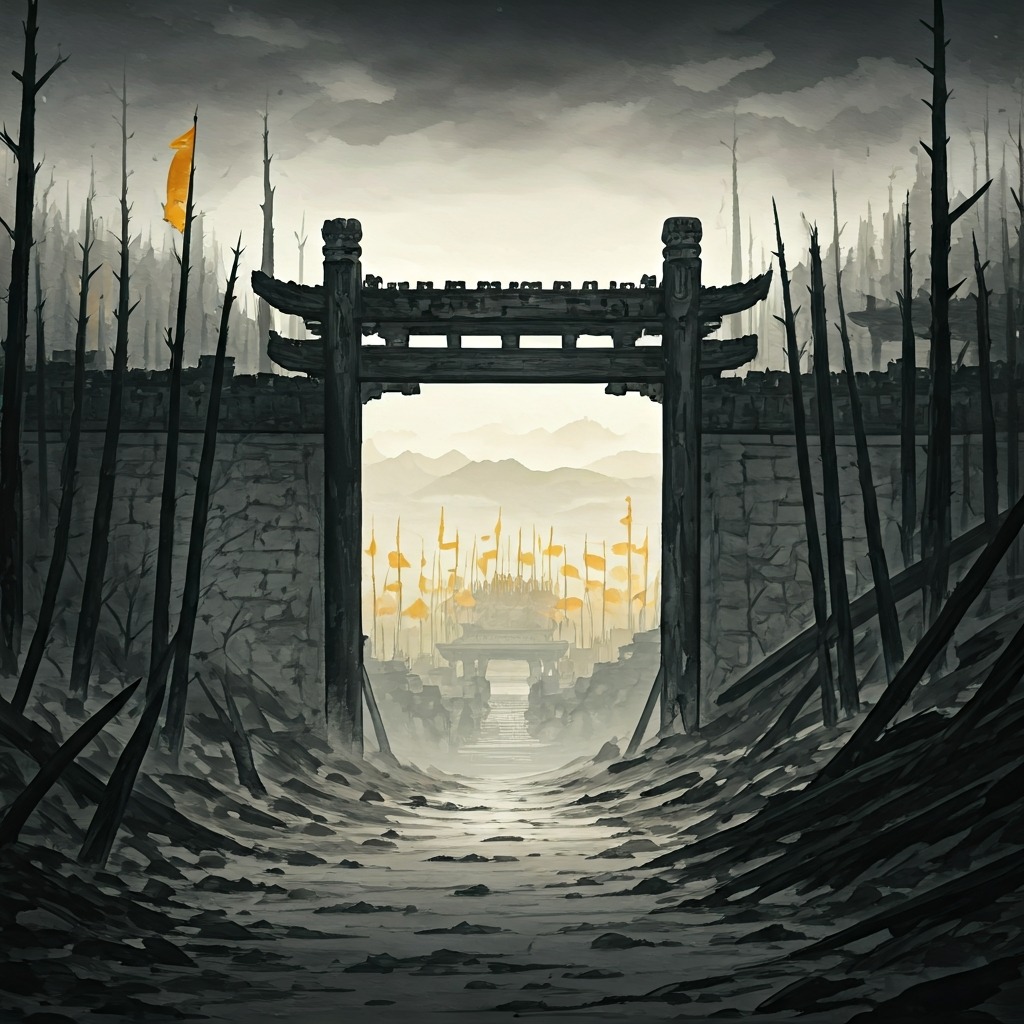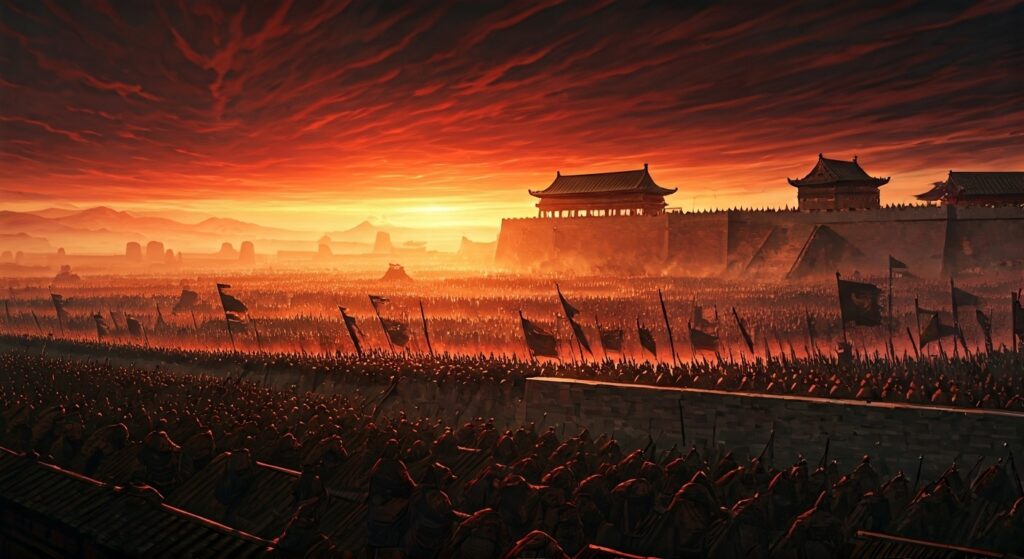
We love a good underdog story. The scrappy few holding out against the mighty many is a trope woven into our cultural DNA, from Hollywood blockbusters to historical strategy games. But in the brutal reality of ancient warfare, the ultimate underdog story isn’t a triumphant fairy tale. It is a descent into absolute, unimaginable nightmare.
Welcome to the Siege of Suiyang.
The Empire’s Jugular
The year was 757 AD. The mighty Tang Dynasty, once the glittering jewel of the medieval world, was bleeding out. The An Lushan Rebellion had ripped the Chinese empire apart, and rebel forces had already sacked the magnificent capitals of Chang’an and Luoyang.
For the loyalists, survival came down to a brutally simple logistical reality: the supply chain. The wealthy southern region of Jianghuai remained untouched by the slaughter. It was the empire’s breadbasket and its treasury. If the Tang Dynasty could keep the southern grain and gold flowing north, they could survive. If they couldn’t, they would be erased from history.
Standing between a massive rebel army and this vital southern supply line was a single, heavily fortified bottleneck: the city of Suiyang.
A Suicide Mission
The defense of this critical choke point fell to two fiercely loyal Tang officials: Zhang Xun and Xu Yuan.
If you were placing bets, you wouldn’t just bet against them—you’d call them dead men walking. Together, they commanded a meager garrison of roughly 7,000 soldiers. Marching toward their gates was the rebel general Yin Ziqi, commanding a battle-hardened leviathan of an army estimated at 150,000 men.
It was a 21-to-1 disadvantage.
But Zhang Xun was a tactical savant. He understood that when you cannot outmuscle a behemoth, you must outsmart it. What followed was a masterclass in psychological warfare, night raids, and audacious deception.
The Phantom Volley
Zhang Xun’s tactical playbook reads like a cinematic thriller. During one of the relentless rebel assaults, Zhang’s men suddenly stopped firing lethal arrows and began shooting harmless weed stalks.
When the rebel soldiers saw weeds bouncing off their armor, a ripple of laughter spread through the ranks. They assumed the Tang defenders had finally exhausted their ammunition. Eager to report the impending victory, the rebel soldiers rushed toward their commander, Yin Ziqi, inadvertently parting the sea of 150,000 troops and revealing his exact location.
Zhang Xun had been waiting for this precise moment.
He signaled his best archer, who drew a real arrow and let it fly. The shaft struck Yin Ziqi squarely in the left eye. The rebel commander was severely wounded, his army was instantly demoralized, and the massive force was forced into a chaotic, temporary retreat.
It was a stroke of genius. But tactical brilliance can only delay the inevitable when the math of starvation is against you.
The Descent into Madness
As the siege dragged on for months, the rebel blockade tightened into an inescapable stranglehold.
This is where the logistics of war turn horrifying. Suiyang’s supplies were completely exhausted. The defenders first ate their horses. When the horses were gone, they hunted down every rat and sparrow in the city. When the animals were gone, they boiled their leather armor and stripped the bark off the trees.
Eventually, every conceivable food source vanished. The defenders were literally starving to death while standing on the walls.
To keep his soldiers alive and fighting, Zhang Xun made a decision that historians and philosophers have debated for over a millennium. He brought out his beloved concubine, killed her in front of his starving men, and ordered them to consume her flesh. Xu Yuan immediately followed suit, sacrificing his own servants to feed the troops.
The Calculus of Survival
This horrifying precedent unlocked the darkest door imaginable. What followed was the institutionalized, systematic consumption of the city’s own civilian population.
To sustain the garrison so they could hold the wall, the soldiers first ate the women. Then they ate the children. Finally, they ate the elderly men. It is estimated that between 20,000 and 30,000 civilians were cannibalized to keep the military machine running.
The soldiers themselves were reduced to walking skeletons—traumatized, malnourished, and hollowed out—yet they somehow continued to repel rebel assault after rebel assault. They held the line.
The Tragic Punchline
In October 757, after a grueling ten-month siege, Suiyang finally fell.
When the rebels breached the gates, only about 400 defenders remained alive. They were so physically weak they could no longer draw their bows. Yin Ziqi—missing an eye but deeply unsettled by their terrifying resilience—attempted to recruit Zhang Xun and Xu Yuan. Both men vehemently refused and were executed on the spot.
But here is the detail that cements this siege as one of history’s greatest tragedies: just days after the city fell, a massive Tang relief army finally arrived and recaptured the area.
Zhang Xun’s desperate, gruesome stand had worked. He had bought the Tang Dynasty the crucial time it needed to regroup, protecting the southern breadbasket. Because of Suiyang, the Tang Dynasty would survive for another century and a half.
But at what cost?
Traditional scholars revered Zhang Xun as the ultimate paragon of loyalty, a man who sacrificed his own humanity for the state. But others look at the ashes of Suiyang and see a monster. The philosopher Wang Fuzhi later condemned Zhang Xun with a chillingly brilliant point: the entire purpose of the state is to protect its people. If you systematically slaughter and eat your own citizens to save the state, you have defeated the very purpose of the state’s existence.
It’s a moral paradox that lingers like a ghost. We idolize the concept of “holding the line at all costs.” But the Siege of Suiyang forces us to look at exactly what “all costs” really looks like.